
In the film Billy Elliot, a boy in the north of England discovers a love for dance, much to his father’s consternation.
“It’s perfectly normal,” Billy tells his dad, who retorts that such pursuits are for girls, “not for lads… Lads do football or boxing or wrestling. Not friggin’ ballet.”
That drama came out in 2000, but whether attitudes like those of Billy’s dad have changed much since then is open to debate. In many parts of the English-speaking world and Latin America, there’s still a big stigma about men dancing.

‘When Men Dance‘
Savage Content/Miami Film Festival
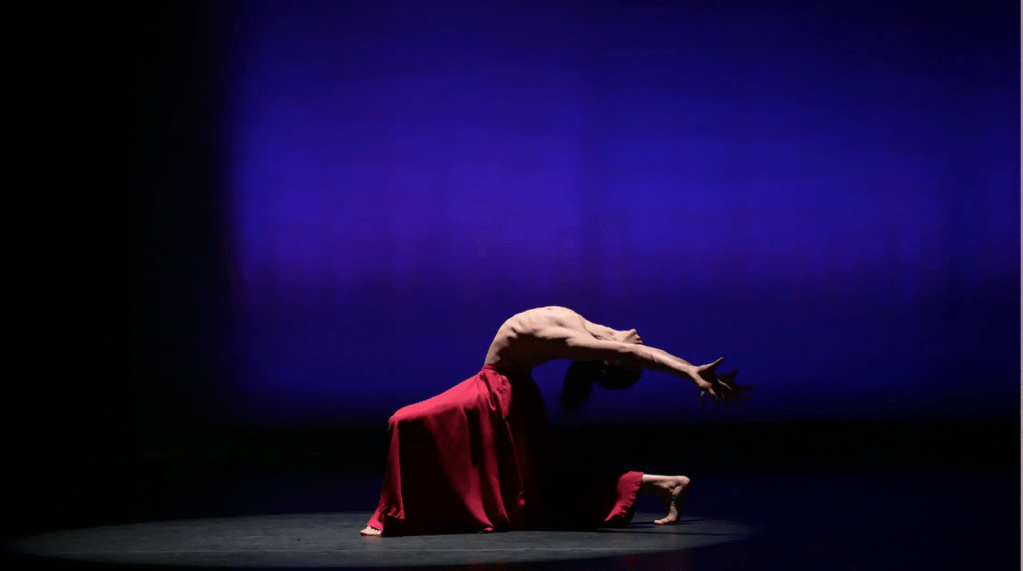
The documentary When Men Dance, which just held its world premiere at the Miami Film Festival, focuses on talented performers who have defied the taboo, throwing themselves body and soul into the artform. It’s directed by Emmy-winner Abbas “Abbi” Motlagh, an Iranian-born filmmaker based in the Miami area.
“As director, producer, and editor of When Men Dance, I tease out and spotlight the lived realities of artists who risk being crushed by a spectrum of societal pressures and norms,” Motlagh writes in a director’s statement. “The drive, talent and devotion of the dancers and choreographers are brought into focus in contrast to the racism, homophobia, and anti-immigrant forces they must navigate.”
The director adds, “Their sense of community, collaboration and camaraderie nourishes them in the face of their struggles. This film will always be dear to me, as the dancers’ interviews let me see into them to reveal the tenderness and the depth of their souls.”
‘When Men Dance’
Savage Content/Miami Film Festival
The documentary was filmed over a several week period in Miami, which for half a dozen years has hosted Men Who Dance, a festival dedicated to male dance.
“I wanted to capture all of them together because the energy that they gave each other was amazing,” Motlagh tells Deadline. “When they’re dancing together, they forget everything. They just try to translate everything through dance, through the movement — body language, actually. So, it was very interesting for me.”
As a native of Iran, Motlagh grew up in a place where men dancing together, instead of men and women, in fact was the norm. “Men and women are separate – at a party, everywhere,” he notes of Iran. “Every time when I was a kid, I see just men dancing together because they cannot dance with the woman… They are very, very relaxed with each other. They’re [not] shy.”
“Everywhere else [in the world], men dance together,” affirms producer Anne Pollack. “I look at videos of dancers, hours every day. I just love, love, love it. From all over the world, it’s on my Instagram feed. About a good 80 percent of them are men dancing together… You talk about in Macedonia, you talk about in Peru, you talk about in Africa, you talk about in Korea. Everywhere, men are connected through dance. And when you dance and you’re kinetically connected, you become whole in some way. You connect with your totality.”
‘When Men Dance’
Savage Content/Miami Film Festival
Pollack continues, “Everyone, particularly men who have seen the film, are suddenly feeling like this is so important and so inspiring. These dancers break through isolation, which men are famously really, really in a state of huge isolation. Women don’t experience that as much because we have each other more.”
In the film, men describe the often-painful journey they faced to become dancers and choreographers, overcoming pressure to conform to narrow definitions of masculinity.
An airborne Natanael Leal in ‘Ballet Fantastique’
Courtesy of Stephanie Urso
“I was so worried because I don’t like sharing my story to anybody,” dancer Nataneal Leal said at a Q&A following the world premiere. The native of Brazil identifies as nonbinary. “It’s a story of struggle and I wanted my story to be something of happiness, something of light. So, I was worried if I used the right language, if I had the right body language. I was very terrified because English is not my first language. For me, any mistake could be taken in a different way, and I didn’t want to offend anyone. I also didn’t want to come out as a lie. I wanted to come out as truly who I was and who I am. And I never thought in a million years that I would share my story.”
For Miami native Antonio Velasquez, “It was almost like a therapy session with [Motlagh and Pollack], to be completely honest. I cried I don’t know how many times and I was not expecting that,” he said. “I think anytime a director or producer, anyone of the sort wants to create something about dancers, like real stories, I’m completely in a hundred percent [agreement] because I feel like most of the time we are so often overlooked in the arts, especially men… we’re looked at as one thing, whether it be a prop, whether it be to be masculine, to be stoic. And I think that once they both explained to me what the film was about and what they were trying to portray, immediately I let my guard down and I found myself speaking about my family and my experiences and what really brought me to dance.”
L-R Antonio Velasquez, Clinton Harris, director Abbas Motlagh, Natanael Leal, Enrique Villacreses, Kaique Barbosa participate in a Q&A following the world premiere of ‘When Men Dance.’
Matthew Carey
Dancer Clinton Harris became emotional describing a natural reticence about expressing himself verbally instead of through movement. Through tears, he said at the Q&A, “I would rather dance 30 minutes straight for y’all right now than to do this. It’s also so healing to me to do this.”
He added, “What I will say is the children are the future. I don’t want them to go through what we went through. So, if you see a little kid — Black, white, Hispanic, Chinese, I don’t care, a little boy, [tell them], ‘That’s not [just] for girls. That’s not gay.’ Just let them be free. It starts literally in our homes. This doubt started in our homes, how our parents saw us, how people who our parents hung with saw us. So, if you just let that veil up of like, ‘No, it’s okay… If you want to go do this, if you want to twirl, okay, have fun.’”
The film is executive produced by Kent Savage, founder of the Boundless Arts Foundation. “We learned about the story and then said, how can we capture it? And that’s where we were so fortunate to meet Abbi. He’s a masterful storyteller and Anne, we knew for a long time — her blood courses with dance and the arts,” Savage explained at the Q&A. “There wasn’t a preconceived endpoint. They captured the story of all these dancers and everything they were going through.”
Pollack heaps praise on director Abbi Motlagh. “He brought so much intimacy. That’s the difference, because so many of the dance documentaries that we watched before, they’re kind of removed. They’re going about their life and then they get on stage,” Pollack tells Deadline. “But these guys, he starts with [a shot of] the sweat of Clinton’s back. We’re already in before we have a chance to stay removed.”