
In 2019, retired Putin spin doctor Vadim Baranov (Paul Dano) reflects on his rise since the early ’90s collapse of the Soviet Union.
It’s an odd experience, to find yourself thinking, “I’d really like to see more Putin.” Yet that is what you’ll likely feel during Olivier Assayas’ long, broad-scoped and often plodding account of the man’s rise to power and the remoulding of Russia into the rogue nation — sorry, “sovereign democracy” — it is today. Adapted from a satirical Italian novel (by Giuliano da Empoli) about a fictional spin doctor loosely based on one-time First Deputy Chief Vladislav Surkov, The Wizard Of The Kremlin is less concerned with the Russian President than the people who enabled his ascent amid the turmoil of the Soviet collapse, and consolidated his position through some pretty audacious political chicanery. In this sense, Assayas’ film has value as a kind of semi-documentarian account of a geopolitically tumultuous era, and how the self-interest of oligarchs garrotted Russian democracy and created a surly, grey-faced monster. If you’re not already aware of the details, it’s a timely eye-opener.
However, the movie’s framing and structure leave much to be desired. The entire story is couched as an unconvincing conversation between Surkov avatar Vadim Baranov (Paul Dano) and an American journalist (Jeffrey Wright), making it lean far too heavily on expository voiceover. Assayas takes an unadventurously chronological approach, clumsily segmenting the film into chapters while trying to fold in an unaffecting love story, with Alicia Vikander popping up in a variety of looks as Baranov’s opportunistic inamorata, who barely makes a dent on the narrative.
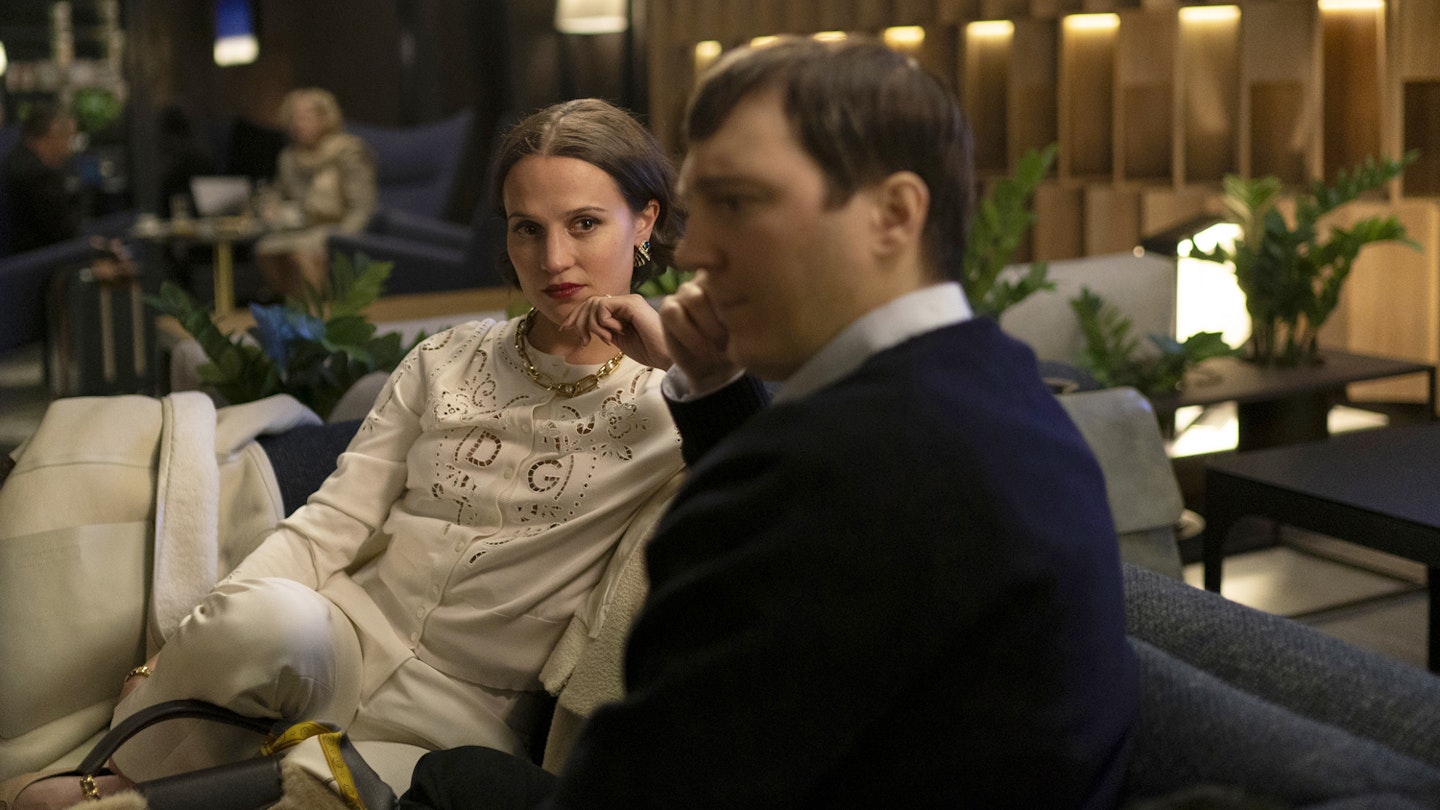
Dano sure-handedly underplays every scene, conveying the sense of a highly intelligent man whose air of faint, supercilious amusement and self-confidence are honestly felt, even if the web he’s so expertly spinning will ultimately trap him along with everyone else. But he is a cold fish of a protagonist, ultimately less interesting than the machinations he devises.
A film that drags on for longer than it should.
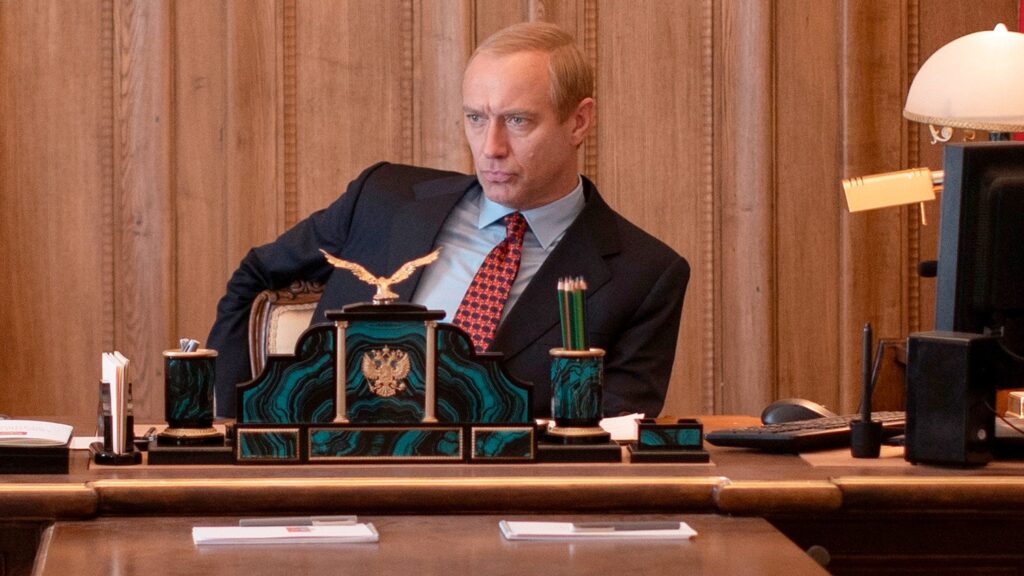
Far more compelling is the “Tsar” of this Slavic tragedy, bravely portrayed by Jude Law without a lick of prosthetics and no attempt to do an accent. Still, it is quite a transformation, as Law-Putin scowls, struts and manspreads his way to supreme power, fists clenched and mouth turned down throughout. There’s no big, grandstanding scene, but Law impresses by teasing evidence of his character’s deep-seated frustration and chilling us with Putin’s almost listless ruthlessness.
There are also even one or two laughs, such as the moment he gruffly asks Baranov, “What is Daft Punk?” But he is in too few scenes, making the part more of an extended cameo in a film that drags on for longer than it should — especially when he’s not on screen.
An occasionally interesting but over-stretched attempt to recount Putin’s rise to power, best appreciated for the few moments in which Jude Law appears.