
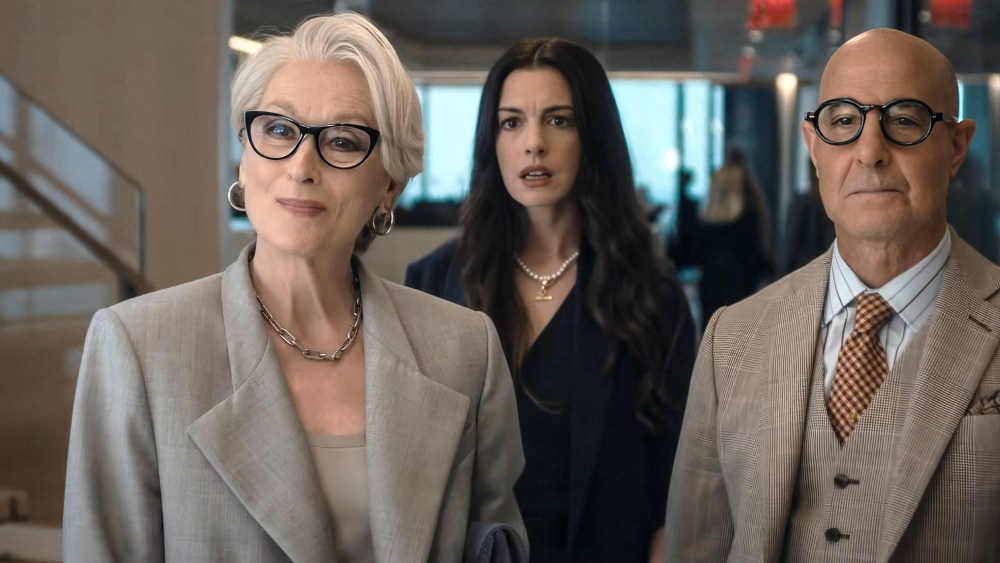
After 20 years and two blockbuster films, does “The Devil Wears Prada” director David Frankel really think “that’s all” for Miranda Priestly and her reign as the terrifying editor-in-chief of Runway magazine?
“I said, ‘Never again,’ and here we are,” Frankel says with a laugh. “So, I certainly would never say, ‘Never again,’ again.”
Not that Frankel wasn’t on board for a sequel to the haute-couture comedy in theory — the 2006 film made $326 million at the box office, after all — but all the stars had to align for another movie to make sense, beginning with the return of Meryl Streep as Miranda.
“Annie Hathaway has a great analogy for the experience of making the movie,” Frankel says, quoting his leading lady who returns alongside Streep, Emily Blunt and Stanley Tucci. “We were getting the band back together for a new album and going on tour and playing the new songs, but the audience also wants to hear the old hits. So, it’s a little bit of sprinkling in the old hits with the new stuff.”
Of course, finding a way to pay homage to a movie that came to define a generation — without overdoing it — would be no small feat. Fortunately, a large swath of the creative team from the 2006 movie returned to take on that challenge, including screenwriter Aline Brosh McKenna, producer Wendy Finerman, cinematographer Florian Ballhaus, production designer Jess Gonchor, composer Theodore Shapiro and costume designer Molly Rogers (who’d been an assistant to original costume designer Patricia Field).
“The Devil Wears Prada 2” ends on a hopeful note, with Miranda, Andy and Nigel ushering the glossy fashion magazine into the future; they’re safe for now, bolstered by the independent wealth of Sasha Barnes (Lucy Liu), but the state of the publishing business is still shaky. After her failed coup, Emily is poised for redemption and a rebrand…at Coach. There’s plenty of runway to plot out a threequel. Plus, the movie has grossed an eye-popping $233 million at the global box office in the first two weeks, making a third movie feel even more likely.
But before we predict the journalism trials they’ll face next, Frankel breaks down some of the sequel’s key moments, from the callbacks to the original movie (and why Adrien Grenier’s Nate didn’t make the cut); highlights from filming in Milan and the symbolism of Da Vinci’s The Last Supper; and why Miranda is less of an ice queen this time around.
How did you and Aline go about figuring out how and when to place references to the original movie? There are callbacks as early as the opening montage, with Andy brushing her teeth and a street vendor holding two identical belts as she walks through the park.
There were little things, like the belts, that were late in the game additions. Other things, like the cerulean sweater and lines like, “A million girls would kill for this job,” were easy to do. Then we had to go through and edit some out because [if there were] too many, you’d get a little annoyed with us.
Eventually, Miranda is going to have to say, “That’s all.” That line comes at a pivotal moment in the story, when she calls out Emily’s betrayal.
That is like “the callback,” if you will, and hats off to Aline for really saving it for that spot in the movie. It’s one of my favorite moments in the movie, because it really all comes together: it’s the pivotal dramatic moment, and the most profound callback.
Tell me more about filming that scene.
That scene is great. Three amazing movie stars firing on all cylinders with great material and huge stakes for their characters in a beautiful setting. Our production designer, Jess Gonchor, created this phenomenal Milan hotel room. Incredible visual effects, because that was shot in New York, not in Milan, so that scene really stands out.
It’s hard to pick a favorite, but what other scenes will you remember?
I love the two scenes in the Last Supper. They are just really beautiful, really resonant. The one where Miranda accuses Andy of betraying her is just so wonderfully dramatic. And then the dinner scene where Benjy — this character that you think is kind of a whack job billionaire — delivers really the most profound speech in the movie about the future and how it’ll come for us all. Miranda’s there, making a plea for the human touch and preserving the best of human achievement. That scene is, obviously, what the movie is all about: this battle between man-made creativity and whatever is coming next; we don’t know what it is, but we’re terrified of it, and we know it’s coming for us.
Tell me about shooting with that incredible tableau in the background.
We scouted the actual Da Vinci Museum, and we could have shot the one scene with people talking in front of the painting. They would have been fine with that. I said, “Can we do a dinner with candlelight?” and they said, “No, absolutely not.” So, we built a set.
But I got to spend a lot of time in the room with the real Last Supper and learn a lot about it. It’s amazing; you’re standing there with a 600-year-old painting that still moves you. There’s no better way to dramatize the best of human achievement than that painting.
And having that painting really underscores what Miranda’s saying to Andy. She’s asking, “Are you Judas?”
There’s definitely that undertone.
These were incredible actors 20 years ago, but now everyone has fully blossomed, particularly Anne and Emily. But this movie is different because it’s not just from Andy’s perspective. We really get a chance to meet Miranda behind the glasses. We go home, go upstairs and hear those conversations that she and her new husband (Kenneth Branagh) have. Why establish them as co-protagonists this time around?
Anytime you’re revisiting something, you want the opportunity to go deeper. In the first movie, when the mask comes down, and you see a little fragility, you understand how driven she is, but also how much pain there is, how much sacrifice. So you think like, “Well, how long can she do it?” And now it’s 20 years later, and she’s still been doing it. Every day, she’s still fighting the good fight and adapting. That’s one of the most remarkable things about the people who stay at the top: how they adapt. How their businesses change, how the money changes, how the people change, and what is important changes. All that has evolved in Miranda’s world. It’s also just fun to see her take off the glasses and pour herself a glass of rosé and spill some tea.
If the movie was just her being the ice queen and the demanding boss for two hours, it would be fun, but it wouldn’t be illuminating. What, for me, is fascinating is a woman in her mid-70s, let’s not forget, really needing to confront the question of, “What’s her legacy going to be? Was it all for naught? Is it all going to disappear?” And as she asks, “When do I stop? When do I say enough is enough?” Speaking as someone who wants to keep doing it till the end, who never wants to hang it up, it’s easy to identify with someone who just loves their job and loves what they do. And I think that’s true of Meryl, too. She loves to play, and she’ll do it as long as people will have her.
What was it like getting to work with Meryl this time around, where she wasn’t going Method? She’s said she allowed herself to have a lot more fun. What was different?
It was really getting to work with the real Meryl versus the first movie, she was Miranda all the time. She and I became good friends through the first movie, but her relationship with Annie and Emily was always distant when we were shooting. Now, after 20 years, they’re good friends, and she’s close to them; they’re like long-lost daughters, and there’s a really great dynamic. She had much more fun making this movie.
Some of that fun is that you allow the actors to improvise and throw out lines. Some of the most iconic and enduring lines in the first movie were things that they came up with. Were there any ideas that they brought to the table this time that stand out?
When you’re lucky enough to have a great screenplay to start with, then there’s so much freedom. You’ve already said something funny; now, let me see if I can top it. That’s the game, and we all love to play it. That’s the beauty of doing a second and third or fifth take. And we also had the benefit of Aline Brosh McKenna being on set the whole time, so a lot of the new lines weren’t even improvised; they’re actually written. They weren’t in the original script, but she’s written them. It’s nice to have that traditional comedy playground where everybody is contributing.
There are very, very funny people in this movie. Justin Theroux is hilarious. B.J. Novak is hilarious. Caleb Hearon is hilarious. Simone Ashley, in little moments, steals every scene. Helen J. Shen is brilliant. So, it’s just nice to bring in a new generation of actors and let them play.
Do you have an inkling of which line people are going to quote back to you?
The one that I’ve already heard a bunch of times is Emily’s line, “May the bridges I burn light my way,” which made me fall down laughing the first time. I’m hoping there’s a lot. But who knows? It’s like trying to pick which single is going to be the chart topper.
There is a very touching full-circle moment at the Runway show in Milan, where Miranda finally lets Nigel have the spotlight. What was it like to shoot that scene?
Years and years ago, my mom told me the best entertainment is full of laughs, but also makes people cry. It moves you because you’re reminded of how fleeting life is, and what’s important and what’s not, and that makes us emotional. That scene in particular is the product of 20 years. It’s an apology or an acknowledgement after 20 years. That’s so long to take someone for granted, and 20 years ago, she screwed him over big time. It’s so moving when that are people so full of love for someone else, that they will suffer like that. I joke that we’ve made this movie that’s trying to appeal to both an older audience and young people. And here’s this scene, which is a 76-year-old woman apologizing to a 65-year-old man, and yet, you really have to have a heart of stone not to be moved by it.
All of us know what it feels like to be overlooked and to finally have the person say it is crazy…
Especially Miranda!
Miranda’s never wrong. You mentioned there were callbacks that you couldn’t weave in. Was there anything that really hurt to leave on the cutting room floor or that you didn’t get to shoot?
An appearance by Nate [Adrien Grenier]. We debated, and we couldn’t find a really satisfying way to integrate him into the story. And we didn’t want to just do a run-in, so in the end, he didn’t make the script. But we have great affection for him, and I really salute Adrien’s Starbucks commercials, because they’re genius and hilarious and so wonderfully self-deprecating. He really performs well in them, and he’s really funny. So, I’m thrilled that he still is part of the universe of the movie in that way.
This movie completely wraps up the story, but there could still be more. Obviously, Emily will one day get her redemption. Fans will want to see what happens with Runway. What do you imagine?
It’s like you’re ready to pitch another sequel.
I’ve got a sequel. I’ve got a spin-off. We can do a Nate show.
Look, it took us 20 years to do this one. And I said, “Never again,” and here we are. So, I certainly would never say, “Never again,” again. Let’s see what happens. If there was an opportunity to revisit the characters and to share a few months with these wonderful actors again, obviously, I’d love it.