
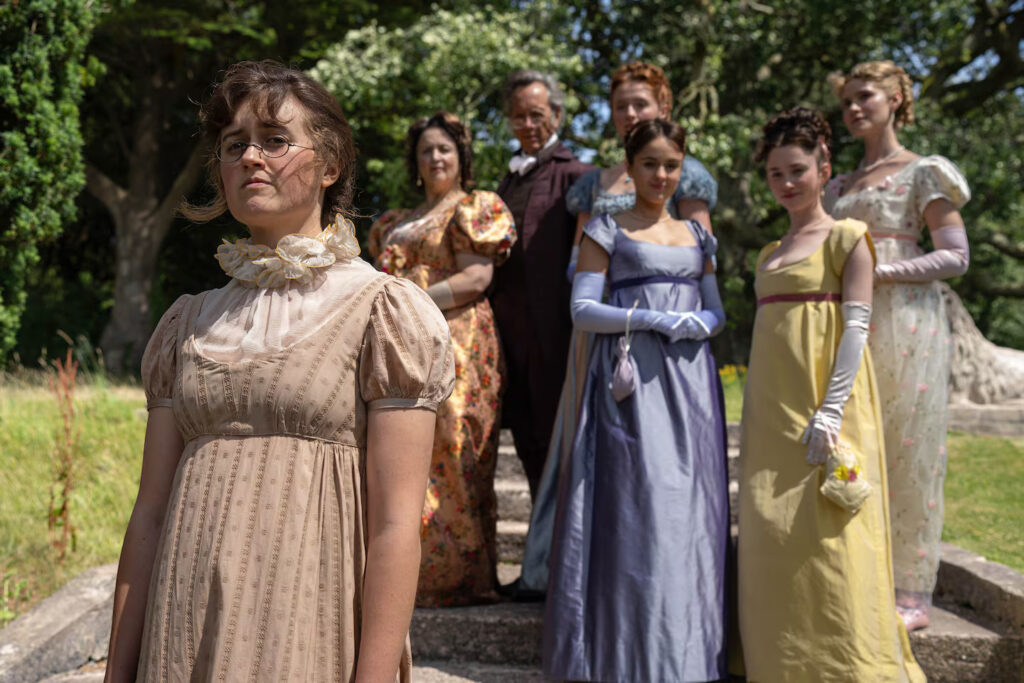
Mary Bennet, middle of five, has few virtues to recommend her. Unlike her eldest sister, Jane, she is not beautiful. Nor is she witty, like second-eldest Elizabeth. Her younger sister, Kitty, may be frivolous but at least she is good-humored and has a fun nickname. Youngest daughter, Lydia, meanwhile, is disastrously reckless, but you can’t deny she has spirit. Although one might think Jane Austen, bookish and unwed as she was, would draw Mary with some degree of sympathy, she describes her in Pride and Prejudice as having “neither genius nor taste; and though vanity had given her application, it had given her likewise a pedantic air and conceited manner, which would have injured a higher degree of excellence than she had reached.” Ouch.
Mary is not the most obvious candidate to helm a romantic-comedy, and yet the Jane Austen Industrial Complex—this is how I tend to think of the interminable production of books, films, tv shows, and other ephemera that bear some relation to the author and her works—is in constant need of new material. Eventually, someone would notice Mary over there in the corner, reading a book about rocks.
And thank god for that, because the BBC’s The Other Bennet Sister (adapted from Janice Hadlow’s 2020 novel of the same name) is a rare treasure: An Austen-ish adaptation that actually justifies its own existence. The first three episodes became available in the US via BritBox on May 6, with subsequent episodes releasing weekly. There are 10 altogether, each coming in at a delightful 30 minutes.
It opens with the familiar announcement that Netherfield Hall has been let to someone named Mr. Bingley. Over the first two episodes we see the events of Pride and Prejudice played out through the eyes of Mary, before she, and the show, really blossom upon re-locating to London under the loving and encouraging care of her aunt and uncle. Ella Bruccoleri imbues Mary with warmth, tenderness, and real curiosity. Blessedly, the show does not have her undergo a nerdy girl takes off her glasses at prom only for everyone to realize she’s a stunner style transformation, opting instead for Mary to come into her own as she learns more about the world and what she might want from it.
Because it is a rom-com, she gets not one but two charming suitors—with Donal Finn delivering a particularly charming turn as barrister Tom Hayward. The plot is not particularly innovative or surprising, but my ability to predict the beats of Mary’s triumphs did little to diminish how heart-warming they were to watch. The decision to render Mrs. Bennet as not simply silly and overbearing but acutely cruel didn’t sit comfortably with me, but otherwise the show is quite gentle in its treatment even of characters Austen rendered with plenty of contempt (Mr. Collins comes off better here than anyone might expect.) Most importantly, nothing about this show pissed me off, which is more than I can say for most recent entries in the greater Austen universe.
What is most winning about this production is what it does not do. It does not attempt to modernize the material by having Mary make cutting quips directly to camera, or making her waltz to a Doja Cat track. Nobody in this show has noticeable veneers. We are spared the indignity of being treated like morons who need to be fed the medicine of 19th-century social critique by putting it in a spoonful of TikTok-ified honey.
Instead, the narrative itself feels fresh, simply by virtue of its interest in Mary’s development as a woman unsuited to the demands of her time, but nonetheless living in it. Don’t make the mistake of overlooking The Other Bennet Sister. She is worth paying attention to.
Recommended