
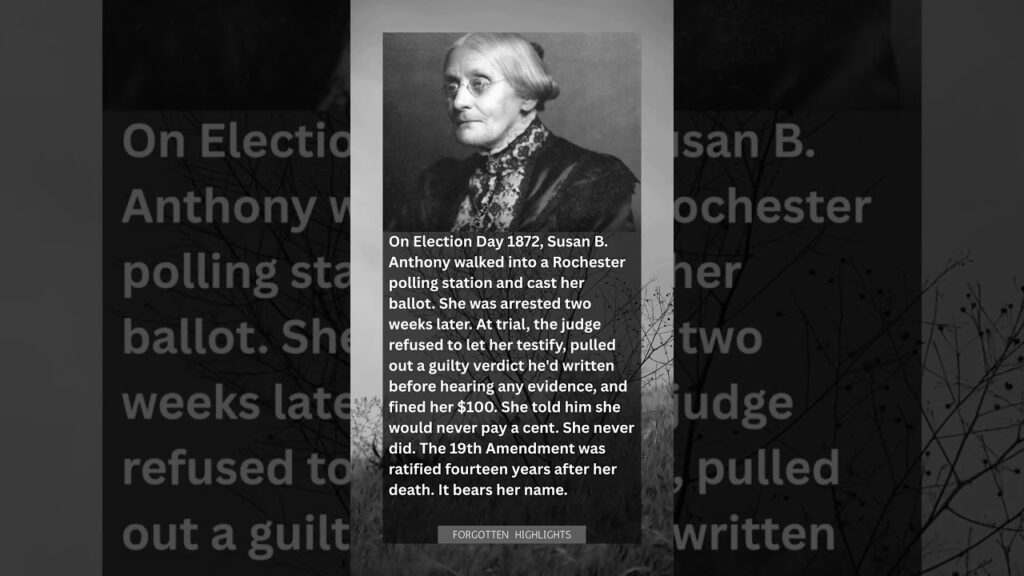
“She Voted in 1872 Knowing She’d Be Arrested. The Judge Wouldn’t Even Let Her Testify.”
She walked into a polling station in 1872 and voted—knowing she’d be arrested, convicted by a corrupt judge, and fined $100. She never paid a cent. Fifty years later, the amendment that gave women the vote bore her name. November 5, 1872. Rochester, New York. Susan B. Anthony woke up knowing she was about to break the law. It was Election Day. Across the city, men headed to polling stations to choose the next president—Ulysses S. Grant versus Horace Greeley, a race that would shape Reconstruction and American democracy’s future. Susan, at 52, had spent decades fighting for the simple right to participate in that democracy. She’d given speeches in hostile halls where men threw rotten fruit. She’d organized conventions, published newspapers, traveled thousands of miles demanding that the word “citizen” actually mean something for women. But on this morning, she decided speeches weren’t enough anymore. She was going to vote. Not alone. Susan had spent the previous days convincing other women in Rochester’s 8th Ward to register. The registration officials initially refused, but Susan argued so forcefully—citing the 14th Amendment’s guarantee that “all persons born or naturalized in the United States” are citizens entitled to equal protection—that they relented. Fourteen other women registered alongside her. On November 5, Susan and several women walked into the polling station together. Men stared. Officials hesitated. The women waited calmly, refusing to leave. One by one, they cast their ballots. Susan placed hers in the box and said clearly, for everyone to hear: “I have the right of every citizen.” For a moment, it seemed possible nothing would happen. That perhaps this act of defiance would simply dissolve into Election Day chaos. Then federal justice began to turn its wheels. Two weeks later, on November 18, U.S. Deputy Marshal E.J. Keeney knocked on Susan’s door. She was under arrest for illegally voting in a federal election. The marshal was reportedly apologetic—he knew who Susan B. Anthony was, knew what she’d been fighting for. But the law was the law. “You have no right to vote,” he told her, required to state the charges. Susan looked at him with the steady gaze of someone who’d been preparing for this moment for years. “I have the right of every citizen,” she replied. She was taken into custody, charged, and released on bail. But Susan refused to go quietly. She immediately began touring New York, giving impassioned speeches about her arrest to packed halls. “I not only committed no crime,” she declared, “but instead, simply exercised my citizen’s right, guaranteed to me and all United States citizens by the Constitution.” The trial was set for June 1873 in Canandaigua, New York. It became a national spectacle—not because of its fairness, but because of its brazen corruption. Judge Ward Hunt presided. He was a recent federal appointee who’d already decided Susan was guilty before hearing a single witness. When Susan’s lawyer attempted to call her to testify on her own behalf, Judge Hunt refused. Women, he ruled, were not competent witnesses in their own defense in federal court. Susan sat silently as men debated whether her act of voting constituted a crime. She couldn’t speak. Couldn’t testify. Couldn’t defend herself in the court judging her. When the arguments concluded, Judge Hunt did something extraordinary in its corruption: he pulled out a written opinion he’d prepared before hearing any evidence and directed the jury to find Susan guilty. He didn’t allow them to deliberate. He didn’t let them vote. He simply ordered them to return a guilty verdict. Susan’s lawyer objected furiously. Judge Hunt ignored him. Then—finally—Judge Hunt asked if Susan had anything to say before sentencing. This was her moment. Susan stood and delivered one of the most powerful courtroom speeches in American history: “Yes, your honor, I have many things to say; for in your ordered verdict of guilty, you have trampled underfoot every vital principle of our government. My natural rights, my civil rights, my political rights, are all alike ignored. Robbed of the fundamental privilege of citizenship, I am degraded from the status of a citizen to that of a subject; and not only myself individually, but all of my sex, are, by your honor’s verdict, doomed to political subjection under this so-called Republican government.” Judge Hunt tried to interrupt her. Susan kept speaking. “May it please your honor, I shall never pay a dollar of your unjust penalty. All the stock in trade I possess is a $10,000 debt, incurred by publishing my paper—The Revolution—four years ago, the sole object of which was to educate all women to do precisely as I have done, rebel against your man-made, unjust, unconstitutional forms of law.” She continued for several more minutes, her voice steady, her words cutting through every attempt to silence her. Judge Hunt had heard enough.