
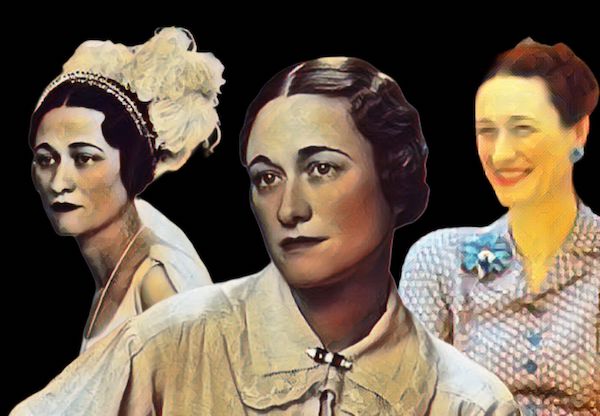
In April 1986, Wallis Simpson died in Paris at the age of 89, bringing to an end one of the twentieth century’s most controversial stories. Forty years later, the figure of the American woman for whom Edward VIII abdicated the British throne in 1936 still occupies a strange place in the collective imagination: at once a romantic myth, a symbol of social ambition, an institutional scapegoat, and a central figure in the transformation of the modern monarchy itself.
Few women have been reduced so completely to a historical caricature. For decades, Wallis was portrayed almost as an intruder who seduced a king and destabilized an empire. The romantic narrative turned Edward VIII into the man who gave up the crown “for love,” while the institutional narrative needed her as the person responsible for a constitutional crisis that exposed the deep fragilities of the British monarchy during the interwar years.
But the real story is more complex, more uncomfortable, and perhaps even sadder.
Wallis Warfield was born in Baltimore in 1896, into a society that valued social status, appearance, and strategic marriages as paths toward advancement. Intelligent, sophisticated, and acutely aware of social codes, she moved through American and European elite circles before meeting Edward, then Prince of Wales, in the early 1930s. Their relationship escalated quickly, but encountered an obstacle that was impossible for the period: Wallis was divorced, and the Church of England, of which the king was the supreme governor, did not permit the religious remarriage of divorced people whose former spouses were still alive.
The problem, however, was never only moral.
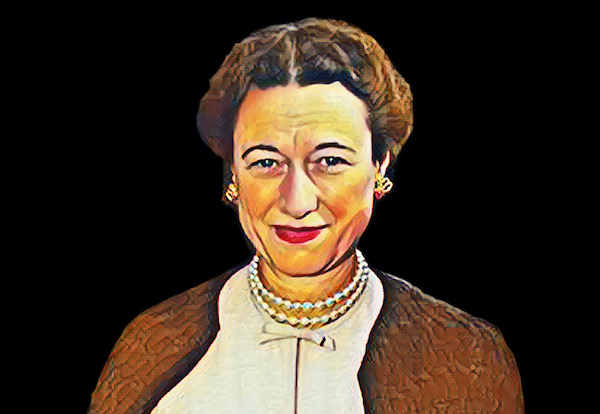
The crisis exposed the collision between a monarchy still shaped by Victorian rigidity and a world beginning to enter the age of media modernity. Edward VIII was impulsive, emotionally unstable, uninterested in institutional duty, and deeply fascinated by the idea of living as an international celebrity. Wallis, meanwhile, understood better than many aristocrats the power of image, style, and social performance. In many ways, the couple anticipated a monarchy far more dependent on spectacle, public desire, and emotional exposure than the institution was prepared to accept in the 1930s.
Edward VIII’s abdication in December 1936 transformed Wallis into one of the most hated women in the world. Even after marrying the now Duke of Windsor, she was never granted the style of “Her Royal Highness,” a refusal that revealed the royal family’s lasting resentment. The institutional exclusion never fully disappeared. Even decades later, Wallis continued to be treated as someone tolerated rather than truly accepted.
There is also another aspect that makes the memory of the couple deeply uncomfortable for historians and for the monarchy itself: the Duke and Duchess of Windsor’s sympathies toward Nazi Germany. Photographs of their meeting with Adolf Hitler in 1937 remain among the most disturbing images in royal history. For decades, historians have debated the extent to which Edward VIII represented a genuine political risk, particularly during World War II. The so-called “Marburg Files,” a collection of German documents discovered after the war, fueled suspicions about Nazi interest in using the former king as a strategic figure should Britain have been defeated.
Wallis always attempted to control her own narrative. Elegant, reserved, and often ironic, she became an international icon of fashion and sophistication. Her style influenced decades of haute couture, jewelry, and society photography. Yet there is something deeply melancholic about her later years. After the Duke of Windsor died in 1972, Wallis spent years isolated in Paris, increasingly removed from public life, surrounded by financial disputes, declining health, and an existence that had become almost ghostlike.
Perhaps that is why she continues to fascinate cinema, television, and literature. Wallis does not fully fit either the fantasy of great romance or that of the manipulative social climber. She inhabits a far more ambiguous space: that of a woman transformed into a symbol so that an institution could survive without confronting its own contradictions.
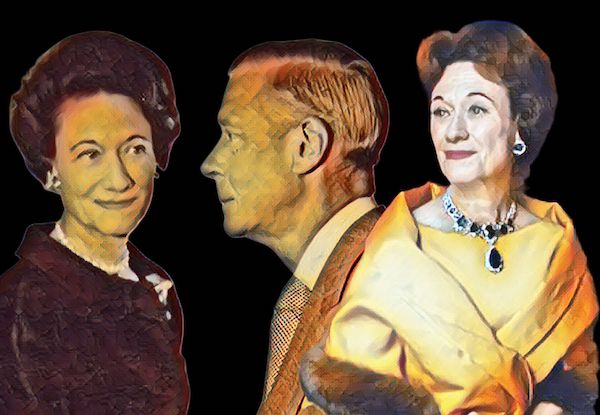
That ambiguity appears directly in the way Hollywood and television have chosen to portray her over the decades. In many productions, Wallis emerges almost as a classic femme fatale, a sophisticated woman whose presence threatens traditional structures of male power. In others, she appears as the victim of a deeply misogynistic and elitist aristocratic system incapable of accepting a divorced American woman in a central role within the royal family.
One of the most remembered portrayals remains the ITV miniseries Edward & Mrs. Simpson (1978), starring Edward Fox and Cynthia Harris. The production helped solidify, for an entire generation, the melancholic image of the Windsor couple, treating the abdication less as a romantic fairy tale and more as an emotional and political tragedy. During the 1980s, Wallis returned to the center of pop culture in The Woman He Loved (1988), a television film starring Jane Seymour that reinforced the idea of a woman divided between passion, guilt, and social survival.
But perhaps no actress connected more deeply to Wallis’s public image than Joan Collins. In The Woman He Loved and in later interviews, Collins seemed to intuitively understand the combination of glamour, moral judgment, and social exile that surrounded the duchess. It was hardly accidental. Joan Collins herself always maintained an ambiguous relationship with the British press: celebrated as a symbol of sophistication while simultaneously viewed with suspicion because of her image as a woman who was excessively ambitious, sensual, and international. Something remarkably similar had happened to Wallis decades earlier.
In The Crown, Wallis appears marked by a mixture of resentment, irony, and late-life melancholy. The series emphasizes the emotional isolation of the Windsor couple after the abdication, almost as if they were two figures frozen outside time, forever living on the margins of the institution they helped transform. There is a constant sadness in that portrayal: Edward seems incapable of finding meaning after losing the throne, while Wallis conveys the feeling of someone who spent decades being blamed for something larger than herself.
Meanwhile, W.E. (2011), directed by Madonna, is perhaps the clearest attempt to revisit Wallis through a contemporary and explicitly female perspective. The film tries to reconstruct her image beyond the stereotype of the “homewrecker queen,” linking her story to discussions about desire, sacrifice, social performance, and emotional imprisonment. Even though the film divided critics and audiences, it helped reposition Wallis as a tragic figure rather than merely a manipulative one.
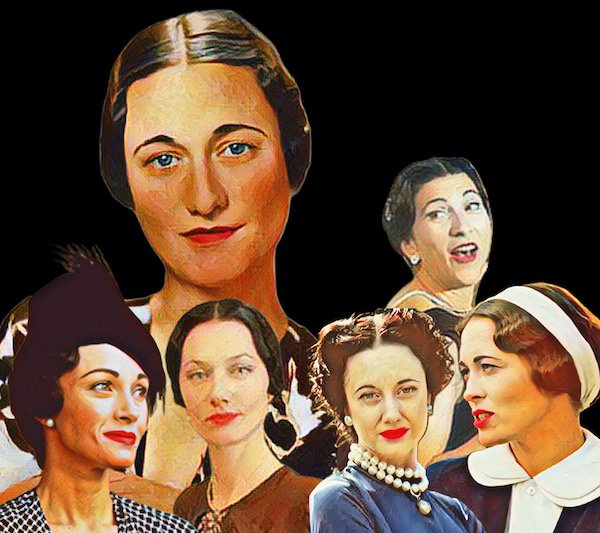
Madonna’s connection to the story never seemed accidental. American, living in England for years when she made the film and constantly scrutinized by the British press as a foreign woman considered too loud and too disruptive for certain aristocratic codes, Madonna appeared to see something of herself in Wallis. There was a clear identification with the American woman transformed into a media obsession inside a country simultaneously fascinated and unsettled by female outsiders who take up too much space. In many ways, W.E. also functions as an indirect commentary on Madonna’s own experience living under permanent scrutiny in Britain.
The film’s luxurious aesthetic reinforced something that had always surrounded the duchess: the idea that Wallis understood her own image almost as an artistic construction decades before celebrity culture as we know it today. At the same time, Madonna insists on showing the psychological cost of that process, suggesting that Wallis may ultimately have become trapped inside the narrative created around her.
Other productions, documentaries, and television biographies frequently return to the same question: to what extent did Wallis actually want Edward to abdicate? Many historians argue that she herself became frightened by the scale of the crisis and even considered leaving the relationship to avoid institutional collapse. That interpretation completely changes the traditional perception of the story because it shifts Wallis away from the role of calculating architect and toward someone equally consumed by Edward VIII’s desires, fragilities, and obsessions.
There is another revealing detail: even in contemporary narratives that are more sympathetic toward the duchess, it remains almost impossible to escape the idea that Wallis must somehow be “explained.” Few men connected to institutional crises receive this same relentless psychological scrutiny. She continues to be treated as an enigma, as a woman excessively modern for the era in which she lived, and perhaps precisely because of that, permanently uncomfortable for the official memory of the British monarchy.
It is impossible to look at Wallis Simpson’s story today without noticing how strongly it echoes through later royal crises. The institutional obsession with controlling image, the fear of outsiders, the discomfort surrounding divorced American women entering the royal family, and the constant struggle to balance tradition with celebrity culture would all reappear decades later, from Diana to Meghan Markle, even if under entirely different circumstances.
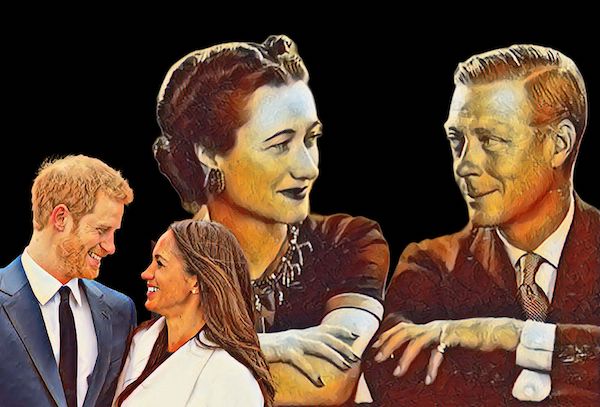
The comparison with Meghan, in fact, has become unavoidable in recent years, especially within the British press. Naturally, the historical contexts are radically different. Meghan entered a monarchy already shaped by global television, the internet, celebrity culture, and contemporary conversations about race, misogyny, and mental health. Still, there is an uncomfortable echo between the two trajectories: both American, divorced, initially perceived as modernizing figures and later transformed into focal points of institutional and media anxiety.
There is also something revealing in the way sections of the British media repeatedly return to the same image of the foreign woman threatening the stability of the House of Windsor. In different eras, Wallis and Meghan both became symbols onto which the monarchy projected larger fears: loss of control, cultural change, excessive emotional exposure, and the institution’s difficulty in dealing with women who refuse to disappear inside royal protocol.
Forty years after her death, Wallis remains a kind of persistent ghost haunting the House of Windsor. Not simply because a king abdicated for her, but because her existence forced the monarchy to confront something that remains painfully relevant today: the difficulty of surviving in a world where emotion, public desire, scandal, and media performance have become inseparable from power itself.
If you like drama and royalty
Descubra mais sobre
Assine para receber nossas notícias mais recentes por e-mail.