
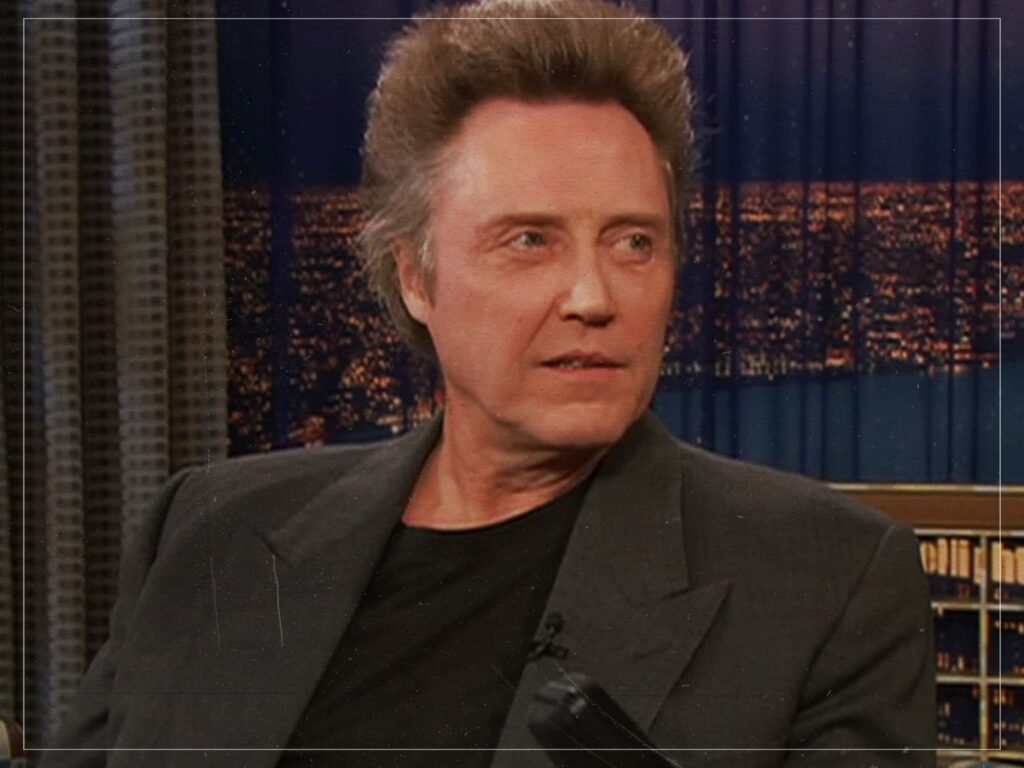
Credit: Far Out / YouTube Still
The problem with making a truly popular, great piece of art, like a seminal album or a much-loved book or a multi-Oscar award-winning movie, is that people immediately start to wonder how on earth you’re going to follow it up. Sometimes disappointment is inevitable, and as Christopher Walken knows, it can take years for some perspective to change minds.
That was certainly the case after director Michael Cimino made the incredible 1978 Vietnam War movie The Deer Hunter, a three-hour epic that switched between the deadly prisoner of war camps run by the Viet Cong and the steel mills of Pennsylvania, and that won ‘Best Picture’ and ‘Best Director’ at the following year’s Academy Awards for Cimino.
Walken deservedly won a ‘Best Supporting Actor’ Oscar for his role in the movie as a young former soldier losing his mind, and his wife, due to Post-traumatic stress, and it was his breakout role opposite Robert De Niro, with many talking about him as someone with the potential to be a generational actor.
The problem for Walken and for Cimino is that The Deer Hunter was so good, so loved by audiences and critics alike, that it simply raised standards and expectations to an unattainable level. The pair worked together again on Cimino’s next movie two years later, an American Western epic set in the late 1800s featuring a cast packed with talent that had issues right from the start.
1980’s Heaven’s Gate told the story of a Wyoming sheriff trying his best to protect the rights of immigrant farmers coming from Europe being accused of stealing cattle by landowners, and Cimino had originally written the screenplay almost a decade earlier in the hopes of attracting a big name like John Wayne to the lead role. But it took making his first film, Clint Eastwood’s Thunderbolt and Lightfoot in 1974, and then The Deer Hunter to get a studio to believe in the project enough to fund it, bringing in stars like Kris Kristofferson, Jeff Bridges and John Hurt.
Cimino was handed $11m to make the movie but problems on the production were manifold, locations that had been agreed refused to host the film due to the director’s demands and perfectionism, which included tearing down and rebuilding sets because they were a few feet too small, flying a tree in pieces from the US to England and building an entire irrigation system under the land for a battle scene so that the grass would be the right shade of green.
Costs spiralled quickly as filming overran, Cimino, shooting over 200 hours of footage, demanding 50 takes of each scene and earning himself the nickname ‘The Ayatollah’. John Hurt got so bored waiting around for his scenes that he went off and filmed The Elephant Man, got nominated for an Oscar for it, then came back to set to film the rest of Heaven’s Gate. The final cost of the film was $32m, and it ran for three and a half hours.
Further reading: Cutting Room Floor
When the movie was eventually screened for film critics, it went down historically badly. Feedback from some was that it was one of the worst films ever made, and it bombed spectacularly at the box office, bringing in just a tenth of what it cost to produce. But Walken stood by his director in later years, saying, “I always suspected that maybe the movie got talked about too much beforehand. I was at that screening, and I thought I’d watched a good movie.”
He added, “Nowadays, movies cost $200million to make, and then there’s marketing. The ‘scandalous’ price of Heaven’s Gate was $44m. It’s a beautiful movie. Go and feast your eyes.”
It took many decades for critics and the wider public to start to agree with him, but a reevaluation of Heaven’s Gate’s merits has certainly brought it up in the ratings over the years, albeit nowhere near the level of the jaw-dropping The Deer Hunter.
ADD AS A PREFERRED SOURCE ON GOOGLE 