
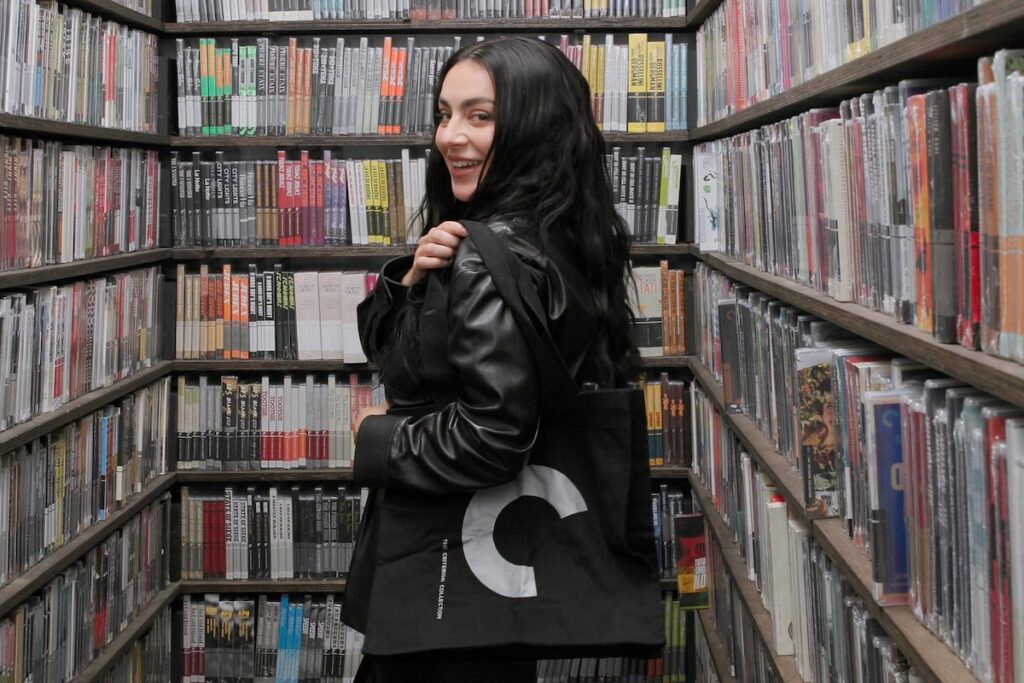
Go on any corner of the internet today, and you’re bound to encounter a celebrity recommendation. You can keep track of Charli xcx’s movie-watching habits by following her on Letterboxd. You can read like Dua Lipa by joining her Service95 book club. You can listen to Terrence O’Connor’s current favourite songs by saving his playlists on Spotify.
Today’s consumers are hungrier for recommendations than ever. Many are outsourcing the search to platforms like ChatGPT, where “Practical Guidance” — aka recommendations for retail, beauty, tech, travel, and other purchases — accounts for roughly 29 per cent of overall usage. Others look to the celebrity interview; now more than ever, celebrities are asked for their hyperspecific recommendations alongside the standard questions about their latest projects. In this context, shows and channels from Perfectly Imperfect to Criterion Closet have emerged, where hosts can go all in on asking celebrities what they’re into right now.
What’s driving this change? The influencer era, for one. The influencer economy democratised taste – or the appearance of taste – alongside the apparent authority to package and share their opinions. But when everyone on social media can (and does) share recommendations, individual taste often collapses in on itself, with the algorithms feeding everyone the same pre-curated cultural diet.
For a time, fitting in became more desirable than standing out – see: that Zara polka dot dress or Gustav Westman’s curvy mirror – but now the pendulum is swinging back, and people are keen to reassert their own individual tastes and styles. “We think that our aesthetic preferences and our tastes are who we are, and that’s our identity and our personality,” Nathalie Olah, author of Bad Taste: Or the Politics of Ugliness, tells Dazed. “We all live with a certain amount of status anxiety, and there’s a fear of not being included, of not being in the know, or of being the clueless person.”
Staying ‘in the know’ and making the ‘right’ choices is a tall order in our hyperconsumerist society, where there’s a seemingly infinite supply of products to buy and culture to consume. In his 2025 book Empire of the Elite: Inside Condé Nast, the Media Dynasty That Reshaped America, Michael M Grynbaum writes that the Condé Nast of the 1990s “told the world what to buy, what to value, what to wear, what to eat, even what to think.” He refers to the media company as a “merchant of fantasies and supreme arbiter of sophistication,” dictating culture’s ins and outs.
But in 2026, cultural authority has been decentralised. Instead of a single media house like Condé Nast setting the terms, we look to multiple different platforms for guidance: Criterion Closet for movies, I Like You! by Isaac Hindin-Miller for city guides, Perfectly Imperfect’s ‘A Taste of Taste’ for everything from condiments to board games. As well as tapping into the pre-existing cultural authority that public figures have, these channels enhance it: even if we’re not already familiar with someone, simply being a guest in the Criterion Closet or being tapped for an I Like You! video provides enough credibility to make them a figure worth listening to. There’s a huge prestige in being anointed by I Like You! as the definite authority on a city’s best neighbourhoods, clubs and restaurants. The Criterion Closet, meanwhile, allows already established A-Listers to position themselves as erudite and sophisticated (much like Letterboxd’s Four Favourites might allow an indie darling to present as surprisingly relatable and down-to-earth, perhaps by a judicious pairing of a Pixar film with Jeanne Dielman).
Being at the forefront of culture grants certain public figures a credibility, which makes us want to learn what they like, what they know, and how their minds work. Importantly, the return of celebrities as trusted cultural arbiters come at a time when we, as consumers, are flooded with endless options, when everything on social media either is an advert or looks exactly like one. Because choice has become so boundless, consumers are determined to cut through the haze and discover what’s really the “best”, whether that’s skincare products or athouse films. It makes sense that we’d look to people who we already respect, who are typically charismatic and who, unlike most influencers, are distinguished for their talent in a creative field.
But while the celebrity recommendation can feel like a friend sharing their enthusiasms, commerce remains at the heart of it. “A celebrity and a corporate entity are now completely inextricable,” Olah says. “So, a celebrity is now a front for a corporation and a consumer-based business.” Often, it’s not so much about the recommendation itself, as much as what it reveals about the person making the recommendation or sharing the take, which is as true for celebrities as it is for us. “It’s about trying to create a certain impression of yourself by curating cultural references or objects that you think will make you look cool or interesting, or distinguish you from other people,” Olah continues.
These new interview formats usually come across as authentic: off-the-cuff, top-of-the-head, bordering on blasé. It’s often charming to see what a celebrity reaches for when asked what they love, and most of them are no doubt sincere in their answers. But it’s always worth remembering that we’re in an era where taste itself has become a subtle form of branding – for celebrities and laypeople alike. Series like Letterboxd Four Favourites and Criterion Closet do not remove celebrities from the influencer recommendation machine so much as refine it, turning cultural preference into just another performance of selfhood. The result is not necessarily a return to authentic cultural authority, but a new kind of taste economy, where the recommendation matters less than the image it creates.