
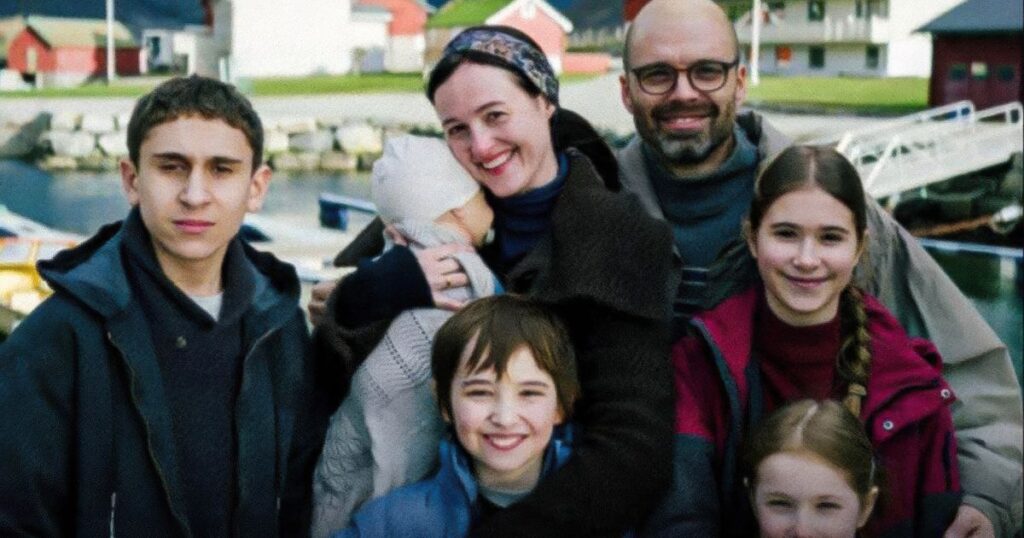
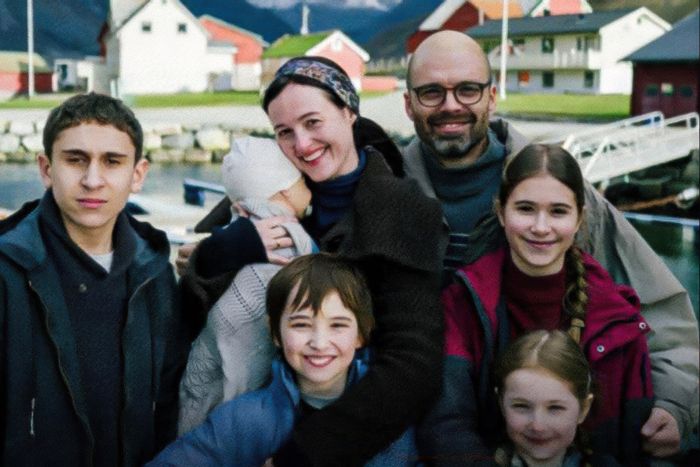
Photo: NEON/Courtesy Everett Collection
When the credits rolled on Cristian Mungiu’s latest, Fjord, at the end of a screening at Cannes, the person sitting next to me gasped “Sebastian Stan!?” with the horrified delight of someone who had not been remotely aware of its leading man’s identity. Stan isn’t exactly unrecognizable in the film, though with his glasses and shaved head, he looks a lot more regular joe than superhero. It’s more that you don’t expect a Marvel star to turn up in a film by Romania’s most talented social miserabilist, the director who won the 2007 Palme d’Or for the astonishing, excruciating abortion drama 4 Months, 3 Weeks and 2 Days. Then again, Stan, who was born and spent the first eight years of his life in Romania, has been pointedly seeking out edgier and more challenging work between his bouts with the cape, from Aaron Schimberg’s droll indie fable A Different Man to his turn as a young Donald Trump in The Apprentice. Fjord is Stan’s most ambitious turn yet, not because he performs half the role in Romanian but because he deftly plays a character, Mihai Gheorghiu, who constantly tests the audience’s sympathies even as he and his family find themselves at the center of a domestic nightmare.
Mihai, an aeronautical engineer, is Romanian, while his nurse wife, Lisbet (Sentimental Value’s Renate Reinsve, who also starred alongside Stan in A Different Man), is Norwegian. They had been raising their five children, the youngest of whom is just a baby, in Bucharest, but they recently relocated to a village stunningly situated alongside a fjord in Norway to be closer to Lisbet’s mother. When someone introduces themself to the Gheorghius by noting that they’re pretty much all neighbors around here, it’s a friendly welcome but also a statement of fact. Mats (Markus Scarth Tønseth), the principal at the school the four older siblings attend, literally lives across the street from the family. Noora (Henrikke Lund-Olsen), the rebellious classmate who develops an instant connection to Elia (Vanessa Ceban), the Gheorghius’ oldest, is Mats’s daughter. But the Gheorghius’ attempts to weave themselves into the fabric of the town don’t go smoothly, in part because they’re conservative Evangelicals who keep a tight rein on their children and are strict in a way that clearly contrasts with the permissive modern parenting the rest of the town prefers. When one of Elia’s teachers spots bruises on her body in PE class one day, she decides to call in child protective services.
From there, Fjord cascades into a series of procedural battles and legal proceedings as caseworkers decide it would be safest to remove the Gheorghiu children from their parents’ care while investigating suspicions of abuse. Mungiu has masterfully depicted bureaucratic abuses, religious oppression, and xenophobia in his past movies, but in Fjord he offers a fascinating photo-negative version of those dynamics: The progressive Norwegian state, with its insistence on doing what’s in the best interests of the children, becomes the crushing institutional force. Gunda (Ellen Dorrit Petersen), a smooth-faced blonde who weaponizes her sense of calm and is capable of maintaining a terrifyingly reasonable tone while arguing that there’s no reason to believe a biological parent’s care is always ideal, is the main wielder of child protective services’ tautological defenses. But as the foster-care ordeal goes on and Mihai and Lisbet go from being aghast to attempting to jump through the required hoops, it becomes clear that the issues at play aren’t just questions about whether they have hit their children but about how they’ve been raising them.
Not allowing your child to have a phone, or listen to secular music, or understand homosexuality as anything other than a mortal sin may not constitute abuse, but it clearly puts the Gheorghius at odds with the culture of the community. If Fjord were a film involving, say, a family of Muslim immigrants, you might expect certain rhythms to its conflicts and power dynamics. But the Euro-on-Euro aspect and subsequent value clashes in Mungiu’s film create wildly unpredictable rearrangements of sympathies as the story unfolds. Mungiu remains shockingly gifted at drawing suspense out of characters who are trying to navigate unfair systems, but even if it’s never really in doubt that the Gheorghius should be allowed to have back the children they clearly love, it’s also enjoyably disorienting to watch a movie in which the main underdog is a bigoted pro-spanking Christian traditionalist who is being menaced by cheerfully polite humanists who keep citing the word trauma. It wouldn’t take much to turn this scenario into a right-wing culture-war fantasy, and occasionally, especially when the sneering child-protective-services attorney played by Christian Rubeck is onscreen, it does tilt too much in that direction.
But Mungiu has a lot more on his mind than tepidly insisting both sides can be bad. For all the political pole reversal that happens in Fjord, the movie stealthily argues what’s really going on here is that old standards about assimilation and cultural uniformity have just been given a socially acceptable gloss. (The school in town holds a dutiful Sámi cultural celebration, but as one of the allies Mihai summons from Romania points out, Norway has an ugly history of “civilizing” the Indigenous population.) Mihai, with his utter humorlessness, his insistence on playing “Amazing Grace” in the cafeteria at lunch, and his beliefs about a “traditional family,” is never going to blend seamlessly into the overall culture of the town he has been trying to make his own. What Fjord asks, in ways that are sincere and complicated, is how much that matters to his living there.
Sign up for the Vulture Daily
An entertainment newsletter for the pop-culture obsessed.
Vox Media, LLC Terms and Privacy Notice
See All