
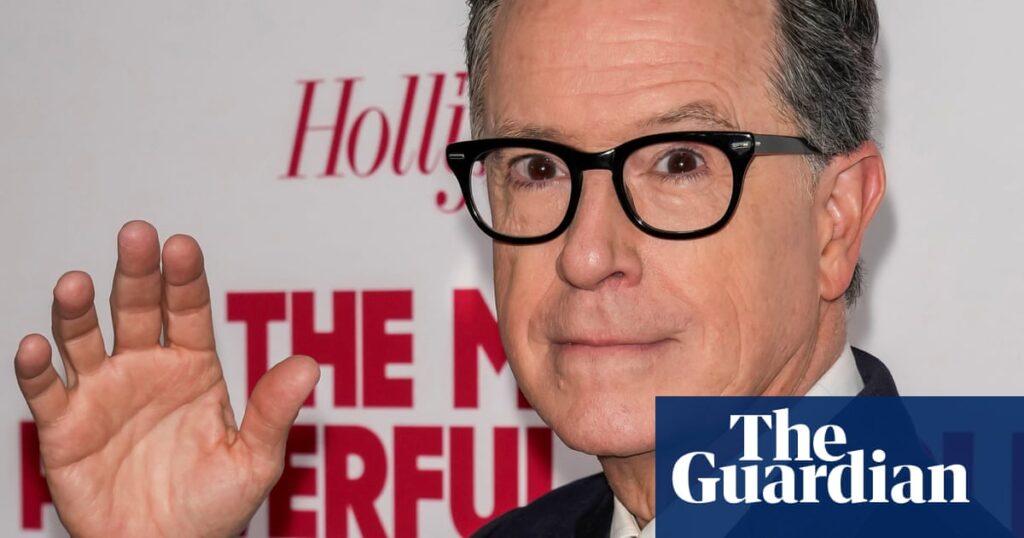
Hugh Jackman sang a parody of Neil Diamond’s Sweet Caroline. Bette Midler performed a satirical rewrite of Wind Beneath My Wings. John Lithgow wrote and recited a poem entitled The Mighty Colbert. Jake Tapper hand delivered a painting of Colbert as Gollum from The Lord of the Rings. And Jimmy Fallon offered a pointed take on Frank Sinatra’s My Way: “And now the end is near/ And so you face the final curtain/ But Trump, he made it clear/ He wants you gone/ Of that we’re certain.”
A roll call of celebrities have paid pilgrimage to the Ed Sullivan Theatre in New York in recent months to join a long goodbye to CBS’s The Late Show with Stephen Colbert, honouring a voice that will be sorely missed from the national conversation when the lights go dark on 21 May.
Colbert, 62, has provided a nightly antidote for millions of viewers feeling discombobulated at the end of another day in Donald Trump’s dystopia. He cut through the malign chaos to reassure them that no, it was not them going mad but the world around them. And he offered a contrast in character: where Trump is vainglorious, Colbert is irreverent; where Trump is narcissistic, Colbert exudes empathy; where Trump is indecent, Colbert manifests decency to the core.
When CBS announced last July that the Late Show would be cancelled, ending a 33-year television institution hosted first by David Letterman then Colbert, many found the timing suspicious. The move came just three days after Colbert used his monologue to ruthlessly mock a $16m legal settlement between CBS’s parent company Paramount and Trump – and just a week before Paramount’s $8bn merger with Skydance was approved by federal regulators.
CBS claimed it was “purely a financial decision against a challenging backdrop in late night”. Letterman, for one, isn’t buying it. “I’m just going to go on record as saying: They’re lying,” he told the New York Times earlier this month. “They’re lying weasels.”
For a generation late night TV was ruled by Johnny Carson on NBC. Carson retired in 1992; a year later CBS launched The Late Show with Letterman as host (it has now outdone Carson’s version of The Tonight Show for longevity). Colbert took over the desk in 2015, having previously portrayed a bombastic, rightwing blowhard on Comedy Central’s The Colbert Report.
Stephen Colbert with guest Ian McKellen. Photograph: CBS Photo Archive/CBS/Getty Images
Bill Carter, the author of four books about TV, including The Late Shift, says: “I thought he was brilliant almost beyond description in his previous late night show. It was like no one’s ever done. He was doing essentially a sketch for nine years. It was satire on such a high level.”
Carter was therefore not surprised when Colbert landed the Late Show job and recalls interviewing him about it. “I said, you must be looking forward to this because you just have to be yourself, and he said something like, well, you know, I’m not sure yet, it’s going to be different.
“And darn if he wasn’t wrong-footed by it when he started. I remember thinking he doesn’t look comfortable at all. He did struggle and he was definitely on the ropes. He was disappointing the management and I think Les Moonves, who was running CBS at the time, basically gave Stephen a bit of an ultimatum: you’ve got to get the thing working.”
That he did, with the help of two men in 2016. First there was Chris Licht, a producer with a background in news rather than entertainment, who was brought in by Moonves as showrunner. Under his guidance, Colbert stopped trying to be a traditional host and embraced his satirical intellect.
Carter comments: “He focused more on politics. He gave himself a voice and he got better and better at being a monologist, which is something he had never done; he was a sketch performer his whole life. Once he started to get it, he really got it. He is a very bright man with great comedy instincts. I was happy for him that he solved it and he went on to have the highest ratings in late night.”
Second, and more improbably, was Trump, whose political ascent changed everything. Each night Colbert delivered a perfectly honed mini-state of the nation address – caustic, piercing, witty, redemptive – that included his own Trump voice impression. Future historians struggling to comprehend this era could do much worse than study them. For a comedian finding his authentic voice, the 45th and 47th president was the ultimate catalyst.
Stephen Farnsworth, a co-author of Late Night With Trump: Political Humor and the American Presidency, says: “If late night comedy wanted to build a foil, it would look just like Donald Trump.
“You’re talking about someone who is an extraordinarily target-rich environment for late night humour: his bluster, his demeanour, his inconsistency, his aggressiveness – all of these things create a very rich environment for mockery. The Arc de Trump, ingested bleach, arguing that an election he lost he didn’t really lose. This is a through-the-looking-glass time in American politics.”
This represented a shift from Carson’s gentler, mostly apolitical humour. But in a recent New York Times interview, Colbert rejected the notion the late night hosts have become politically partisan. He said: “I don’t have any problem with Trump being a Republican. I have a problem with Trump being a complete narcissist who is only working for his own interest and does not appear to care if the entire world burns. That’s not a partisan position.
“I have eyeballs and ears, and I think calling late night partisan is just roughing the ref. And we don’t even want to be refs, but they perceive us as refs. I reject the partisan description. Partisan means you’re never, ever going to make a joke about a Democrat, and that’s just not true. There’s just no comparison of how fertile the fields are.”
Colbert offered more than mockery. There was also a moral anchor in the monologues that despaired of Trump but never despaired of America, the sensitive interviews with everyone from Anderson Cooper to John Oliver and from Bernie Sanders to Neil deGrasse Tyson, the references to his Catholic faith, the lack of bitterness about his own sacking and a recurring segment with his wife Evie McGee Colbert, an advertisement for how a marriage can age like a fine wine.
David Litt, an author and former speechwriter for Barack Obama, comments: “He’s been an important satirical voice but I actually think he has also been an important moral voice. We’re not living in particularly kind times and Colbert always obviously had a strong point of view, which is why Trump worked so hard to get him cancelled, but he also seemed like there was a fundamental kindness to him, and a generosity.
“One of the things I remember most was the interview he did with Joe Biden, where they both talked about the tragedies they’d experienced in their lives and what grief had meant to them. That’s a hard kind of conversation to imagine happening on late-night television in general. Colbert could pull that off and I don’t know how many other people could. That’s not a dig at them; it’s just saying he had a unique ability to be human.”
Colbert was 10 years old when his father and two of his brothers were killed in a plane crash. He brought a unique emotional honesty to the late night genre. Carter observes: “As Johnny Carson once said, if you do this show long enough, who you are comes out and is going to be transparent to people.
“That is true of Stephen. He is a very human guy, a very deep guy, and he did suffer a terrible loss when he was a child and it shaped him. People who watch these late-night shows like seeing the human side of this guy. If they are going to spend time with him on a relatively frequent basis, they want to know who he is.”
Yet this profound connection with audiences, the highest ratings in late night and last year’s Emmy award for outstanding talk series were not enough to save Colbert from becoming collateral damage in Trump’s full-front assault on US democracy.
Trump had sued Paramount over a 60 Minutes interview with Vice-President Kamala Harris. Critics widely viewed the settlement as an attempt to clear hurdles ahead of Paramount’s pending sale to Skydance Media – a merger that required approval from the Trump administration. Colbert did not hold back, declaring on air that the legal term for the deal was a “big fat bribe”, adding, “I don’t know if anything – anything – will repair my trust in this company. But, just taking a stab at it, I’d say $16m would help.”
Trump’s response to The Late Show’s demise was swift and vindictive. On his Truth Social platform, he proclaimed: “I absolutely love that Colbert got fired. His talent was even less than his ratings. I hear Jimmy Kimmel is next. Has even less talent than Colbert!” Kimmel was indeed taken off the air by ABC for a week and has recently faced renewed attacks.
A demonstrator at the US Capitol in 2025. Photograph: Allison Bailey/NurPhoto/Shutterstock
Late night TV has been facing economic pressures for years. Ratings and ad revenue are down and many young viewers prefer highlights online, which networks have trouble monetising. Even so, Carter is among those who remain sceptical about CBS’s reasons for pulling the plug on Colbert.
He says: “They have said it had nothing to do with politics. At some point you have to say, come on folks, we’ve seen the president attacking these people and doing everything he can to get them off the air and they had to get approval from the government to get their sale through. It’s not hard to connect those dots.”
The Late Show will be replaced by Comics Unleashed, a syndicated talk show that features stand-up comedians joking with host Byron Allen. Carter regards the move as effectively waving a white flag for late night TV. “They are saying to the public: this is something we’re not gonna try to do anymore. We’re not going to try to have an entertainment show at 11.30 that has a star who is a signature star and basically the face of the network.”
Farnsworth warns of a chilling effect. He says: “It’s been a challenging environment for late night comedy because of these increasing commercial pressures. You have an environment where Kimmel is pretty regularly under siege, where questions of ABC licence renewals and demands to be taken off the air arise from time to time.
“You have growing conservative ownership of key media properties and a growing aggressiveness to use the FCC [Federal Communications Commission] as a weapon to reduce criticism of the president. That creates a very difficult environment for media companies but the opportunity continues to exist for more combative content to exist in places away from the television networks on cable.”
This could be Colbert’s next move, Farnsworth speculates. “There may be a third act, if you will, for Colbert but it’s not clear yet what shape that might take. There’s certainly an audience that would follow him if he were to go to HBO or some place so we’ll have to see where he finds his most compelling offers.”
The JRR Tolkien superfan is already working on a script for Warner Bros for a new Lord of the Rings film. And in a recent interview filmed at Barack Obama’s new presidential centre in Chicago, Colbert said: “How dumb do you think it is for people to say I should run for president?”
Obama replied: “The bar has changed. Let me put it this way: I think that you could perform significantly better than some folks that we’ve seen. I have great confidence in that.”
Colbert thanked Obama and asked if this was a formal endorsement. “It was not,” the 44th president said.
For Carter, a Colbert presidential campaign would be no more ridiculous than that of Trump, previously a reality TV star on The Apprentice. “Colbert is a thoughtful, smart man who hasn’t had 20 women accusing him of sexual impropriety and everything else. He does have enough credentials to run for president: smart guy, incredibly good on TV, et cetera. He’s a very talented man.”
Carter adds: “I don’t think he wants to retire. He’s made no noise about that. If he has a plan, I haven’t heard about it. There’s a range of things he could do from going on cable to doing a podcast thing like Conan O’Brien does to Broadway. Why couldn’t he do a one-man show? He has a lot of skill he can do whatever he feels like doing, but I think he mostly wanted to do what he was doing, so that’s a shame.”