
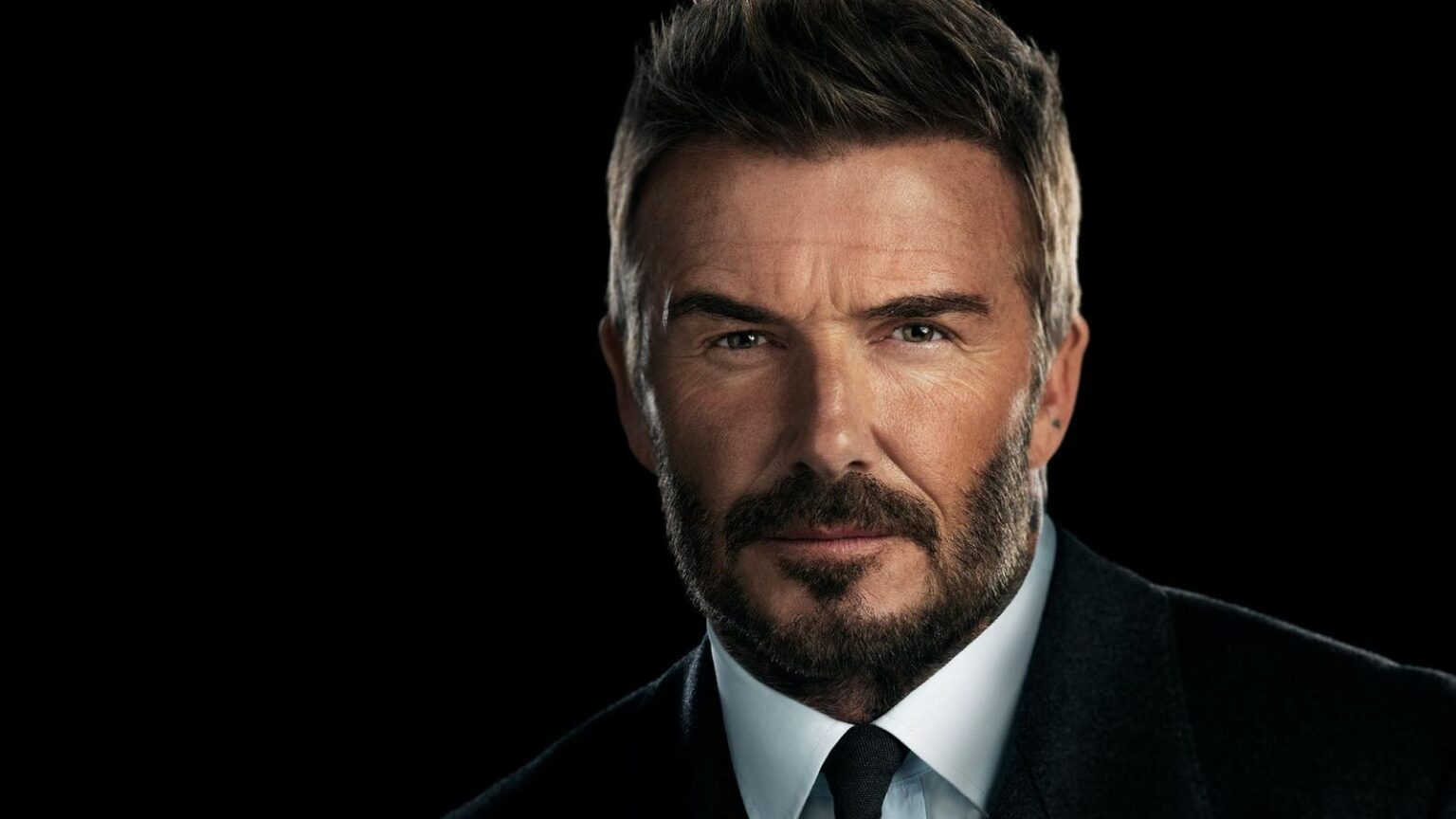
It is 10 A.M. in Chiswick, a pleasant west London suburb, in late April, and Sir David Beckham has already been on set for two hours. This should have been expected: The 51-year-old retired soccer superstar is notorious for being early.
Cranes, tents and trailers clutter the driveway of a two-story brick home, giving it the outside appearance of a film studio. Inside, a few dozen crew members move through the rooms with practiced efficiency, managing cameras and lighting rigs. Beckham’s production firm, Studio 99, has set up today’s shoot for British speaker company Bowers & Wilkins. Yesterday’s shoot was for appliance maker SharkNinja. There are several more scheduled in the coming days, all in service of the machine that is “David Beckham Inc.”
matthew brookes for forbes
As cameras roll, Beckham sits on an oversize sofa in a white Hugo Boss sweater, distressed jeans, a gold Rolex and white sneakers. There is a cocker spaniel, rented for the day, curled beside him. The dog lunges mid-shot. From the next room, Beckham’s longtime creative director watches the playback on her monitor and snaps into action. “Jumper! Jumper!” She isn’t worried about the leaping dog—it’s Beckham’s sweater (or jumper, as Brits call it) that’s bugging her. A team descends to straighten it.
“I understood early that being with the right brands and having the same values as these brands, that’s when you get to work for them for ten, 15, 20 years,” Beckham explains. “I work hard at these relationships because it’s important. . . . We always over-deliver.”
Beckham retired from professional soccer in 2013 at age 38, after earning more than a half-billion dollars on and off the field. He was a global celebrity during his playing days, arguably the first soccer player since Pele whom the average American would recognize. Unbelievably, he has become more famous after retirement—and much richer.
Last year, Beckham raked in $100 million, lending his meticulously manicured aura to products ranging from Adidas cleats to Nespresso coffee machines. It’s no longer just endorsements. There are Netflix documentaries, Florida real estate deals and investments in a slew of startups. In 2024 he launched IM8, an anti-aging and holistic health supplement brand. There’s Beeup, his line of children’s fruit snack lines made from honey. And then, of course, there’s his 26% stake in Inter Miami, one of Major League Soccer’s most popular clubs. Add it all up and Beckham is a billionaire, worth $1 billion by our count—one of just six living pro athletes (Jordan, Magic, Tiger, LeBron, Federer and retired Romanian tennis ace Ion Tiriac) to manage the feat.
The biggest chunk of his fortune is his stake in Inter Miami. Beckham stunned the soccer world in 2007 when he announced he was leaving Spain’s top-tier club Real Madrid for America’s Major League Soccer, then a floundering, second-tier league. “My gut was saying this is the right thing,” he says, “and I always go on my gut.” He negotiated a five-year contract to play for the Los Angeles Galaxy for $6.5 million per year—more than three times the salary cap (the league wisely granted an exception), plus an unprecedented cut of the team’s sponsorship and merchandise revenue. Most crucially, he insisted on an option to purchase an expansion team for $25 million when he retired.
He picked Miami from a short list of MLS-approved expansion markets, drawn to its population of soccer-loving Latin Americans and its appeal for players. “I always believed Miami could entice great players with its diversity and vibrance,” he says. Now Inter Miami is the hottest team in the MLS, both on the field—winning the 2025 MLS cup on the back of superstar Lionel Messi—and off. Forbes estimates the team is worth a league-record $1.4 billion before debt, placing Beckham’s 26% north of $300 million, a more than 12x return on his initial investment in just over a decade. In April, the team moved into the new 27,000-seat Nu Stadium near Miami International Airport. The structure was privately funded by Beckham and his co-owners, real estate billionaire Jorge Mas and his brother Jose, at an estimated cost of $350 million. Next door, construction crews are adding 1 million square feet of office and retail space, a 750-room hotel and a 58-acre park for a further $1 billion, funded with debt and equity from the partners.
“There’s this rising narrative of athletes getting involved in professional sports—they’re taking off their shorts and they’re putting on a suit,” says MLS commissioner Don Garber. “This isn’t just a sponsorship or an endorsement deal. This is David being an owner.”
Leonardo Fernandez/Getty Images
It wasn’t easy. To launch Inter Miami Beckham first had to cycle through a couple partnerships and three failed stadium plans. By 2016, three years after retirement, he was down $39 million on the project between the expansion fee and a sea of failed plans, permissions and other setup costs. The MLS offered to write Beckham a $50 million check to take the option back, but he flatly refused. “There was never one moment where I was like, ‘This is not happening,’ ” he says.
Now, as America cohosts the World Cup this summer for the first time in 32 years, all of Beckham’s carefully laid plans are coming together: Miami is an official host city for seven matches; Beckham has signed on to be the face of the MLS’ promo campaign; and he is leveraging all the attention into a string of new ads for Adidas, Lay’s, Stella Artois, Lenovo, McDonald’s, Verizon and Home Depot. Get ready for Beckham summer.
“To see all the obstacles he has overcome is remarkable,” says Victoria Beckham, the former Spice Girl who has been Beckham’s wife for 26 years. “David is so great at making the impossible possible.”
Beckham learned to put in the work growing up in London’s East End, the son of Ted, who fixed and serviced gas ovens, and Sandra, a hairdresser. His father, who had played soccer semi-professionally, worked long hours, leaving the house at 6 in the morning and often not returning until 9 at night. His mother cut hair, often for older women, at home until 11 p.m.—all while picking up the kids from school, cooking dinner and ensuring David and his two sisters did their homework. “I’d be in there helping,” Beckham says, “making cups of tea and making cake. That’s the greatest gift they could ever have given me. It’s all about work ethic.”
Andrew Matthews/Getty Images
David, a late bloomer who was always smaller than his peers, spent nights and weekends practicing dribbles and stepovers. He won a skills competition at age 11 and signed with the youth team of Manchester United for around £30 a week at 13. In 1996, at 21, he caught the eye of Adidas scouts and got his first contract, for about $75,000 ($160,000 in today’s dollars). By 22, he was a national figure. The transformation accelerated when he began dating Victoria Adams of the Spice Girls, at the time more famous than he was. British tabloids soon christened them “Posh and Becks.” He inked his first endorsement deal that year, a four-year agreement with hair pomade brand Brylcreem worth around $7 million.
Then came the fall. His infamous red card in the 1998 World Cup that possibly cost England the game led to years of abuse from angry fans. He kept his head down and, three years later, in extra time against Greece, he bent in the free kick that sent England to the 2002 World Cup. By 2003, he was England’s captain, a six-time Premier League champion, a Champions League winner and on his way to Real Madrid.
He raked in some $75 million off the field while playing for Real Madrid, including signing a deal with Adidas in 2003 that paid him a reported $80 million upfront plus a cut of profits from merchandise sales and promotional work, one of sports’ largest sponsorship deals at the time. Looking to evolve his business from simply cashing endorsement checks, in 2003 he signed with British talent manager Simon Fuller, who had long worked with Victoria.
Over the next decade, Beckham bounced around, maximizing his fame by joining top teams in four countries: Real Madrid through 2007, the LA Galaxy from 2007 to 2012, AC Milan on loan in 2009 and 2010, and Paris Saint-Germain for a final half-season in 2013. He captained England at the 2006 World Cup and won MLS Cups with the Galaxy in 2011 and 2012. Along the way, Fuller helped Beckham execute multiyear deals with the likes of Vodafone, Gillette, Coty and Armani.
matthew brookes for forbes
He eventually realized he no longer needed Fuller and bought out his one-third interest in his brand business in 2019 for around $50 million. “I wanted to control my own world,” he says. “I wanted to control my own business and future.”
By early 2022, Beckham’s brand business was a thriving outfit with 30 staffers running partnerships, marketing, social, PR and creative in-house—and roughly $66 million in annual sales. That’s when Jamie Salter—the founder and CEO of Authentic Brands Group, the world’s second-largest brand licensing company (behind Disney)—came knocking. Salter already owned the rights to Elvis Presley, Marilyn Monroe and Shaquille O’Neal and had loads of experience with high-end celebrity brands.
“David is very particular about his brand. He doesn’t want mistakes. When you’re high-end-focused, you have to be meticulous about everything,” Salter says. “He’s not going to get into a dirty car. He’s always dressed well. David Beckham is always perfect.”
“He’s very thorough and thoughtful in how he makes his decisions,” adds NFL great Tom Brady, who has been Beckham’s friend for nearly 20 years.
Salter and Beckham worked out a deal for Beckham to sell 55% of his brand business in February 2019 for $250 million in cash and stock in privately held Authentic, then valued at around $13 billion. Salter got to add one of the world’s most marketable stars to his roster. Beckham got access to one of the world’s biggest marketing juggernauts, a big pile of cash and stock—and he kept creative control and a 45% stake, giving him a big piece of the upside. “Ultimately, we’re not going to do anything David doesn’t want to do,” Salter says.
Since the Authentic deal, Beckham’s brand business has boomed, with revenue climbing to $100 million in 2025. Beckham’s stake in Authentic has similarly risen. The $2 billion (estimated sales) brand giant, which also owns retailers Brooks Brothers and Forever 21, is now worth an estimated $20 billion, a more than 50% return for Beckham.
Beckham has worked to keep his name in the spotlight. In 2023, for the ten-year anniversary of his retirement, Studio 99 released a four-part Netflix docuseries chronicling Beckham’s career that drew more than 30 million viewers, won an Emmy for Outstanding Documentary Series, paid him $21 million and, as Beckham hoped, introduced him to a new generation of fans—and customers. “Beckham was a breakout success for us,” says Netflix chief content officer Bela Bajaria, who also greenlit a three-part series on Victoria that premiered last October and agreed to a first-look deal with Beckham in December, which gives the streaming giant first dibs on Studio 99’s documentaries and unscripted projects for three years.
Frustrated by his overly complicated daily wellness routine managing a cabinet of pills, Beckham cofounded the anti-aging supplement company IM8 in 2024 with Prenetics, a Nasdaq-listed, Hong Kong–headquartered health sciences company as his partner. The business, which sells an all-in-one powder and a daily supplement, reported $60 million in revenue last year and hopes to hit $200 million in 2026.
“He’s incredibly gifted, but he had to work hard,” Victoria says. “Some footballers can just get out of bed and do it. David had to work hard at football. He’s had to work hard at business.”
Just past dusk on a humid evening in early April, amid the deafening roar of nearly 30,000 fans, David Beckham strides into the center circle of Inter Miami’s much-ballyhooed Nu Stadium. Outfitted in a navy suit emblazoned with the club’s crest—his co-owners Jorge and José Mas similarly dressed beside him—Sir David, as he was anointed by King Charles in November, speaks first. “I came to America and the MLS 20 years ago. My dream was to win championships, help raise the game of soccer I love so much and to build my own team,” he tells the crowd, reading the speech off his iPhone. “Thirteen years ago, I announced that Miami was my choice. We had no name. We had no badge. We had no stadium.”
“It was a 12-year challenge,” Beckham tells Forbes in Manhattan shortly afterward. “The biggest challenge of my business career.” It took four years from when he exercised his MLS expansion team option in 2014 for the other league owners to finally approve it, and two more years to put together a team. Inter Miami played six seasons in a temporary stadium in Fort Lauderdale while Beckham and his co-owners, which originally included telecom billionaire Marcelo Claure and Japanese billionaire investor Masayoshi Son, worked to find the team a permanent home. A plan to build an open-air stadium on the Miami waterfront in PortMiami was killed by the port unions. A waterfront parcel near the Miami Heat’s basketball arena was lost to politics. A deal for land in Overtown was undone by community opposition and persistent legal hurdles. “He’d come off planes with no sleep, run into city council meetings, then get in a car to the next one,” MLS commissioner Garber says of Beckham. “It never stopped him.”
In the summer of 2018, Garber introduced him to Mas, who became a billionaire building Florida-based MasTec into a publicly traded construction and engineering giant. “To say we hit it off is an understatement,” Mas says. “We both believed in Miami and in the United States being a soccer country.”
Mas, an expert in getting tough deals done in the Sunshine State, told Beckham he would personally take the stadium deal on his shoulders. They found the 131-acre city-owned Melreese Country Club, which was contaminated with arsenic and required $100 million in abatement before construction could begin. They put the plan to turn it into what would become Miami Freedom Park to a public referendum and won approval in November 2018 with 60% of the vote, on two conditions: fully private financing and that the project would include a 58-acre district development—not just the stadium. In 2021, amid reports of rising tensions between the ownership group, the Mas brothers bought out Claure and Son’s combined 48% stake.
The brothers run the team day-to-day and own the biggest share, around 75%, but Beckham has been sure to add his own stamp to the club. When designing the team’s badge, Beckham insisted Brooklyn-based studio Doubleday & Cartwright show them a hundred different football club shields spanning the last hundred years before settling on the heron, the shape and the exact shade of pink. “I wanted us to own a color,” he says.
He also obsessed over the roster. Beckham long had his eye on Messi, perhaps the sport’s greatest player. On the final slide of an early branding deck shown to his partners in 2018, Beckham mocked up Messi in an Inter Miami kit, before the star had shown interest in the club.
After nearly four years of conversations—including a secret meeting alongside Mas with Messi’s father in Barcelona—Messi signed in July 2023, turning down a reported $400 million offer from Saudi Arabia to join Inter Miami instead for between $50 to $60 million in annual guaranteed earnings, plus a revenue-sharing agreement between him and MLS sponsors Apple and Adidas. The “Messi Effect” launched the club into the stratosphere, rocketing annual revenue from less than $70 million to beyond $250 million, due to turbocharging ticket sales, new sponsors and global tours. “If Inter Miami were ever open to new investors, I would be very interested,” says hedge fund billionaire Ken Griffin, who was born and raised in Florida. The price would be steep. At nearly $1.4 billion, the team is now the league’s most valuable, almost double the average MLS squad. And that doesn’t include the value of Nu Stadium, on which the partners have a 99-year-lease, or the rest of the Miami Freedom Park development, slated for completion in 2028.
The question that looms large is how the team will fare once the 38-year-old Messi retires, but that fear was kicked down the road in October, when the star forward signed an extension through the 2028 season. And he may not be going far: When Messi hangs up his cleats, he could end up joining Beckham in the owners’ box, thanks to his own option to take a small stake in Inter Miami.
Legacy seems to be at the forefront of Beckham’s mind these days. He and Victoria have four children together—Brooklyn, 27, Romeo, 23, Cruz, 21, and Harper, 14. Brooklyn has been loudly and publicly estranged from the family since his marriage to Nicola Peltz, the daughter of Wall Street billionaire Nelson Peltz, in 2022. The rift has provided constant tabloid fodder, although the elder Beckhams have largely declined to address it. “I want my family to walk into that stadium and know that Daddy built it,” Beckham says at one point. Other times he defines legacy in much grander terms.
“When I put buying a team in my contract, it was purely about legacy. It was about having a commitment to America, a commitment to the MLS, a commitment to football,” he says. “I want to leave something behind when I’m no longer here.”
More from ForbesForbesHow Eric Trump Created A Myth Around His Kids-Cancer CharityBy Dan AlexanderForbesWhat To Do With All Your Parents’ Stuff–And Your OwnBy Kelly Phillips ErbForbesAmerica’s Top Architects: A Florida House by Brillhart Architecture Resists Rising SeasBy Fred AlbertForbesWhere Not To Die In The U.S. In 2026By Kelly Phillips ErbForbesBillionaire Jim Goodnight Built An Analytics Profit Machine. AI Is Forcing Its ReinventionBy Phoebe Liu