
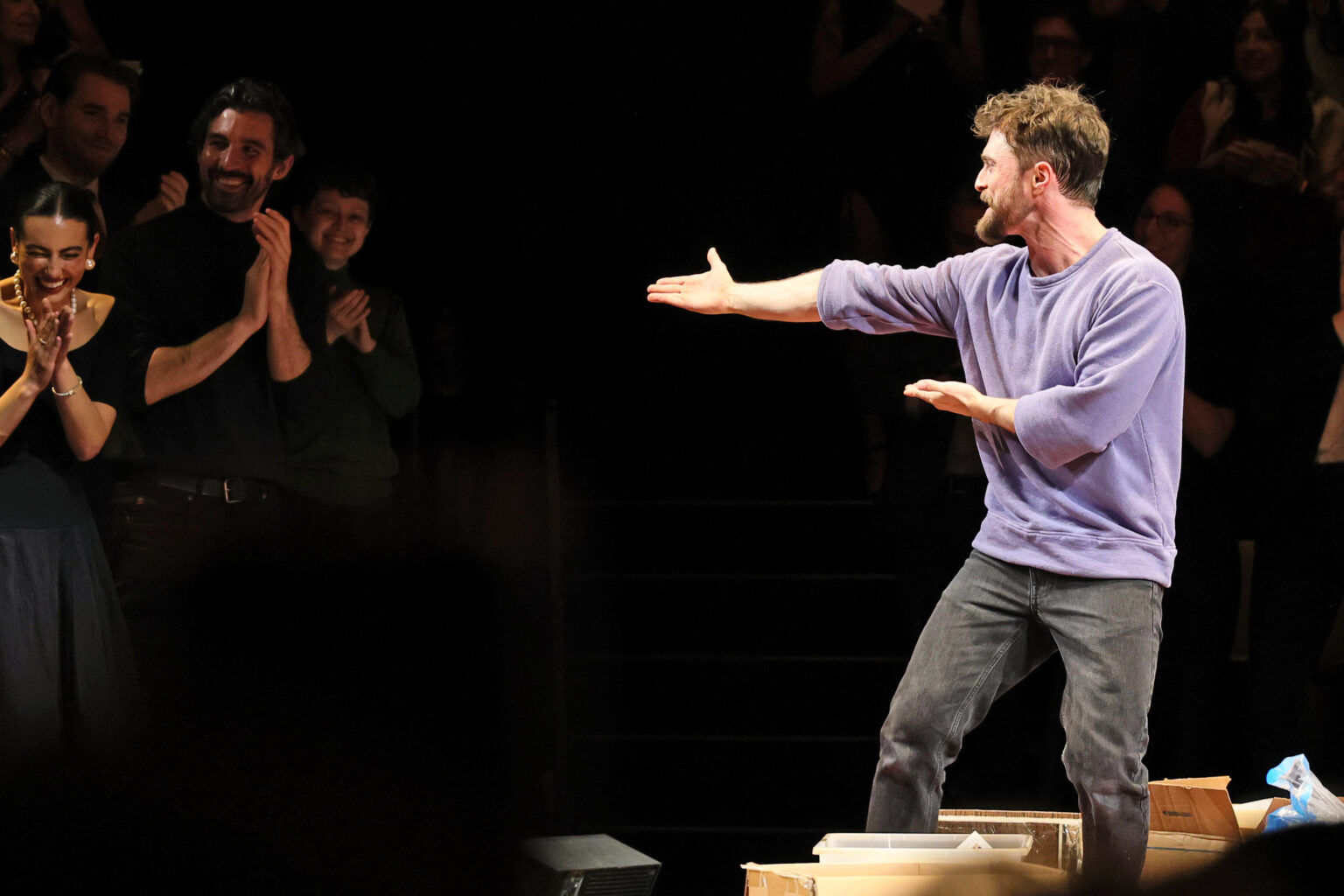
When I first read that Daniel Radcliffe would be doing Every Brilliant Thing on Broadway, I didn’t think it would work. It’s not that I was worried about Radcliffe, who besides his film and TV career has established himself as a bona fide stage entertainer. I was worried about everybody else in the theater, because this play runs on audience participation. For Radcliffe in particular I imagined it could be like navigating a minefield, especially in a show about depression and suicide. Every description I’ve heard or read about him involves the word “charming” somewhere in there, but he’s also someone I associate with intense scrutiny and obsessive fandom, thanks to the whole Harry Potter phenomenon. For example, someone who worked at a theater where Radcliffe had previously performed once told me that they had to hire extra security so people didn’t break into his dressing room. With the Hudson Theatre holding just under 1,000, the odds didn’t seem good that everyone who attended on a nightly basis would demonstrate polite behavior when Radcliffe crossed the traditional divide between audience and performer.
But if anyone’s been a total weirdo at Every Brilliant Thing, I haven’t heard about it. And when I attended the show, now a couple months into its run, I was impressed both by the overall chill of my fellow theatergoers and the way the audience participation transcended its potential for gimmickry to become something that genuinely worked in the context of the play. There are certainly Broadway shows with more action and more developed writing, but the pieces of Every Brilliant Thing, orchestrated by Radcliffe, fit together to form an experience that justifies the leap of faith required to perform or attend it.
In any venue, with any level of celebrity in the cast, breaking the fourth wall is a tricky endeavor—I know several people who are terrified by the idea that an actor may “call on them.” If that’s you, you’ll want to sit in the balcony, because the overwhelming majority of audience participation is sourced from the seats closest to (or actually on) the stage. But a lucky few from up high get to shout something out when cued, and in order to prepare them for their moment, Radcliffe does travel upstairs before the formal start time. As I was taking my own seat in the balcony about 10 minutes before the top of the hour, I was delightfully surprised to encounter him delivering instructions to someone sitting just a few rows ahead. The average audience member looked a lot like me—women in the rough age cohort where it was once actually normal and fine to really love Harry Potter—but I was quite impressed that nobody moved to get closer to him or interrupted his task. I personally couldn’t resist snapping a photo, and of course folks were staring at the star of the show. But if you swapped Radcliffe out with a very handsome usher, the scene would have looked just about the same.
The preshow does a great job building anticipation for the thing itself. A frenetic Radcliffe bounces around the theater on a mission to fill out all the roles in the story to come, occasionally stopping to converse with theater employees in much the same manner that a quarterback might chat with his receivers between drives. (I’m sure they’ve developed a knack for analyzing a given person’s spotlight-readiness.) He’s excited and eager to put on a good show, in a kind of Kermit the Frog way. He’s doesn’t bear much of a resemblance to the boy wizard anymore, but he does still embody that sincere spirit of adventure that made him such a flawless fit for the films, and his enthusiasm is infectious. If Daniel Radcliffe is this focused on doing his job, I’m sure it’s going to be a treat.
Every Brilliant Thing opens without any ceremony. Radcliffe, on a bare stage surrounded by audience members on all sides, launches right into the story, which begins with our protagonist’s mother attempting suicide when he is just 7 years old. The traumatic event inspires this optimistic boy to create a list of “every brilliant thing” that makes life worth living, starting with ice cream and continuing on into increasingly abstract emotional territory. Our unnamed protagonist narrates us through a conversation with his dad, a meeting with a child therapist, and so on, requesting help from folks or asking for props whenever the scene requires more than just him. These parts are not complex, but often require a good sense of spontaneity from the amateurs. Though Radcliffe’s comic timing, charisma, and burgeoning Broadway Icon status make the process as painless as possible—he handled it like a pro when an audience member’s book turned out to be The Case For Christ, a title that prompted guffaws from the crowd—this is not a foolproof production. However, there’s magic in seeing strangers learn in real time how to do something they’ve never done before. In an early scene where Radcliffe plays his character’s dad, and an audience member plays him at 7, learning his mom’s in the hospital, all the recruit has to do is ask “Why?” again and again. At the night I went, the guy initially gave pretty rote-sounding “Why?”s, like he was mostly focused on not screwing up. But as the scene progressed into more heart-rending territory, a couple of those “Why?”s sounded really genuine, like an actual kid trying to understand the complicated depths of the world around him.
Writing out the subject matter, it sounds like a heavy play. It’s anything but. With Radcliffe at the helm, able to draw laughs seemingly at will, the rougher bits go down as easy as chocolate milk. (Even just hearing him describe himself as “British” in a self-deprecating tone does the trick.) The listed runtime is 75 minutes, and the show is as breezy as that sounds. I’ve been blessed to have seen a lot of fantastic one-person shows, and purely as a script Every Brilliant Thing isn’t one of them. The big moments, like Radcliffe describing how it felt falling in love or freaking out at just how outstanding the drums sound on Curtis Mayfield’s “Move On Up,” are ecstatic, but the character’s low moments are too hurried for real profundity. One of my favorite aspects of an expert monologue is being able to imagine the story as it happens—to be transported to a different time and place. Every Brilliant Thing’s descriptive writing, unfortunately, does not carry anywhere near the level of vividness needed to achieve this feat, typically settling for one detail when five would have been closer to sufficient. Even the love of our protagonist’s life has to be sketched vaguely enough that they could be portrayed by a random selection of hundreds of brides and grooms over the course of several months. But it is a testament to Radcliffe’s talent that he’s able to fill a big room with words alone, and words that would probably look fairly bland had you only read them.
I’m going to spoil something here, even though this isn’t a show you see for the plot: The list of brilliant things fails at its initial goal. The narrator’s mother does eventually die by suicide. I think for some audience members this is a frustrating choice—you go see a whole show about a life-affirming project, only to learn that it didn’t really work. But to me it’s the key that unlocks the whole value of this production. In life, it’s incredibly difficult to accept that no matter your efforts, what another person does is ultimately out of your control. It echoes, in an unexpectedly lovely way, what Radcliffe is doing nightly in this theater. He’s doing his very best to create the conditions that will allow other people to thrive, and then he’s trusting them. It’s working.
The Suicide & Crisis Lifeline is available for people in crisis or those looking to help someone else at the phone number 788. The Crisis Text Line is a texting service for emotional crisis support available by texting HELLO to 741741.
Recommended