
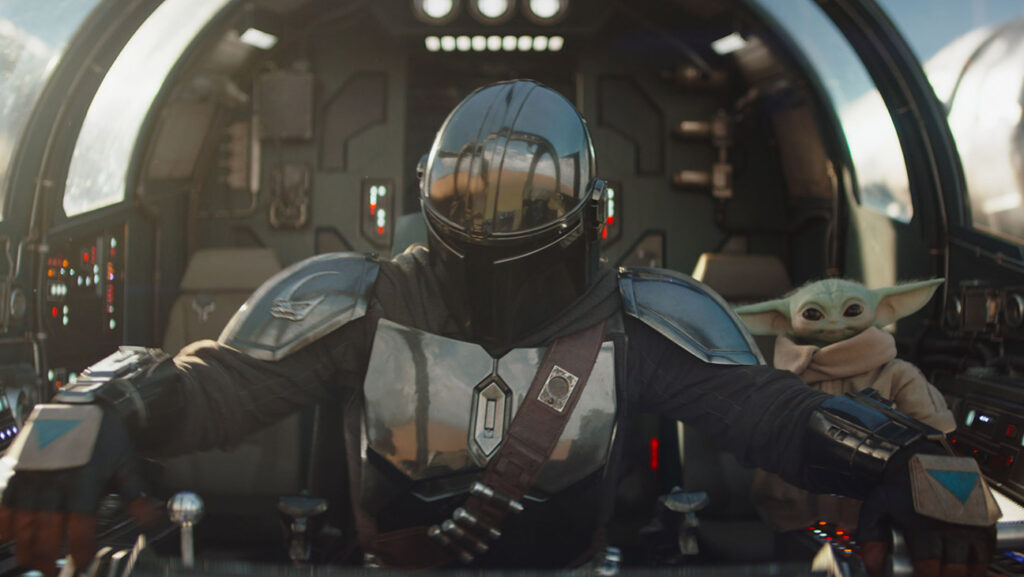
Can Baby Yoda become a cultural touchstone once again?
That’s the major question as Star Wars: The Mandalorian & Grogu opens on the big screen over Memorial Day weekend. The film continues the story of The Mandalorian, Jon Favreau‘s series that helped launch Disney+ and introduced the world to Baby Yoda (Grogu) just before the depths of the pandemic
The scrutiny couldn’t be more intense. A standalone movie or not, it’s the first Star Wars film to play in theaters in seven years due to a host of reasons, beginning with the pandemic and followed by the labor strikes.
Tracking services show The Mandalorian and Grogu opening to roughly $82 million at the domestic box office for the four days, while some exhibitors see it coming in as high as $95 million to $100 million. That would be on the lower end of any Star Wars title released by Disney since paying $4.05 billion to buy Lucasfilm in 2012, and it could potentially end up the lowest domestically, not adjusted for inflation. Globally, Disney insiders expect Mandalorian and Grogu to earn at least $160 million. It’s rolling out in virtually every corner of the globe, save for South Korea.
Others who pay close attention to social metrics are more bullish. A major advantage: it is arguably the most family friendly title of any Star Wars film.
“Word-of-moth across social media is the key; critics have become largely irrelevant to performance,” says one a top Hollywood financier who still believes Mandalorian has a shot at scoring as much as $105 million for the four day weekend in North America and another $85 million overseas. “The film’s fate will also hinge on whether it draws in the family audience. We expect that demographic to turn out. If they do not, the grosses will be lower than our predictions.” This person adds, “Historically, Memorial Day has been driven by casual audiences deciding to go to the movies. Star Wars films have also relied on walk-up business.”
In 2018, Solo: A Star Wars Story debuted to $104 million over the four-day Memorial Day weekend, including $84 million for the three days. The stand-alone movie marked a low point in topping out just north of $393 million at the global box office. A year later, Star Wars: The Rise of Skywalker, part of the main saga, topped out at $1.069 billion despite being panned by many critics (it also fueled further fan outrage over the overall state of the storied franchise).
Rise of Skywalker‘s critics score on Rotten Tomatoes was a lowly 51 percent, but the audience score was a rousing 86 percent (Solo scored better with critics with a still-not great 69 percent, but it’s audience score was a dreaded 63 percent).
As of midday Thursday, Mandalorian‘s score among critics rested at 60 percent; if it falls one point lower, it will be in “rotten” territory.
The first read on how U.S. audiences feel about Mandalorian will come Thursday afternoon when the movie opens in previews across the country at 2 p.m. (it’s already started rolling out overseas in its first several markets).
Disney and analysts say the film’s theatrical performance is only one piece of the financial puzzle. The Disney+ series generated more than 13 million pieces of Baby Yoda goods sold, making it one of its top-selling characters. And it’s the most successful show in the history of Disney+, amassing more than 1 billion hours viewed, so the feature film version could also do well when eventually landing on Disney+. And a Star Wars attraction at Disneyland has also been revamped in honor of Mandalorian.
“This is not only about the film’s performance for Disney,” says the film financier.
The movie sees Pedro Pascal return as Mandalorian, a bounty hunter also known as Din Djarin, who is charged with protecting Grogu. Favreau directed the film from a script he wrote with Noah Kloor and Dave Filoni, who earlier this year was upped to oversee the creative direction of Lucasfilm as president and chief creative officer following Kathleen Kennedy’s departure (he was a George Lucas protégé).
In the film, the Mandalorian is tasked by Sigourney Weaver’s Colonel Ward of the New Republic to rescue Rotta the Hutt, voiced by Jeremy Allen White. (Martin Scorsese also voices a memorable, four-armed food stand chef.)
“It’s hard to imagine anyone experiencing this as their first Star Wars film and getting hooked for life as those who saw the original trilogy in theaters did,” writes The Hollywood Reporter in its review. “Still, it’s an entertaining, fast-spaced space adventure that benefits immeasurably from the charisma (mostly vocal, but still) of Pedro Pascal as the bounty hunting Mandalorian Din Djarin and the adorable cuteness of the animatronic Baby Yoda, excuse me, Grogu.”
As for the future, the franchise may face a bigger referendum on its health next year when Star Wars: Starfighter, directed by Shawn Levy and starring Ryan Gosling, opens on May 28.