
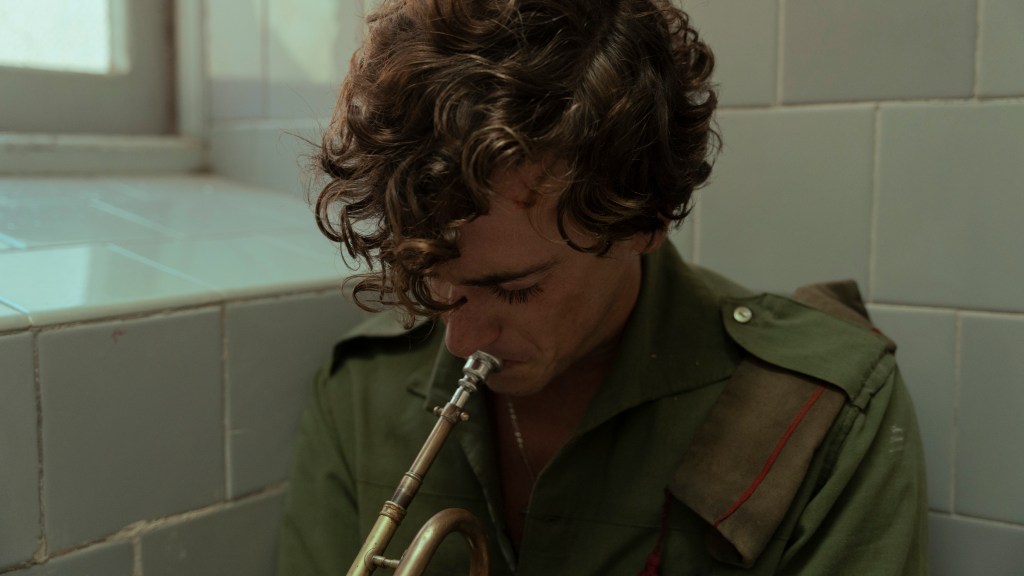
Nothing says “I love you” like a bullet to the heart in Javier Calvo and Javier Ambrossi’s La Bola Negra (The Black Ball), an unashamedly romantic decades-spanning drama that emerged in the last days of a very austere Cannes Film Festival as a possible dark horse Palme d’Or winner. It’s long even by Cannes standards, and requires an awful lot of very specific cultural knowledge (start brushing up on Spanish history and literature now), but the level of craft is extraordinary, notably in the way three very distinct timelines — 1937, 1932 and 2017, in that order — are woven together seamlessly.
The first timeline introduces us to Sebastián (musician Guitarricadelafuente making his acting debut) in 1937; a trumpet player with a military band. The Spanish Civil War is in full swing, and Sebastián is part of a welcoming party organized by his village, believing that Mussolini’s men are coming to liberate them. They are, indeed, coming but not to liberate them. As bullets and bombs rain down from an aerial attack, Sebastián takes off amid the chaos and is taken in by a traveling band of Nationalist soldiers.
The second timeline, 1932, is fictional, and this is where we meet Carlos (Milo Quifes). Carlos is on his way to the casino, turning down his mother’s offer of his favorite lunch and proceeding with such purpose that his head is barely turned by a parade of the gayest matelots since Pierre et Gilles’ 2005 book Sailors & Sea. Carlos is applying for membership of the casino, but his confidence does not last long — he is blackballed by the committee, to the dismay of his father (blink and you’ll miss Antonio de la Torre), on the grounds of some… well, rumors.
Lastly, we come to 2017, where Alberto (Carlos González) is leading a very messy life, having abandoned his career as a playwright to collect rare pre-war records and pursue random gay sex through Grindr. Alberto learns that his grandfather has recently died, which comes as a surprise since he believed that he was already dead. But when he confronts his mother, Teresa (Lola Dueñas), she gets angry, and tells him not to involve himself in the reading of her father’s will. But Alberto goes anyway, and his inheritance (in all possible meanings of the word) is contained in a brown envelope, some scraps of paper that take on an awful amount of significance over the next two hours.
Meanwhile, the story cracks on, largely following Sebastián as he becomes part of a mixed Spanish-Italian platoon and is put in charge of a handsome POW, Rafael (Miguel Bernardeau). Sebastián becomes infatuated with Rafael, falling in love him in much the same way — we later learn — as the poet Federico García Lorca once did. Lorca, murdered in 1938, is key to the film’s central mystery, but the film still has some way to go yet, and there are plenty more secrets still to be discovered (to heavily paraphrase a line near the end, the heart of a gay man is “an ocean full of secrets”).
Lorca’s ghost hangs heavy over the film, and his poetry doesn’t always translate (at the Cannes press screening, even the French and English subtitles often seemed at odds with one another). There’s also an awful lot of snow, and references to snow — hint: in the 1918 poem Autumn Song, he wrote “Will the snow melt when Death carries us off?” — which sends the film off on a new, cryptic magic-realist tangent when Carlos’s story should be wrapping up. The vagaries of the Civil War are also hard to intuit at times. Nevertheless, La Bola Negra has an unshakeable self-confidence that keeps all the working parts moving, and if the rumors are true that the directors were editing up to the wire, it’s possible that the film might yet be streamlined for release.
As its 20-minute ovation showed, there is certainly an appetite for a new kind of gay love story this year at Cannes, where Jordan Firstman’s similarly disarming Club Kid left grown women in tears. This kind of inclusivity would explain Glenn Close‘s appearance — as a visiting literary scholar — at just the right moment, as well as Penélope Cruz’s showstopping cameo as Nené, a singer-slash-hooker who schools Sebastián on the then-nascent form of the modern transgender movement.
The behind-the-scenes involvement of Pedro and Augustin Almodóvar is also significant in this regard; La Bola Negra certainly reflects the broad church of their production company El Deseo and very much follows Almodovar Snr. in its use of melodrama and the convoluted algebra of desire that configures whenever two or more people fall in love. Almodóvar tried something similar himself, in the closing scenes of 2015’s Parallel Mothers and his tribute to the missing of the Civil War. La Bola Negra not only succeeds where he failed, it takes the Almodóvarian concept of romantic love to the next logical level —and hopefully to the next audience — as Spanish cinema continues to evolve in his wake.
Title: La Bola Negra
Festival: Cannes (Competition)
Directors/Screenwriters: Javier Calvo and Javier Ambrossi
Cast: Guitarricadelafuente, Miguel Bernardeau, Carlos González, Penélope Cruz, Glenn Close, Milo Quifes, Lola Dueñas
Sales: Goodfellas
Running time: 2 hrs 35 mins