
Photo: Victor Boyko/Getty Images
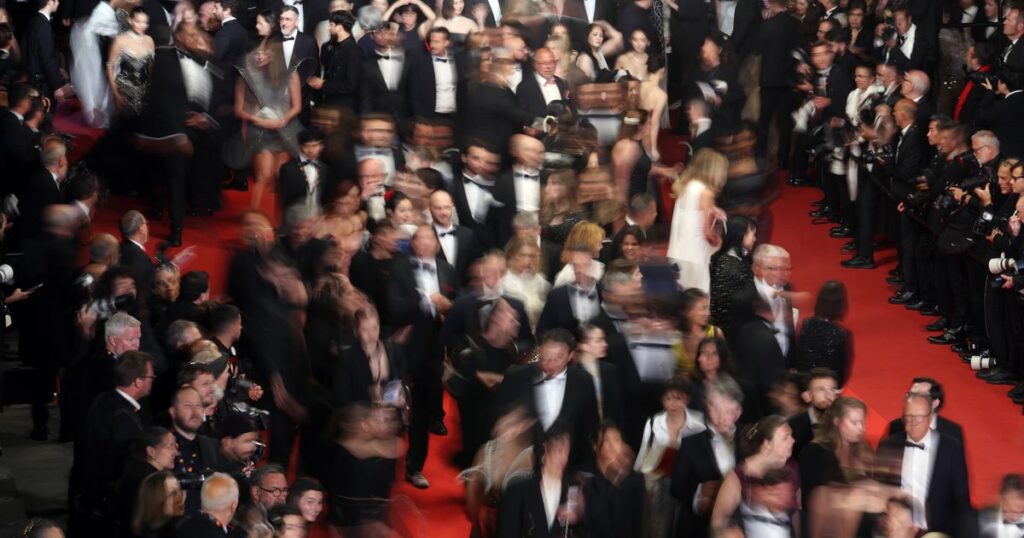
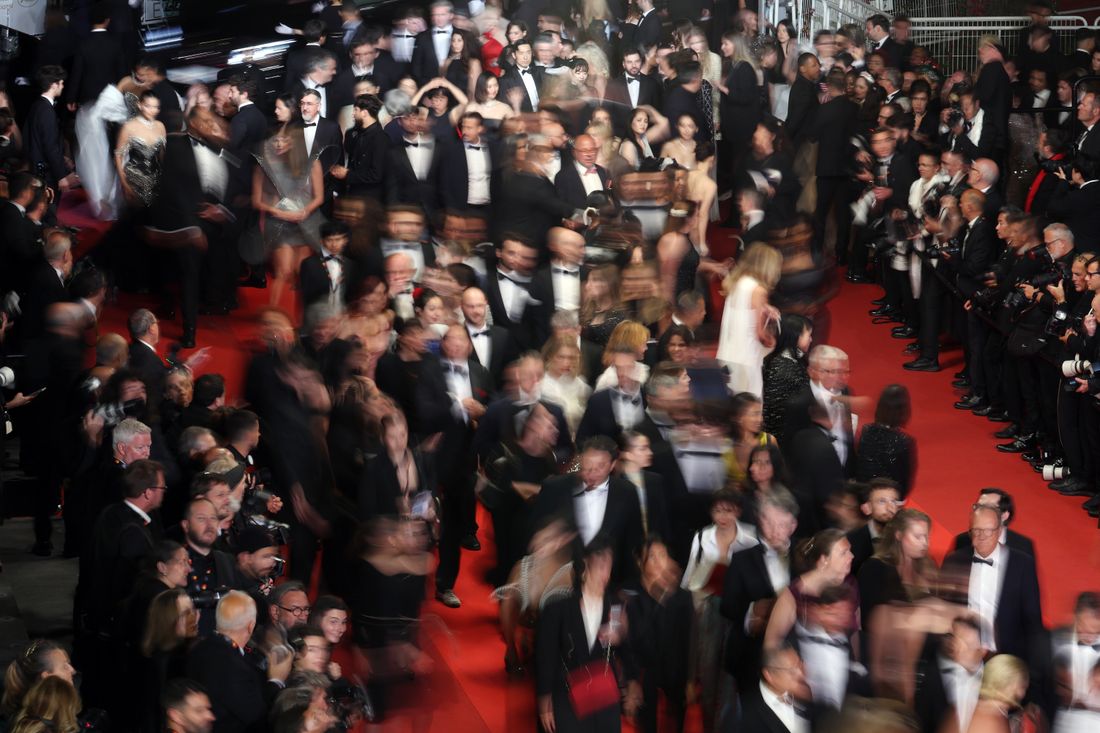
A seemingly malevolent presence lurked over the Cannes Film Festival this year. I’m talking, of course, about Meta, but also something else. Some (me) wondered if there was a curse afoot. It all started when Jacob Elordi broke his foot, subsequently withdrawing from the jury. Then a makeshift roof platform collapsed at a starry hotel party. Many of the best films were shown out of competition. Somebody ate my dinner as Sharon Stone yelled at me to hug a stranger. Barbra Streisand decided not to fly across the world to retrieve her honorary Palme d’Or because of a knee injury. And everyone everywhere was talking almost exclusively about AI.
On day one of the festival, Demi Moore set the tone at the jury press conference in her answer to a question about whether we were doing enough to protect “human artistry” from the technology’s filthy clutches: “I think the reality is that to resist — I always feel that againstness breeds againstness. AI is here,” she said. “And so to fight it is to, in a sense, to fight something that is a battle that we will lose. So to find ways in which we can work with it, I think, is a more valuable path to take.” Things devolved from there.
On the second day of the festival, I dragged my decreasingly human form to Meta House, a pop-up hub inside Cannes’s Majestic Hotel designed for Mark Zuckerberg to foist his spy glasses upon the unsuspecting public. For some reason, the room was entirely blue, with wall-to-wall blue carpet. I began chatting with a group of young French men in crisp white shirts and black pants, trailed by their Entourage-esque manager. “We make funny videos,” they explained. (Later, I learned they had hundreds of thousands of followers on Instagram and TikTok.) Pairs of Meta Ray-Bans sat ominously inside glass boxes around the room, and I picked up a pair, unsure how to turn them on. One of the French boys tried to show me, pressing a small button on the inside of the glasses, but we couldn’t get them to work.
“I have a pair,” he said, smiling. He and his comedy group were all 21 years of age. I told him I found the glasses creepy, an invasion of privacy. “Not at all,” he said. “We do pranks with them.” He showed me video he’d taken with his glasses of a random woman on the street, who looked confused but eventually tried to be a good sport about it. “We ask them after we film if it’s okay to post, and 100 percent of the time, they say yes,” he said. He told me Meta had just gifted the group new Ray-Bans. “It’s really, really cool,” he said. “They have headphones, so you can listen to music.”
I was recorded more than once against my will inside the Meta House. I’m just noting this for the inevitable future moment when my face is on a billboard promoting Meta-sponsored prison camps. I asked one of the employees for a demonstration of how to use the glasses so I could eventually record what was happening at this prison camp. He showed me how to turn them on, explaining that the glasses had an “AI function,” with microphones “all around” and that I could listen to music, take phone calls, issue hands-free commands, translate languages in real time, and permanently implicate myself and future generations. The employee led me into a dark room that was set up with tiny flashing lights to make it seem like I was being hounded by paparazzi and told me I could record myself on my glasses and pretend to be famous. I did.
I asked if he was at all concerned about normalizing the recording of strangers in public via a pair of innocuous-looking glasses. “It’s just like a phone,” he said. “But it has a visual light cue to let people know you’re recording.” Indeed, there was a tiny light in the upper corner of the glasses. I wondered if most people knew to look for the tiny light and told him about the comedians who used the glasses for pranks. “A lot of people aren’t privy to the light being an indicator,” he admitted, “but I think once people know about the glasses in general, they’ll look out for the light.” He added that the glasses were better than a phone on a societal level because “you’re more present instead of having your head down.” I gave him back the glasses and realized I couldn’t find my phone. I asked if he’d seen it, and he looked pointedly at my hand. I was holding it. We both laughed. “It’s a part of you,” he said.
A few days later, I sat down, glasses-free, to watch Steven Soderbergh’s new Meta-sponsored documentary, John Lennon: The Last Interview, featuring audio from a wide-ranging interview of Lennon and Yoko Ono conducted hours before Lennon was shot. Soderbergh had been doing interviews about the film in the lead-up and was transparent and characteristically levelheaded about his AI usage, explaining that maybe “10 percent” of the doc was made with Meta’s generative-AI video tool. He said the AI sections, had they been made with VFX, would have been “prohibitively expensive” and “taken a year,” versus five weeks. He described what the standard creative process might have looked like, had AI not been available. “I’m sure if you talk to the people that I was working with, it had to have been frustrating. I’d say things like, ‘Opening shot of the film, I need a ’50s-style radio. I want you to create some rings that will pay off later. This will be a recurring motif, these kind of light rings. But for now, there are these light rings, and then this radio comes out of nowhere and comes up and fills the screen until it whites out.’ And they go, ‘Okay …’ And then they’d come and show me versions and I would go, ‘Slow it down. Make the radio bigger,’ or whatever.”
As a Soderbergh fan, it brings me no joy to report that the film comes across like boomer Facebook slop. Between archival footage and photos of Lennon and Ono, there are dozens of jarring, ugly visuals, seemingly generated by entering Ono and Lennon’s dialogue into a machine that spits out bizarrely literal interpretations of text. When Lennon pontificates on the “primitive” behavior of men, the screen populates with a series of frighteningly jacked cavemen flexing and wielding clubs. When he talks about being an active, engaged father versus hiding from his family at work, a baby toddles down an office hallway. When he describes artists as “mirrors” of our society, we’re treated to an uncanny montage of people holding mirrors (yes, their hands are weird) or walking past mirrors in a forest.
At one particularly low point, when Lennon is talking about the post-’70s state of countercultural politics, and mimicking his peers whining and complaining about not getting what they wanted from the movement, we see a series of babies in hippie garb crying on the floor. Despite the fact that thousands of hours of ’70s protest footage must be available — some of which we do see in the film — we get several shots of fake protests and fake protesters. We see fake generals and fake kings, fake oil dripping down fake skyscrapers to indicate corporate greed (an ironic moment, considering AI’s appalling environmental impact), lots of shots of fake people floating through the sky (?), fake peacocks strolling through fake city streets to accompany a quote about people “from all walks of life” (??), and aesthetically unappealing recurring motifs, including a black rose morphing into various other objects and the aforementioned “frustrating” light. I’ve rarely seen more walkouts during a Cannes screening, and the reviews have been appropriately castigating.
I was unable to get into the Anthropic x Graydon Carter x Bryan Lourd party at the Hotel du Cap — no press was invited, likely because it was populated by billionaires discussing the features and whereabouts of the bunkers they will retreat to after they have finished stripping the Earth and its citizens for parts. But I was invited onto a docked yacht to hear about and see footage from an “AI-native” “film” made for $500,000 total with a team of 15 people in two weeks. It wasn’t the only AI film to premiere at the fest; there was an “adult short film” made by transforming actual 1976 magazine photo spreads into a movie with dialogue, an AI short from Nicolas Winding Refn and Hideo Kojima made for Prada, and plenty of start-ups scattered around the festival trying to convince people that it’s ethical and cost-effective to do things like this. On the yacht, a relatively well-known director from the ’90s was part of a brief moderated conversation about the “movie,” as was the CEO of the AI company. I don’t want to mention any names here, lest I accidentally legitimize the whole affair.
“I think a lot of people see the shortform videos on social media, but this is a huge step up in terms of quality and the premium feel and also the fact that it’s over a 90-minute period, which is really impressive,” said one of the panelists. Over and over again, the panelists described AI as a “tool”: “These are just tools and don’t be afraid of them. This is the moment, especially if you are an underrepresented filmmaker in the world — grab these tools and get a little edge,” said one incredibly enthusiastic woman.
“It’s still about filmmaking and craft, but if you can supercharge, almost, like, give yourself superpowers, it allows you to be dangerous in Hollywood, and I think some people don’t like that,” added one of the men. They spoke about using AI instead of real sets, instead of real wardrobe, instead of real actors to save money. “But it’s not just the economy,” one said. “It’s about using the technology to make the films more beautiful, more epic, and give the audiences greater entertainment.”
They turned our attention to a trailer playing on a TV at the front of the yacht. It began with a voice-over, playing across scenes that looked like if Final Fantasy were made for $14. “You ever think about what happens after?” asks a woman. “After what?” asks a man. “After we stop,” she replies. An AI man falls to his knees in a forest, blue flowers surrounding him.
The trailer stopped abruptly due to technical issues. The boat was quiet. “We’re not gonna flog a dead horse if it doesn’t work,” said one of the executives. They started it again.
“You ever think about what happens after?” “After what?” “After we stop.” The trailer stopped again. They played it again.
“You ever think about what happens after?” “After what?” “After we stop.”
This time, we got a brief plot explanation, which seemed like it had been stolen — sorry, generated — from a Marvel film, perhaps Infinity War: “They say the Gods formed six artifacts of unimaginable power. Three were taken by demons. Three were hidden on Earth.” An AI demon catches a bomb in its mouth, then farts loudly. The trailer stopped again. They gave up.
The panel continued half-heartedly. The director explained why he wanted to keep working with AI instead of actually making movies. “I have a young daughter, and she says, ‘Why does it take so damn long for a sequel to come out?’ And I was like, ‘I got you. I’m gonna try to make an animated feature at the level of the films you love in less than a year.’ And I believe that’s the future, when you think about creating IP. The sequel should be able to come out a year later because if you wait four years, that kid can now be a teenager and then you lose your audience.”
He smiled at the crowd. “I think IP, it’s an enablement with AI, and then you recreate it and let your crowd and your audience interact with your content, let them create assets from it. I think that’s the future.”
Sign up for the Vulture Daily
An entertainment newsletter for the pop-culture obsessed.
Vox Media, LLC Terms and Privacy Notice
See All