
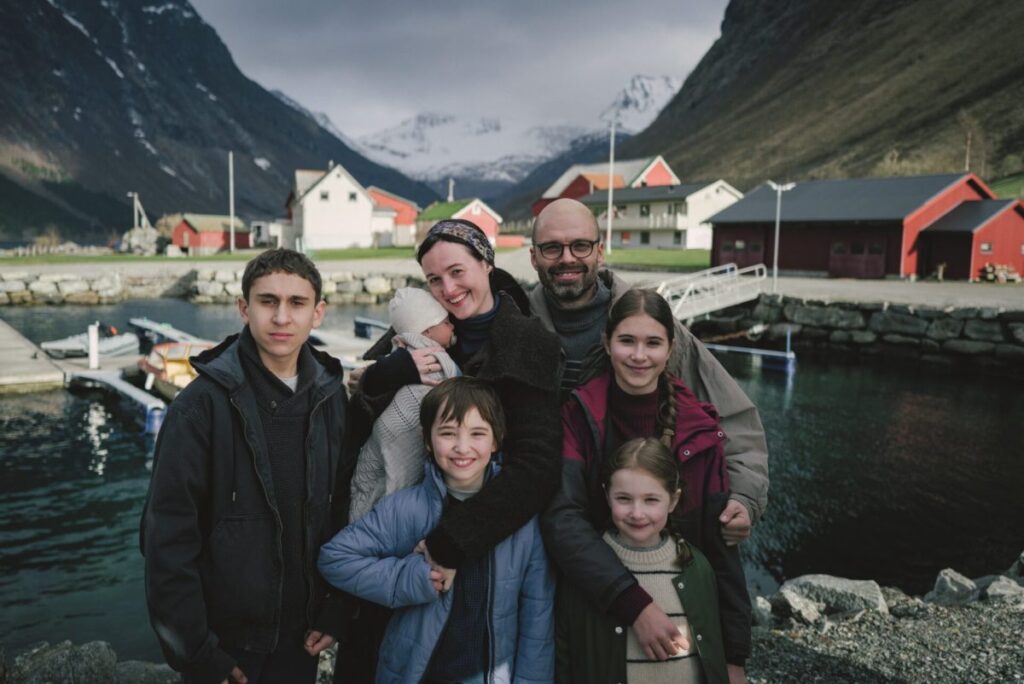
Fjord is set in a remote town in Norway, where the Gheorghiu family moves at the beginning of the movie and where the mother, Lisbet Gheorghiu (Renate Reinsve) was born and grew up. Mihai Gheorghiu (Sebastian Stan) is originally from Romania and works as a software engineer at the local school his children attend. When two of the teachers, Gunda (Ellen Dorrit Petersen) and Frida (Lisa Loven Kongsli), notice bruises on the older children, Elia (Vanessa Ceban) and Emmanuel (Jonathan Ciprian Breazu), an investigation starts involving child protection services regarding the suspected abuse from the parents towards their children.
At its heart, Fjord tackles the issue of child abuse and the different opinions that the people in the film have on it. Seeing this as a conflict between conservative values and progressive ideas is not wrong, but it would minimise the movie as a simplistic opposition of the two. In reality, what this story reveals is the fundamental cultural differences between Eastern Europe, historically attached to communist values, and the European countries that have not been as touched by the communist experience and are more oriented towards a capitalistic mindset. After all, the film contains many references to communism and religion that contextualise the beliefs and values the protagonists uphold.
This movie features incredible performances from Renata Reinsve and Sebastian Stan. They are both very good opposite each other as husband and wife, but they also embody their respective characters successfully, making the audience want to learn more and more about this family and what they really believe. Stan, in particular, is incredibly magnetic as Mihai Gheorghiu in a role that viewers will not have seen him portray before. Stan becomes the focus every time he is on screen, to the point that it is hard to pay attention to anyone else; his character commands attention, despite being a secondary one compared to his wife.
The setting is also a key part of this story, so much so that it almost feels like another character in its own right. From the establishing shots at the beginning of Fjord to the same locations the audience sees over and over throughout the film, the setting is key to this story, with the avalanches, snow-covered houses, and the titular fjord that make the remote town the Gheorghiu family relocated to unique and authentic. This is not just true in terms of visuals, as the audience learns to navigate these spaces just as well as the characters by the end of the movie, but also narratively. The entire story happens because the family moved from Romania to Norway, making the setting the inciting incident that starts the entire story.
As a movie that explores such an important topic as children’s upbringing, viewers may wish Fjord had taken a firmer stand regarding this case. Instead, a lot of it remains ambiguous, and the movie itself does not seem to want to pass judgment on the characters. But in a world where religious fanaticism is on the rise and child abuse is often in the headlines, should the movie have more commentary on such a sensitive topic? Admittedly, the narrative is based on a real-life case, which might have influenced the portrayal of the characters and events to be less black-and-white and more open to interpretation.
Ultimately, Fjord is a well-made movie, but one that does not provide any answers. Instead, it asks compelling and thought-provoking questions that viewers will find themselves reflecting on long after the film has ended. Anchored by two incredibly powerful performances and a visually stunning setting that is portrayed very well through the camera lens, the film transports us into the daily routine of the Gheorghiu family and what everyday life looks like in a remote town in Norway.
Fjord was screened in competition at the Cannes Film Festival.