
With Women Of Action, Caroline Siede digs into the history of women-driven action movies to explore what these stories say about gender and how depictions of female action heroes have evolved over time.
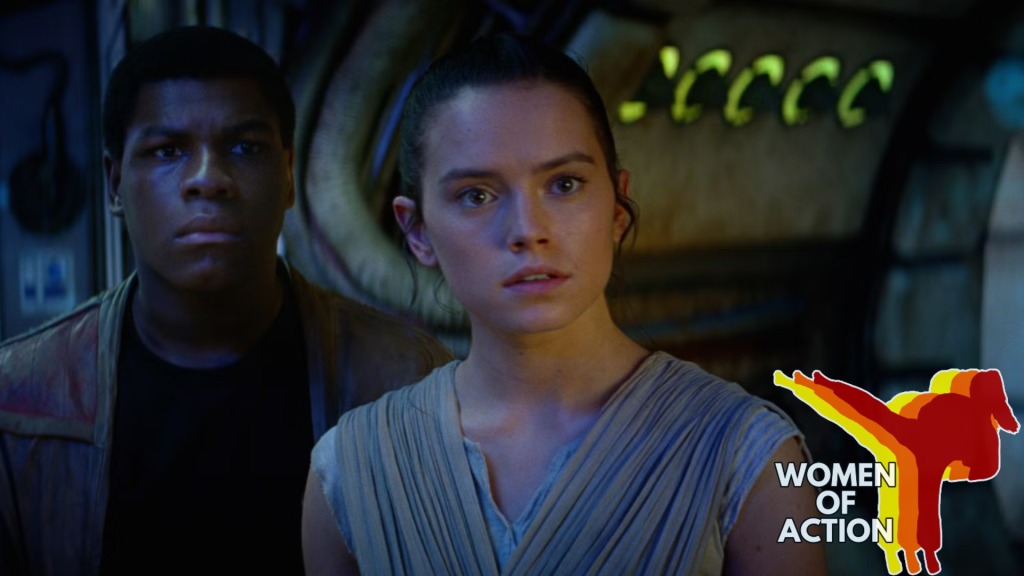
If you’re a white brunette woman looking to feel represented in the Star Wars universe, you’ve got your pick of the litter. Between Princess Leia (Carrie Fisher), Padmé Amidala (Natalie Portman), Jyn Erso (Felicity Jones), Qi’ra (Emilia Clarke), and now Sigourney Weaver’s New Republic Colonel Ward in The Mandalorian And Grogu, Star Wars has a very particular image of what empowered women look like. Yet none of those doe-eyed space heroines caused quite the same hubbub as Daisy Ridley’s Rey Skywalker née Palpatine—a likable young lead who somehow managed to generate cycles upon cycles of discourse from the moment she debuted in 2015’s The Force Awakens.
There were Rey lovers, of course, including those who praised her as a “feminist hero,” celebrated that her gender wasn’t any more central to her story than Luke’s was, and admired that she wasn’t first and foremost presented as a love interest in a sexy outfit. A cycle of positive press about how the film (briefly) passes the Bechdel test was followed up by a baffling debacle where Rey was left out of the movie’s tie-in merchandise and Twitter had to start a #WheresRey campaign to get her added. Mostly, however, there was a whole lot of debate about whether or not Rey is a “Mary Sue”—a term that originates from self-insert fanfic tropes but has mostly just come to mean a female character that fanboys find annoying.
It’s not worth rehashing all the exhausting details, but the argument basically boils down to the idea that Rey being able to use The Force without proper training was so unbelievable that it ruined the otherwise airtight logic of a film where the galaxy still collectively loves Luke, Leia, and Han even though they raised a second Space Hitler. I think the obsession with training seems kind of antithetical to the idea that the Force is an “energy field created by all living things” that some people have a natural aptitude to access. But, hey, to each their own.
Yet while sexism unquestionably drove the anti-Rey backlash, I understand why the character is a little hard for people to process. Both within the Star Wars canon and outside of it, Rey is an unusual female action heroine. If there’s one thing that links nearly all the female characters I’ve covered in Women Of Action, it’s a certain sense of defiance—the kind that manifests in an overt “I’m better than the guys” confidence, or at least an anti-authoritarian streak. Both men and women tend to respond well to kickass female characters like Ripley, Sarah Connor, Foxy Brown, Beatrix Kiddo, and, of course, Princess Leia, whose take-no-shit debut in 1977’s Star Wars paved the way for so many of the big-screen action heroines who followed in her wake.
Rey, however, is a much sweeter, more emotive leading lady. Though she’s visually coded as the Luke Skywalker of the sequel trilogy, her tougher desert childhood gave her a different outlook on life. Where Luke was a farm kid who grew up with someone serving him blue milk, Rey was abandoned and left to raise herself. While Luke managed his boredom by dreaming of flying off to have big, exciting space adventures, Rey survived her crushing loneliness and grueling existence by adopting a sunny, almost willfully naïve sense of optimism that her family would come back for her one day.
In Disney Princess terms, Luke is the plucky Little Mermaid yearning to be part of another world, while Rey is more like a retro throwback to the quietly patient ethos of Snow White and Cinderella—right down to rescuing BB-8 and making him her “animal sidekick.” Yet in addition to metaphorically singing into a wishing well, Rey also honed an impressive collection of scavenger survival skills, like engineering, piloting, and using a staff as effectively as the lightsaber she’ll later wield.
In other words she’s both capable and guileless, and we don’t really have a shared cultural touchstone for that kind of female action hero, unless it’s in the context of a comedy like Charlie’s Angels or a “born sexy” movie like The Fifth Element. More than her skillset, it’s that unique characterization that makes Rey feel “off” to some people. If she had the same sarcastic, insubordinate personality as Black Widow or Katniss Everdeen, I doubt the Mary Sue accusations would exist. (No one gets mad at Princess Leia for being too competent.) That’s probably also why so many of Rey’s most ardent fans are women who weren’t longtime sci-fi lovers, but people who jumped into this new Star Wars trilogy because it had a female lead. Without that ingrained sense of what “badass” action heroines are supposed to feel like, they could just enjoy Rey for who she is.
It took me until writing this column to fully appreciate just how much naivete is an intentional part of Rey’s characterization and not just the result of the screenwriters failing to make strong enough choices about her personality. Two moments really define Rey in The Force Awakens. The first is that, even after an exhausting day of scavenging has left her with barely enough for a single dinner, she still playfully throws on an old starfighter helmet while she eats. Even the toughest day on Jakku can’t rob Rey of her whimsy. (As Cinderella puts it, “they can’t order me to stop dreaming.”)
The second is when she’s finally headed towards her first-ever alien planet and earnestly marvels, “I didn’t know there was this much green in the whole galaxy.” Though Rey takes a second to warm up to strangers, she’s inherently open to the wonders of the universe most people take for granted. That’s a pretty clear explanation as to why she’s able to access the Force so easily. Back in A New Hope, Luke is so distracted by his yearning for glory and adventure that he has to be taught to “stretch out with his feelings.” Rey is nothing but feelings. Her yearning isn’t for adventure, it’s for connection, which seems to be what the Force is looking for. (In that way, her closest comparison is young Anakin in The Phantom Menace, who was also a bit of a Jedi savant thanks to his openheartedness.)
Some people make the mistake of assuming that, because The Force Awakens looks and feels so much like A New Hope, director/co-writer J.J. Abrams is trying to recreate that movie’s character arcs too. But, to his credit, he does a lot of remixing with his central trio. Where Luke refuses and then answers the call within 25 minutes of his first appearance, only to spend the rest of his debut movie slowly growing his skillset, Rey’s journey is much more internal. Her skills are largely formed by the time we meet her, but she spends almost the entirety of The Force Awakens refusing the call and trying to return to Jakku to wait for her family. She doesn’t embrace her destiny until the final 15 minutes of the movie, when she claims the lightsaber that’s been calling to her and accepts Maz Kanata’s advice that, “The belonging you seek is not behind you, it is ahead.”
That’s the sort of slow burn you can only pull off when you’re confident you’re getting two more installments to tell the full story of Star Wars‘ first central (non-animated) female Jedi. The best thing about Rian Johnson’s The Last Jedi is how it turns Rey’s naivete into both her greatest strength and her greatest weakness. All her childlike optimism about her family’s return gets transferred into an equally childlike belief in the good vs. evil binaries of the Jedi—that heroic Luke Skywalker can simply defeat the dastardly Kylo Ren in one fell swoop if she asks him to. When that doesn’t work out the way she expects, she flips the script and decides Kylo is the troubled hero who will immediately turn good with just a little bit of empathy. She starts calling him “Ben” like she knows him better than he knows himself, only to watch in disbelief as he kills Snoke not to help the Resistance, but because he wants Rey to rule the galaxy with him.
Though Rey gets that much-demanded “training” in the second movie, her arc isn’t really about learning to be a Jedi. Instead, it’s about learning to temper her optimism with shades of gray; to accept that Luke isn’t a flawless mythic hero; that Kylo can be something in-between all-good and all-bad; and that her parents aren’t important people who had some grand reason for abandoning her. The movie doesn’t strip her of her earnestness—to some degree she’s right to have faith in both Skywalker men—but it balances it out with a dose of realism. The Last Jedi is about Rey growing up, though Ridley never loses the buoyancy of her performance; the “fiery spit of hope” of a true Jedi.
Indeed, of the many, many reasons the “somehow Palpatine returned” twist of The Rise Of Skywalker falls flat, the biggest is that Rey is such a fundamentally good person, there’s no real threat of her turning evil just because the grandfather she never knew was a dictator. She has none of the whiny, tortured angst that made that a more interesting question for Luke in The Empire Strikes Back and Return Of The Jedi. Like most things about Rise Of Skywalker, it feels like the movie is resolving a very different character arc than the one that was established across the first two films. Rey’s story has been about discovering that a complicated but loving found family can be just as meaningful as the fairy-tale origin story she once dreamed up for herself. Making her a lost Empress who draws her strength from all the past Jedi is thoroughly detached from what’s come before.
Rise Of Skywalker also emphasizes just how male-centric the sequel trilogy is. Like a lot of modern genre stories, the Star Wars sequels take the lazy route of introducing a lot of women but then treating them as the sole “strong female character” of individual storylines. Laura Dern’s Vice-Admiral Holdo enters the picture after Leia winds up in a coma. Naomi Ackie’s Jannah is introduced after Abrams bowed to racist, sexist backlash and all but wrote Kelly Marie Tran’s Rose Tico out of the final film. Keri Russell’s Zorii Bliss technically exchanges a few words with Rey, but otherwise exists to flesh out Poe’s backstory.
Though Rey gets to have lived-in dynamics with Finn, Poe, Han, Luke, and most notably Kylo, the only female character she has a meaningful relationship with is Leia—and there’s only a single conversation between them that isn’t jerry-rigged from old footage. Even before that, however, Leia plays a bizarrely passive role in the series given that she’s the general of a resistance against her own son who turned evil because of her family blood. As ever, Star Wars would prefer to imagine children simply spring wholesale from their fathers and uncles.
By the end, the sequel trilogy feels as much like a Kylo story as a Rey one. (He gets big emotional climaxes in all three films in a way Darth Vader never did.) Still, to Rise Of Skywalker‘s credit, Rey at least gets to hold onto her defining earnestness rather than succumbing to the same fate as Leia and Padmé, who all but lost their personalities in the final installment of their respective trilogies. Ridley’s sincere, emotive performance gives Rey a consistency that’s not entirely there on the page. But it’s a waste not to use that openness to do something new with the franchise’s classic battle of good and evil. Colin Trevorrow’s unmade Duel Of The Fates script had her reject the dogmatic approach of the Jedi and bring balance to the Force by embracing both the light and the dark. That’s a little more in line with the arc the first two films set up.
Disney claims it’s bringing Rey back to explore more of her story in a spin-off directed by Ms. Marvel‘s Sharmeen Obaid-Chinoy, who would become the first woman and first person of color to helm a Star Wars film. Until that happens (if it actually does), Rey’s action heroine legacy is strange. She’s not a trailblazer like Princess Leia, yet she did her fair share of trope subversions. While Leia proved sci-fi heroines don’t need to be damsels in distress, Rey suggests there’s more to female power than just defiance. Perhaps that’s the balance she brings to the Force.
Next time: Before a new Girl Of Steel hits the big screen this summer, let’s revisit her cinematic debut in 1984’s Supergirl.