
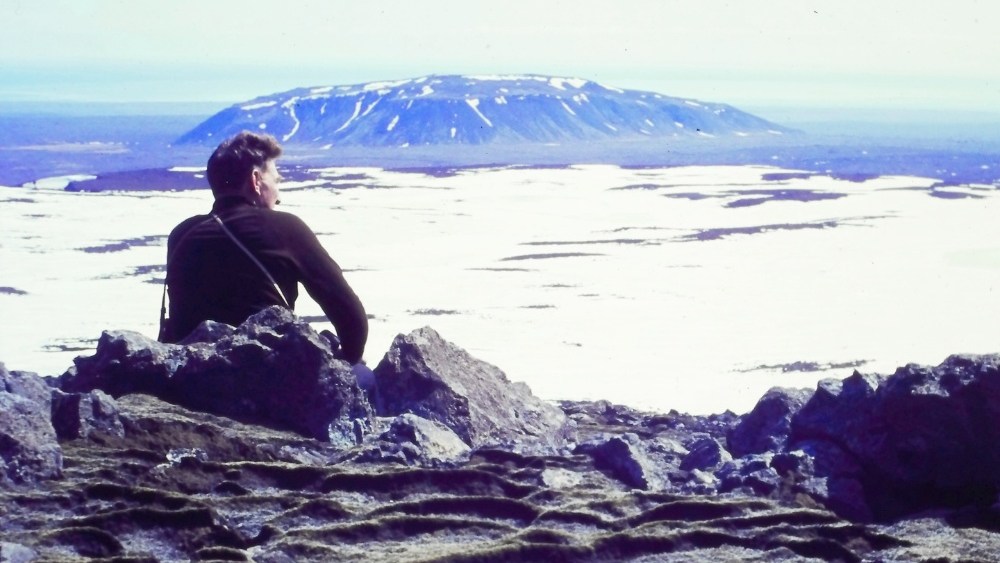
Making a film about the climate crisis is a daunting task. How does a filmmaker meet the urgency, enormity and impending doom of this crucial moment in time? Oscar-nominated “Fire of Love” director Sara Dosa goes back to basics: family, love, home. The documentarian partners with Icelandic poet and author Andri Snær Magnason to craft a portrait of the melting glaciers of his homeland. Far from being an ecological investigation, “Time and Water” is a moving story about what the Icelandic terrain has meant and still means to Magnason’s family. In telling this one family’s story and examining their connection to the land they were born into, Dosa makes an affecting documentary about a looming danger that many are ignoring.
Inspired by Magnason’s book “On Time and Water,” the film unfolds like a long letter written by the author to someone close to him, perhaps one of his children. He narrates the story of the melting glaciers, what they meant to the land, to him and his ancestors before him. “Time and Water” starts with the history of the terrain, how the glaciers came to be formed and became important to Iceland, and also tells the contemporary tale of how the climate crisis is leading to their extinction. Yet quickly it becomes something deeper: a love story. The glaciers are where his explorer grandparents, Arni and Hulda, met, fell in love and started this family.
The audience spends time with Magnason’s grandparents through their long relationship and generations of love, their life mirroring that of the glaciers that brought them together. As they age, Magnason explains, so do the glaciers. The film shows clearly the effects of time: While people get wrinkles and grey hair, glaciers turn blue. In contrast, with the impact of global warming, the author’s young teenage daughter Hulda, named for her great-grandmother, is unlikely to live on an Earth that resembles the one his elders knew. In tracing this four-generation lineage, Magnason makes connections between his family, their terrain and the history of Iceland, expressing his fears for the future.
Dosa brings this narrative to vivid life using many elements in her docmaker’s toolbox. In addition to Magnason’s recollections and archival footage, there’s new footage shot by Pablo Álvarez-mesa, plus animation that fills in the gaps where those resources cannot. On the soundtrack, the audience doesn’t just hear his silver-tongued narration, but also folkloric Icelandic hymns that create a reverential, almost religious mood. What brings it all together, however, is the brilliant editing, which flows to the rhythm of the poetic writing. Editors Erin Casper and Jocelyne Chaput, who also worked on “Fire of Love,” are credited as writers alongside Dosa and Magnason. It’s not an easy task to marry each image, archival and new, to the words, but this team accomplishes that and more. There is a natural rhythm and easy flow that makes the story digestible, entertaining and, above all, tenderly moving.
At moments in the film, closing one’s eyes and just listening to the words is transformative — so many passages feel ready to be quoted. When Magnason talks of having a funeral for a glacier, despite his voice being steady and smooth, there’s such sadness in it that it acts as an alarm to the crisis we are living in. A mention of a glacier’s scent almost fills the nostrils with that fresh arctic smell. With “Time and Water,” Dosa turns the climate crisis into something heartbreakingly tangible. She and her collaborators create not just an urgent documentary, but a profoundly beautiful elegy for a world slipping away before our eyes.