
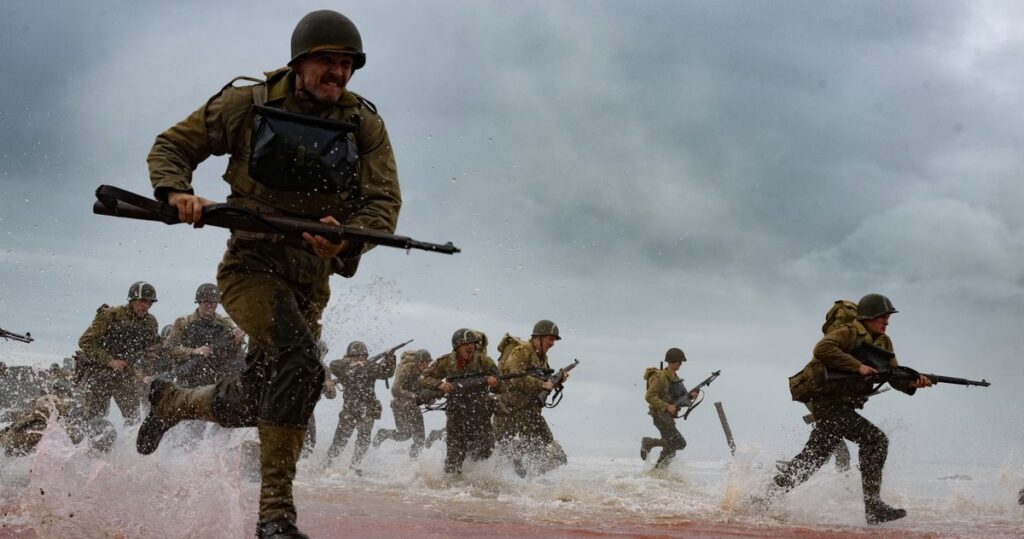
Photo: Alex Bailey/Focus Features/STUDIOCANAL
The version of Dwight D. Eisenhower portrayed by Brendan Fraser in the gripping new World War II film Pressure may not be entirely accurate, but he does make for a fine narrative accelerant. Fraser plays the legendary general (and future president) as a tempestuous mountain of a man, a far cry from the modest and even-keeled Eisenhower of record. But no matter: We need an Ike like this for the drama to work. Pressure isn’t really about Eisenhower so much as it is about the efforts of a stiff-upper-lip British meteorologist, Group Captain James Stagg (Andrew Scott), to forecast the weather for the D-Day Normandy invasion of 1944. Hounded by a loud, impatient Eisenhower and faced with the very real evidence that a brutal trio of storms will make an early June invasion impossible, Stagg is torn between doing his duty and, well, doing his duty. As the British general Bernard “Monty” Montgomery (played with just enough flamboyance by Damian Lewis) explains helpfully for both Stagg and the audience: If D-Day is canceled, the Allies will lose the war. But if D-Day goes on, the giant waves and the insane winds will ensure its catastrophic failure and the loss of countless men and vessels.
That’s a great narrative conceit, which also happens to be true. The weather forecast for D-Day was indeed a fraught affair. (There’s already been another film partly about this subject, the not-very-good TV movie Ike: Countdown to D-Day, starring Tom Selleck.) The script, by David Haig and director Anthony Maras, effectively strips the complex affair down to its compelling cinematic essentials: On one side are the partying, carefree American forecasters, led by Colonel Irving Krick (Chris Messina), who’ve looked at a half-century’s worth of old weather maps and predicted that D-Day will be sunny and clear. Played by an enormously entertaining Messina, Krick is pure Hollywood: Though he’s had great success during the war so far, his main claim to fame is that he accurately predicted the weather for Gone With the Wind and its spectacular scenes of Atlanta being burned to the ground. (This, too, is true, by the way.) And then there’s the prim and unfriendly Stagg, who doesn’t play well with others, who insists on having the office to himself, and who refuses to let the affable Krick be a part of his reports to Ike and the rest of the generals. But we understand that his standoffishness is due partly to his nerves and to the fact that he’s had to leave his pregnant wife back home before taking on this top-secret job.
Pressure does get messy whenever it leaves the compound where all these decisions are taking place, but thankfully it doesn’t leave too often. For the most part, the film is a model of narrative economy and clear character development, all grounded and enhanced by Scott’s delicate performance. This is a great showcase for his subtle brand of acting, whereby he can convincingly relay one mood while hinting, with his haunted eyes and the slightest twitch of his lips, at an entirely different psychological reality.
The more Stagg digs in his heels, the more everyone in the movie hates him — and the more we like him. His determination becomes a matter of identity.
As does the contrast he strikes with the burly and expansive Eisenhower. Ike, we’re told, likes certainty. But he also wants Stagg to tell him that the weather will be good enough to go on his appointed date for D-Day. (Avoiding the storms will mean a delay of weeks, which would also ensure failure; there’s no way an invasion force of this size can be kept secret for that long.) The temptation to go with Krick’s more pleasant (and somehow more spiritually American) forecast is obviously great. But Fraser gives the enraged Ike just enough honesty and human indecision that we understand why the supreme commander would wait for the say-so of a mousy weatherman: He clearly admires Stagg’s rectitude and his willingness to be hated.
The disagreement over the weather also suggests a broader, more cosmic conflict going on at the heart of this film. Stagg’s coolly analytical look at upcoming weather patterns clashes with Krick’s reliance on the past, and in the struggle between two men we can sense a struggle between two visions of life, between the hope that things will remain as they were and the existential embrace of an unknowable tomorrow, a struggle that also winds up playing out across Fraser’s increasingly anxious face. It’s a great example of performers expanding a narrative in the subtlest ways. The beauty of Pressure is that it gives us the contemplative space to think beyond the mere borders of this specific historical event, which is the ultimate aim of most good war movies.
Sign up for the Vulture Daily
An entertainment newsletter for the pop-culture obsessed.
Vox Media, LLC Terms and Privacy Notice