
EVEN in his early teens, Trevor Birney’s questioning mind refused to accept things he was told without challenge.
The journalist and filmmaker, who would find himself in a prison cell after being wrongly arrested over his documentary on the Loughinisland atrocity, had always felt a need to seek out the truth.
He was 14 years old in 1981 when the IRA hunger striker Bobby Sands was elected MP in his home constituency of Fermanagh-South Tyrone.
Birney, from an evangelical Protestant and unionist family in Enniskillen, recalls an older relative telling him that there were “30,000 Provos” in Fermanagh, a reference to the number of people who voted for Sands.
“I was only 14 but I knew that couldn’t be true. I played youth football at Enniskillen Rangers and no matter what your background, religion or anything else, when you went to football practice all those good people of integrity were the same.
“I remember being struck at how easy it was for him to label everybody who supported Bobby Sands as being in the IRA.”
Three years later, Birney entered his local paper, The Impartial Reporter, as a print compositor.
He says working among the strong personalities of the print room was an “awakening” as a 17-year-old.
When the owners recognised his talent and transferred him to the newsroom, it was the beginning of a career marked by a determination to “challenge the dominant narrative”.
It’s meant telling the stories of many people on the margins who suffered injustice.
It’s a line running through his work, moving to UTV and becoming editor of current affairs where he exposed hospital failings in the deaths of children, leading to the hyponatraemia inquiry.
He then formed his own film companies, collaborating with major figures, and has become a significant figure in the Irish film and television production world.
Providentially, after his earlier experience, he ended up making the film ‘Bobby Sands: 66 Days’.
But it was an examination of allegations of security force collusion in the loyalist murders of six innocent Catholics watching the 1994 World Cup in a small bar in Loughinisland, Co Down that resulted in the high-profile arrest of Birney and his colleague and good friend, former Irish News reporter Barry McCaffrey, for which they later received substantial damages.
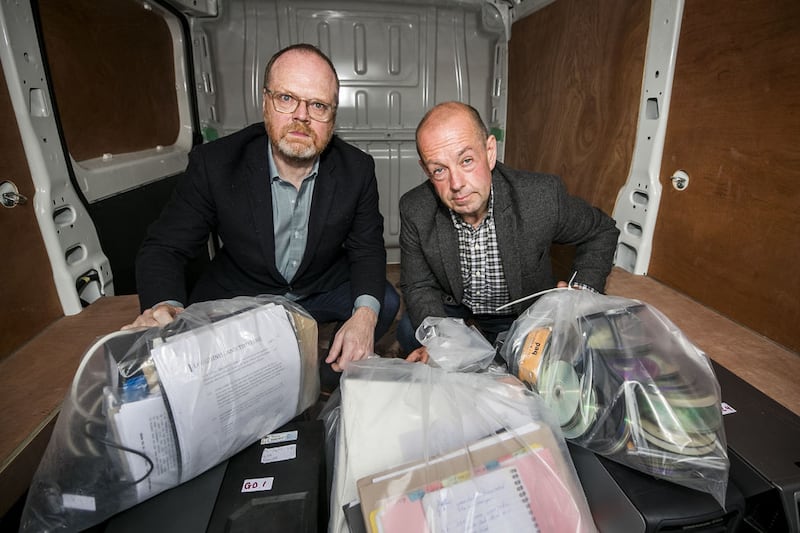 Trevor Birney and Barry McCaffrey with journalistic material seized by police following the making of the Loughinisland documentary No Stone Unturned
Birney’s career has gone through several gear changes, with a varied body of work in documentary and film, so “journalist” barely covers it now.
He was at the Cannes Film Festival earlier this month and is currently working with Terry George, “one of the greatest Irish filmmakers of the last 30 years”.
They’re collaborating on the film ‘Ceasefire’, about the role played by Irish-American journalist Niall O’Dowd in the lead-up to the IRA ceasefire in 1994.
O’Dowd, who wanted to effect change, will be played in the movie by Chris O’Dowd, while Jane Fonda will play Jean Kennedy-Smith and Ciaran Hynds the part of the influential Irish-American businessman Bill Flynn.
Birney’s catalogue also includes films on George Best, Cyndi Lauper, Boy George and many others, including the recent ‘Saipan’, telling the story of the Roy Keane-Mick McCarthy World Cup walk-out.
He has has plans for further work as varied as films on Brendan Behan and Jeremy Corbyn.
I ask how he would describe himself – journalist, filmmaker, producer, director, story-teller, company CEO or…?
“I think it depends what time of day you find me,” he laughs.
“But there is no doubt that the drug is journalism. There is nothing that gives me greater pleasure than being in the middle of a story as it is developing; trying to work out how we’re going to tell this story, what is the value of the story,” says Birney, who with some self-reflection admits he’s had to be a “hustler” to get documentaries or scripted films to screen, often with multi-million budgets.
“Journalism and documentary is the blood that runs through my veins and I’m very lucky to work with so many talented people within Fine Point Films and Below the Radar. The Detail, an investigative journalism website which we launched back in 2011, is still going strong and producing some great stories.”
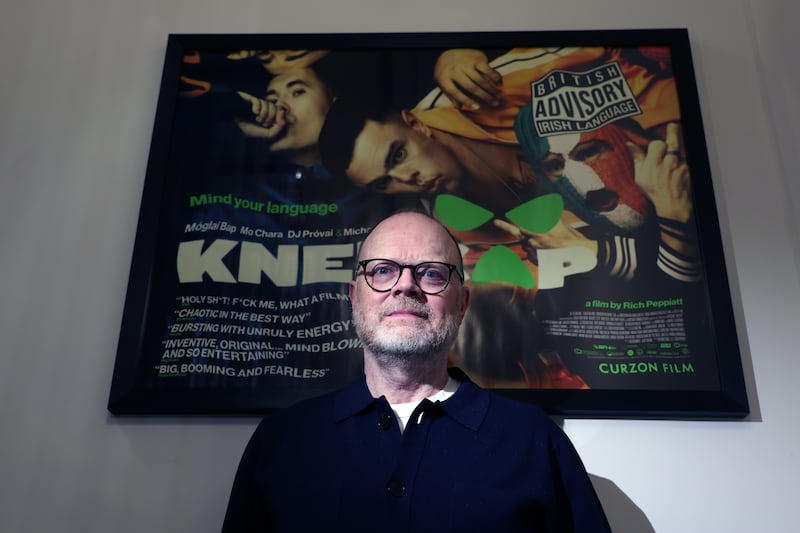 Trevor Birney’s film productions include Kneecap PICTURE: MAL MCCANN
To get to the bottom of stories, there is a determination about Birney which was built from an early age via a mixture of nature and nurture.
He’s one of three brothers. The eldest, Nigel, was a talented footballer who played in the UEFA Cup for Glenavon, and Ian isn’t just a successful runner but the man who has helped bring Enniskillen Running Club to be one of the foremost in Ireland.
Neither Ian nor Trevor inherited Nigel’s footballing ability, despite their mutual love of Liverpool, but all three have in common that they are high achievers with a drive to succeed.
Their late father, Albert, held down three jobs, including as a member of the RUC Reserve during the conflict, and still found time to act as a trade union official.
“I remember people coming to the house all the time, day and night to seek his advice,” says Birney.
“People of all religions and backgrounds had no fear of coming to the house and he had no fear of seeing them any time of night to help them.”
Trevor considers himself “very lucky” to have been brought up in Enniskillen and regularly visits his mother, Jean, whose bright energy he clearly admires.
He recalls her working as a dinner lady at St Joseph’s College and says: “I remember one particular friend, Jeanette, who was profoundly deaf. My mother took her under her wing and brought her to our house all the time. She was a Catholic, but my mother went out of her way to help her.”
The background of social justice, public service and a sense of empathy, regardless of one’s politics, has featured strongly in Birney’s work, and he felt it was “the obligation of the journalist to tell the story accurately and as sympathetically as possible”.
“I ended up calling our first company ‘Below the Radar’ because those were the types of stories we wanted to cover,” he says, mentioning the killing of Arlene Arkinson, the young Castlederg victim of child killer and rapist Robert Howard.
“There was a kind of attitude towards Arlene Arkinson… If Arlene had been born on the Malone Road, it would’ve been a completely different attitude.
“The same with Raychel Ferguson (one of the children featured on ‘When Hospitals Kill’). Had she not been born into a wonderful family from Derry, but instead been born into a family of well-connected parents in Belfast, again that would’ve been different.”
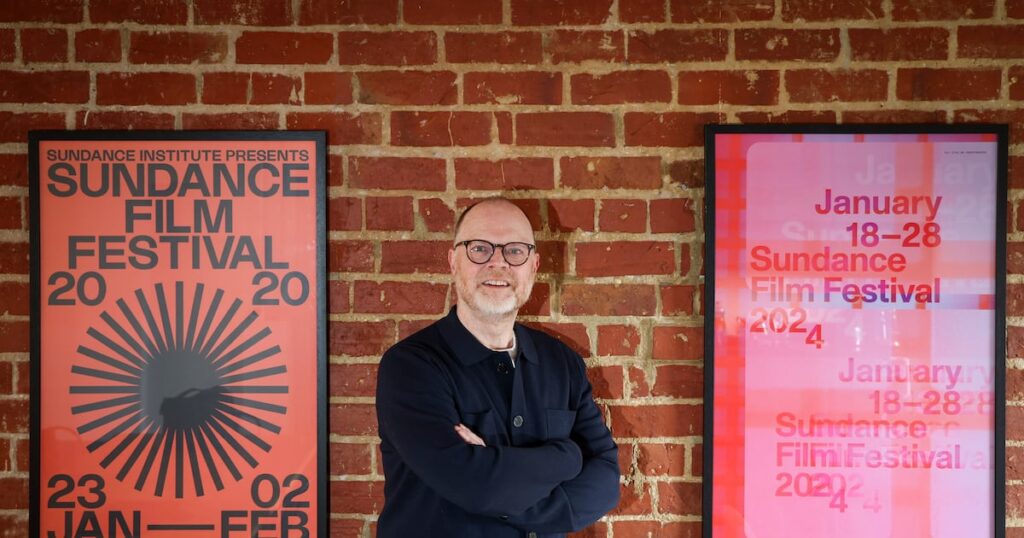
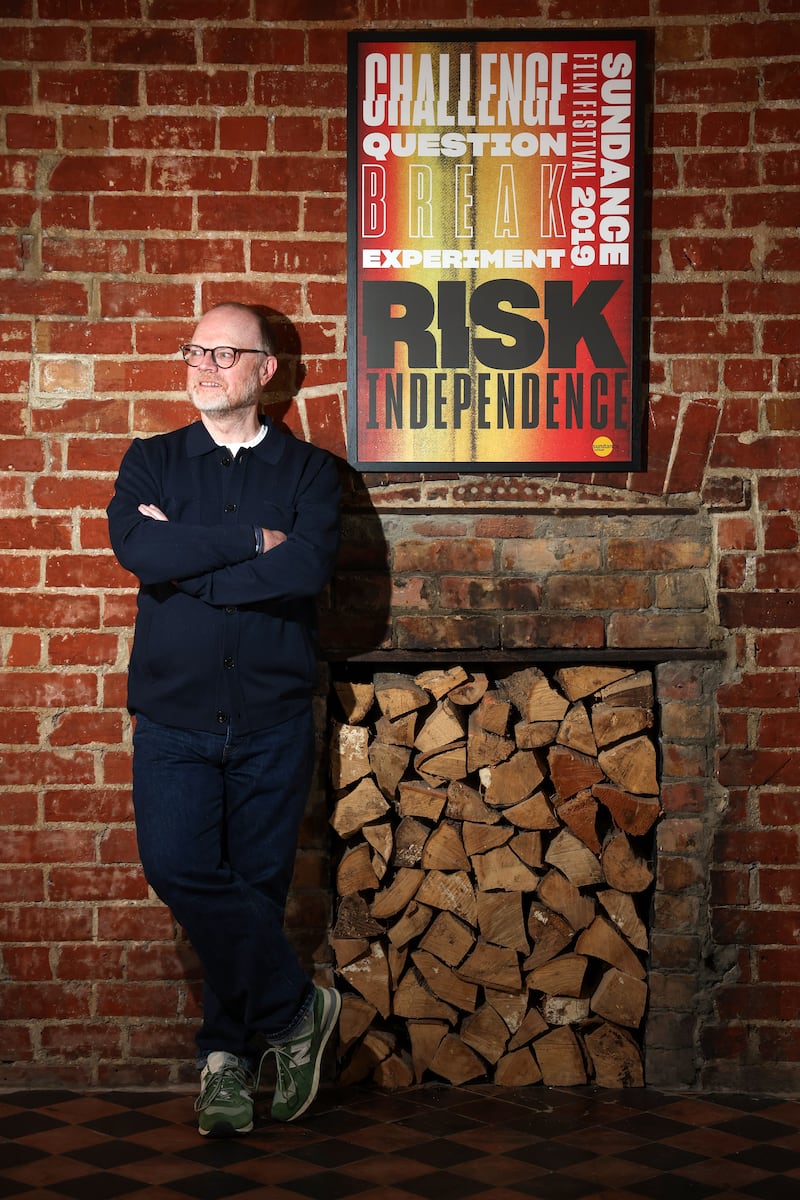 Trevor Birney PICTURE: MAL MCCANN
One of Birney’s UTV investigations, into the still unsolved 1974 murder in Trillick, Co Tyrone of nationalist councillor Patsy Kelly, which exposed links to security forces, would bring the broadcaster personal criticism because of his Protestant background.
“I got a phone call from someone I knew well in Fermanagh who said ‘I was letting the side down’. Why would I possibly want to pursue an investigation into the death of Patsy Kelly?”
Birney was undeterred and knew he was doing the right thing.
He said “at the Impartial Reporter, we were encouraged to write those uncomfortable stories and tell those uncomfortable truths”; though it was an illustration that challenging the narrative often came with personal pressure.
He’d learned this at the weekly paper where local journalists come face to face with the people in their stories.
One such story involved a relative of people killed in the Enniskillen bomb of 1987, who was critical of the authorities’ handling of rebuilding the War Memorial. This went against the perceived image of Enniskillen’s forgiving response.
This style of journalism, Birney admits, came with a price, and the greatest example was ‘No Stone Unturned’.
It’s 10 years this month since then Police Ombudsman Michael Maguire published his seminal report into the massacre.
Birney and McCaffrey’s powerful documentary would see both men arrested at the crack of dawn one morning and their journalistic materials seized. Police later accepted the search warrants had been unlawful.
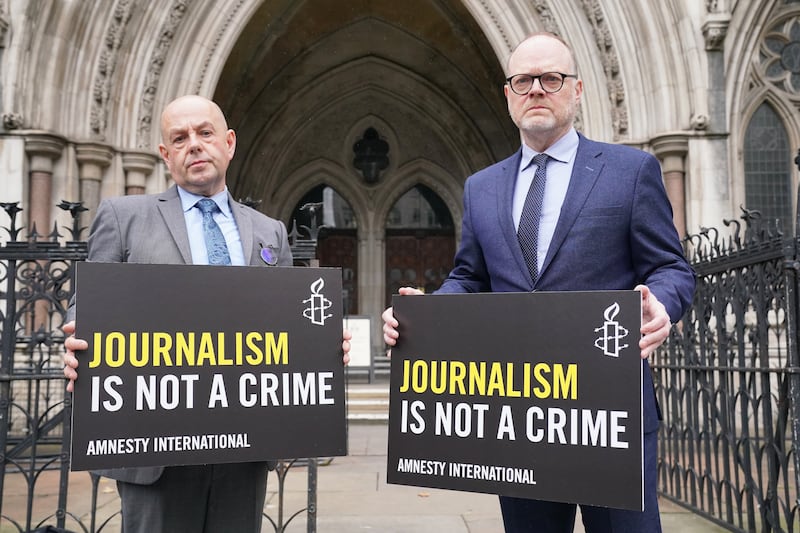 Journalists Barry McCaffrey (left) and Trevor Birney outside the Royal Courts of Justice, in London, last year (Jonathan Brady/PA)
“It’s quite clear to me that that kind of backlash that Barry and I suffered from was back to the old days,” says Birney.
“They failed miserably and their actions only served to highlight the film and raise its profile. The film has been shown as far away as San Francisco to Sydney, in eastern Europe, in South America and audiences around the world.
“It just showed they were from yesterday, they were from the past and they still felt the rules they used to govern with still applied,” says Birney, who recalls a phrase “The dead hand of Ulster.”
Worryingly, he adds: “I do feel that it could still happen today.”
The issue of press freedom was highlighted by the episode, as well as revealing the fact that journalists in Northern Ireland were being spied on.
It came with something of a personal cost for Birney and McCaffrey, with Trevor saying it was an attack on the two men personally and their families.
While his family in Enniskillen were his anchor in his formative years, he’s a family man himself now and they’re crucial to his work.
His wife, Sheila, a stenographer, helped practically with the business as well as supporting his ideals.
They have three daughters: Ella, who’s studying for a Masters in New York, Mia who’s involved in her father’s media companies, and the youngest, Freya, who is doing her GCSEs.
“Sheila and the girls keep me right,” says Birney.
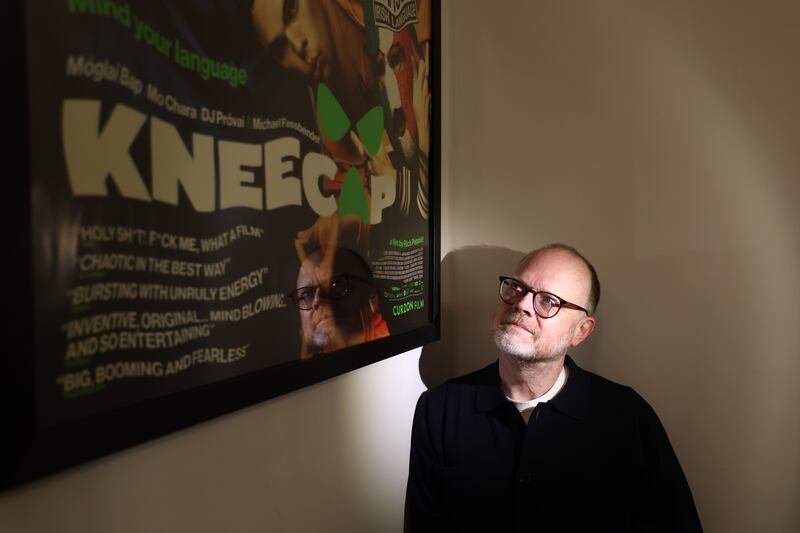 Fermanagh born producer, director and journalist Trevor Birney. PICTURE: MAL MCCANN
Birney’s career has moved considerably over the last decade and he now spends 90 per cent of his time on film and television scripts.
Fine Point Films came out of a visit to the Galway Film Festival in 2008 when he heard a talk by American Oscar-winning producer Alex Gibney.
The two men had a pint of Guinness afterwards and Birney was impressed with his ideas on how film and television could be financed.
While he entrusted his long-time colleague, Michael Fanning, to continue making content for the traditional public service broadcasters, Birney moved to a new model of finding finance.
The result was a number of films “challenging the narrative”, including ‘Mea Maxima Culpa’, a study of sex abuse in the Catholic Church, and ‘Elian’, the story of a five-year-old boy in the middle of a custody battle between Cuba and the United States.
‘No Stone Unturned’ and then ‘Kneecap’ followed, with Birney talking with affection and admiration for the lads in the west Belfast Irish language rap group.
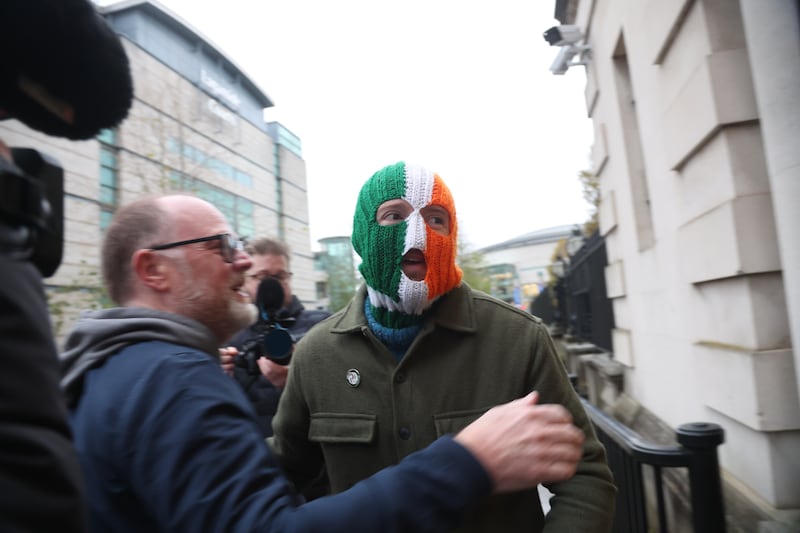 DJ Próvaí of Kneecap with Trevor Birney PICTURE: COLM LENAGHAN
Birney turns 60 next year he shows no signs of slowing up, believing passionately in the “shared island” idea of the north and south’s vibrant film industry.
He’s been working again with the writer/director of Kneecap, Rich Peppiat, on a possible new movie to be filmed in Ireland.
“It’s a very exciting project and given what Rich did with Kneecap, there’s no doubt he’ll be pushing boundaries again.
“Being in Cannes has only confirmed that Irish talent, both on and off screen, is leading the world. We’re born storytellers; that’s our USP,” says Birney, who’s also working with Michael Fassbender’s company, DMC, and separately with “kindred spirit” Stuart Carolan, the writer of Irish crime drama ‘Love/Hate’
“Our industry is primed for growth, there’s a huge appetite for Irish films and television series,” says Birney, who passionately believes that both parts of the island working together will bring huge benefits for the burgeoning industry.
Trevor Birney is an outgoing and engaging character, humorous and a natural storyteller even away from his work. His gregarious nature, though, is underpinned by a steely determination, even defiance, that he will get to the truth.
About to head into his sixties he may be, but the fire in that 14-year-old boy is still burning brightly.
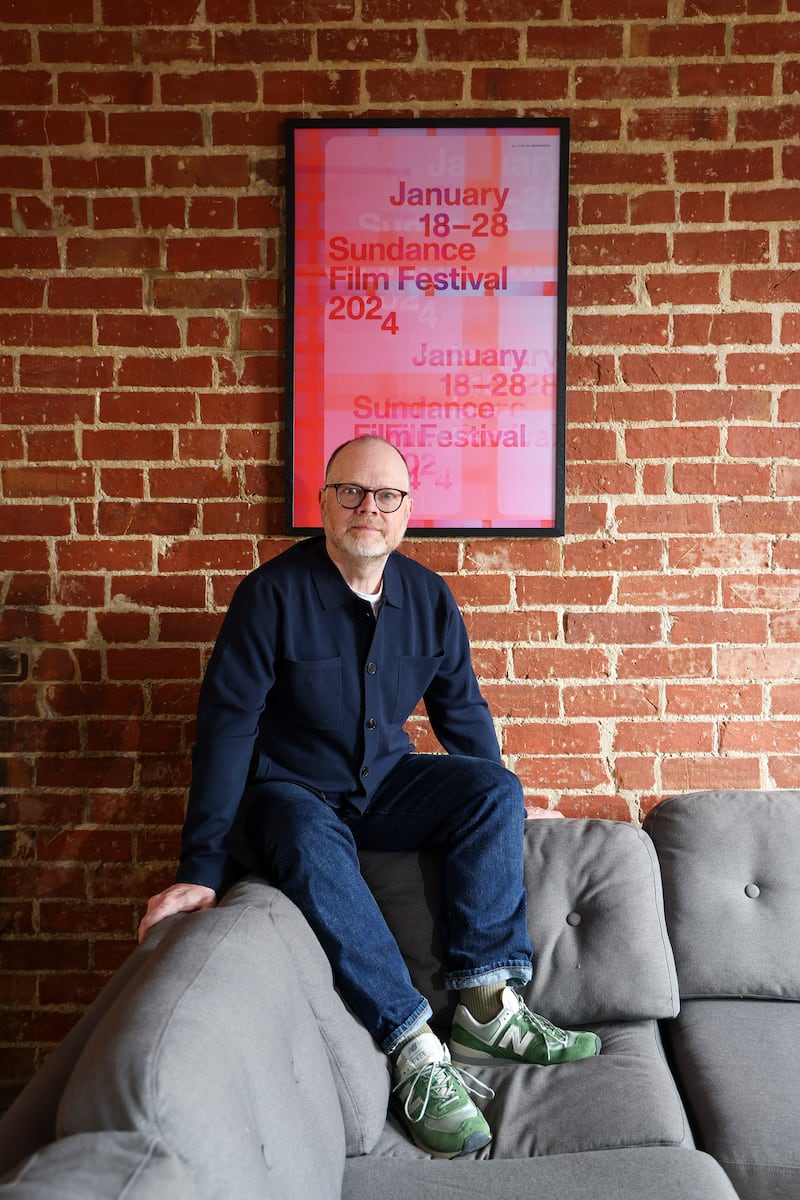 Trevor Birney PICTURE: MAL MCCANN