
When I last spoke with Pluribus star Karolina Wydra, she was just reentering the Hollywood fray, after having taken years off to have children amid the pandemic — a personal decision that led to her representation dropping her as a client. Now, her portrayal of Zosia, the hive mind emissary sent to cajole Rhea Seehorn’s Carol into joining the world’s collective consciousness in Vince Gilligan’s Apple TV sci-fi tale of a happiness apocalypse, has stirred up Emmy buzz. Below, the Polish American actress discusses the intentionality that went into crafting Zosia and how well she would fare in the uncanny valley of the Others.
You’ve worked with many greats — like David Lynch and Graham Yost — but you called working with Vince “a dream.” What about his work or process resonates with you, and why was he your white whale?
I’ve been a fan of his for a very long time, and I think he’s just such an incredible storyteller; the journey that he takes you on that’s always unexpected … When we do his work, you don’t improvise, and you don’t need to add anything because it’s so good, and it’s so rich. It’s really hard, after working with him and you read scripts; it can be quite challenging because of [what] his writing does to you.
There’s a visual storytelling [in] how he sets up the scenes — even the introduction to my character, the way he wanted the cameras to be far away, because she’s far away, and not to be too intrusive. He’s very specific with his storytelling, and it’s so fun to be part of that. I was lucky enough to sit in one day and watch him do that on set. I had my headphones on. I was doing voice-over for the phone call for Rhea in Episode 2, and just listening to the dance that he does with the Camera A operator to tell the story and why he’s going to set up the shot this way, it’s really exhilarating, and it’s so inspiring. He is a man of his own.
Beside that, he’s also a beautiful human being. He’s such a kind man, and he’s just so humble and so modest and so sweet and such a gentleman, and he really cares, and he’s so thoughtful. I’m a mega-fan of [his]. I get really touched when I meet someone that’s a beautiful artist and a beautiful human being. I think that’s just the sexiest thing in the world.
For sure, and it helps create such a collaborative and safe environment.
As an actor, it can be such a vulnerable process. And when you have someone that makes you feel seen and safe, you go, ‘I want to give you everything and then some.’ And what’s better than that?
Last time we spoke, you mentioned having stepped away from acting to have kids, your representation choosing to go another way. But now you’re in the Emmys conversation. What does that feel like to you? How are you processing that?
Come on, what?! I want to go: ‘What is wrong with you people?’ [Laughs] I go: ‘Vince, of course. Rhea, duh.’ It’s wild, and also, I feel honored that people are touched by my performance, or find my performance interesting enough to have those conversations. It’s beyond my wildest dreams, Natalie, everything that’s been happening.
I want Vince Gilligan to get all the accolades. His contribution to — should I say, humanity? — that sounds so big, but what he creates, people are given the opportunity to think for themselves and have their own experience of his shows. They get to really sit with what they see, and they have to be present for it, and they have to dissect it. It percolates in your brain, and it stays there. We wrapped a year and a half ago, and I still think about all the nuances that are there, the constant ideas that come out. We need these original shows that make us think, and they’re not spoon-feeding us every little emotion; that allow us to have our own interpretations.
And then Rhea, what she brought to this character and her performance is just utterly magnificent. It’s mastery of acting. And for me, that I get to work with her and learn from her, it’s the greatest gift.
I love acting so much. I remember when I started transitioning into acting, and I would be taking all these classes. I would spend hours sitting with my friends in New York, [smoking] cigarettes — when I smoked cigarettes back then — [drinking] coffee and [talking] about acting. ‘All the different techniques,’ [pantomimes smoking] ‘and God — Al Pacino or Anna Magnani.’ It was just so intense, but it was so beautiful.
It’s a long-winded answer to what you’re saying, and I’m trying, probably, to avoid it too, a little bit. I feel really blown away by it, and just [am] in utter gratitude. And I do feel humbled by it. I didn’t expect that. I’m grateful that my performance gave birth to the vision that Vince had — that’s my greatest joy.

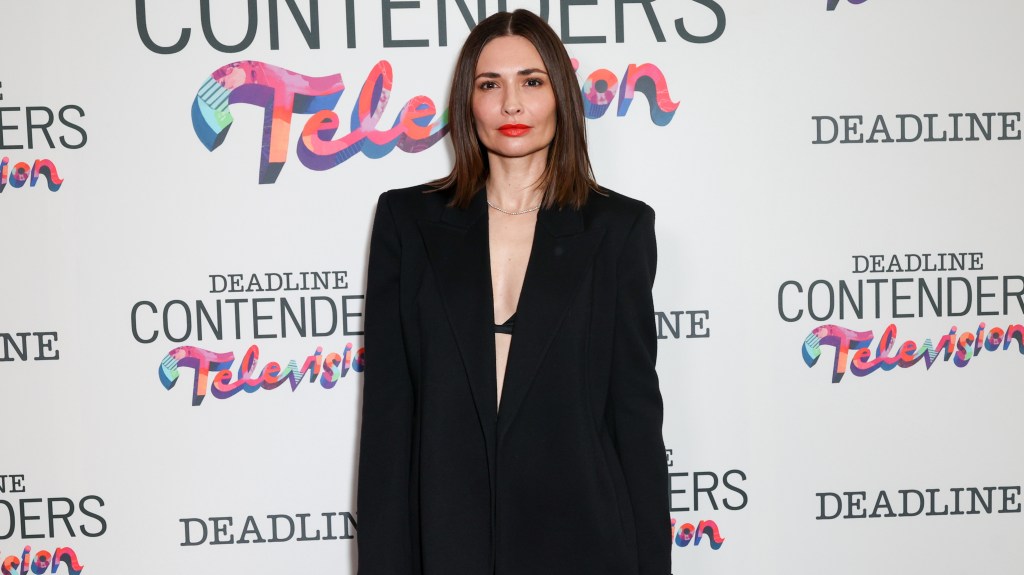
Karolina Wydra of “Pluribus” at the 2026 Deadline Contenders Television held at Directors Guild of America on April 25, 2026 in Los Angeles, California.
Speaking of acting techniques, you did mindfulness work to tap into Zosia and how detached from emotion she can be. Did playing her teach you anything about yourself?
Being a mother, the beauty that I was able to give to Zosia is that unconditional love and understanding truly, viscerally, what it means to love something, someone, so unconditionally. And what a beautiful gift that has been for me and being able to share that with Zosia, because that’s what she does for Carol, to love her that deeply and that profoundly. I do dream work too, tapping into the subconscious and going to swim into those waters has been magnificent.
I had a conversation the other day; we were talking about how characters come to you as a gift, and Zosia was a gift in the sense that she made me pause and think and not be reactionary. She holds space, and she’s there for Carol, and she’s able to take in all of her emotions and not be affected by them. But there [were] also challenging moments for me to play, physically, because it was going against my natural instincts as an actor, as a human. Because if you start yelling at me, I would: ‘Ah!’ I would be, like, fight or flight.
The Others have memories of all these things, but [the emotion] doesn’t live in their body. They have this contentment and blissfulness and happiness about them. They are unflappable, but they’re also beings of love. Everything is very calculated, too: every movement, every physical behavior, even the way I stand. When I started working on her, I started to [put] my hands in front of my body. Sometimes, because I slouch, [Vince’s] like, ‘Straighten your back,’ so I’m more inviting and more pleasant. There’s no threat, so [thinking about] the physicality that goes with it.
They’re very lawyerly. They have the best lawyer in the world in their consciousness. I speak very proper. The words that I use, the nuances of every chosen word to tell the story, to then Episode 8, where I start to be more relaxed in my vocabulary. I say ‘yeah’ instead of ‘yes.’ Everything is done for a reason.
Carol’s really suffering in certain moments, and there’s a knee-jerk instinct to be empathetic, but there has to be some distance there, as you mentioned. When the camera wasn’t rolling, were you and Rhea able to support each other as scene partners, or did you live in that space?
When the camera was not rolling, we would literally joke around all the time, which was awesome. We just had the best time.
We had to have a donut every day. And I never ate donuts before, but she would have to have half a donut, and then I would jump on, and I would have a whole donut, or we would split a donut.
What kind — that’s the real question.
She likes it very simple. She doesn’t like anything with cream inside.
Me neither.
Oh, yeah, you should talk about that [with her]. But she hates anything that’s stuffed with other things. I don’t; I’m all about it. I would try different ones, but that was a daily donut eating experience. And I’ve never had so many donuts in my life, and funny enough, I haven’t had a donut since.
Well, Season 2 is coming up.
It is. I’m gonna be back on my donut diet.
Which is my perfect segue: Have you read anything? I know you didn’t want to know what Zosia’s past looked like, but might we find out more of who she is?
I wish I could be like, ‘Let me tell you, Natalie, this is what’s gonna happen.’ I know nothing.
They’re breaking the season, and that’s what’s beautiful: Vince needs his time. You see in his end result, the attention to such detail to tell the story that he wants to tell, and he doesn’t want to be rushed just to put things out there.
The other day, we were at PaleyFest with [writer/director/EP] Gordon Smith and [writer/co-executive producer] Jean Carroll. I’m like [with a raspy voice], ‘You guys, something? Anything? Any crumbs? Ideas?’ They’re like, ‘Sorry, babe, no.’
But I’m excited. I can’t wait to be reunited again, because I’m just dying to be with the whole cast. [It’s like] when you have a favorite author that comes up with their next book, and you just can’t wait. I am curious where Zosia’s background [is from]. I might ask him, maybe, but I might not. I’m curious where that ending goes.
And I’m excited to go back to New Mexico; I really enjoy being there. Have you been?
Actually no, but my friends just went to Santa Fe, and they really enjoyed it. So it’s on my list.
Yeah, you got to come through.
A set visit? I’m just pitching myself.
Let’s do it; put that out there.
Absolutely manifesting that. You’ve mentioned doing multiple takes, different interpretations of the script. As a result, is there a version of Zosia that’s settled in your mind or is she ever-shifting according to what the scene or Carol’s mindset dictate?
That’s exactly it. You nailed it. For the scenes, it’s just always dictated by Carol and the story that we need to tell to provide whatever it is for Carol so that we can get her on board to join us. So whatever — I don’t want to say tactic — is necessary for that. It’s always shifting and moving and evolving.
Zosia is different when she’s with Carlos [Manuel Vesga, who plays Manousos]. She’s different when she’s with Samba [Schutte, who plays Mr. Diabaté]; all the others are different depending [on] who they’re with. When they’re with the Others, they’re connected to the one hive mind and the collective, so they behave very differently. And you see those shifts.
We all had a different interpretation for things in [Episode 8]. The questions of: Is Zosia really falling for her for real? Is it [a] performative thing? Is it because she has all [of] Helen’s memories? It’s just so fun to discover all those things and go on that journey.
Rhea Seehorn and Karolina Wydra in Pluribus. (Apple TV)
Something that was so curious to me was this lack of privacy the Others share. There’s no real individuality, but there’s also no shame or insecurity, like when they sleep in the same gym.
In Episode 2, when I take my clothes off, for instance, they don’t have shame about their bodies. There’s just no awkwardness. My body is a vessel. My connection is a whole other thing to this world. We’re not afraid to die; every memory, every thought is uploaded, so we live forever, but our physicality is just a vessel. We’re not that precious with it. There’s no jewelry, so there’s no monetary value — which, that’d be hard for me, I love my jewels.
But that was a conversation. The simplicity of their clothing is a transition. So the reason why I wear the clothes that I do is for Carol, to replicate a little bit of Helen’s wardrobe and also the character that she created so she feels there’s something familiar, something safe, something where she feels seen. That’s why they choose me to be the one that goes to her.
Eventually clothing becomes: Everybody wears whatever, there is no connection to it. So whatever clothes are there, we would just grab it and put it on. There’s a detachment from all these things that our ego is attached [to], which, it was very revealing to me of how I would not survive in this world. That scene: There’s so many people, there’s so many extras, and everyone [did] such a beautiful job. It was really cool to watch, but I was like, this would be really hard for me, where you’re just like sardines, sleeping next to each other. But there was something beautiful about the efficiency of just caring so much about this planet that they didn’t have the connection to housing, the sizes of a house. Rhea and I would just discuss it, how we would not survive.
It’s super enticing. I can understand, especially those moments where it’s like: There’s no war, there’s no hunger.
There’s no prejudice. Everyone’s tolerant of each other. There’s unconditional love, understanding; there’s peace. People really care about this planet. And people live by their code of: We’re going to do everything to preserve it. While we’re going: ‘Well, no, my life is important to me, and I’m going to destroy whatever it is in my way to preserve my thing.’ And look what’s happening in the world that we live in; it’s really, really terrifying.
Rhea and I were talking about: Not being surprised again, not seeing a show for the first time, not reading a book for the first time. Somebody tells you a great joke, and you’re like, ‘God, that’s really funny.’ And you have that laugh that’s so painful, where you’re just like, ‘That was the funniest thing.’
To not have that would be devastating … There’s just things that would become a lot more muted if people don’t have attachment to anything, which is quite incredible.
This interview was edited and condensed for concision and clarity.