
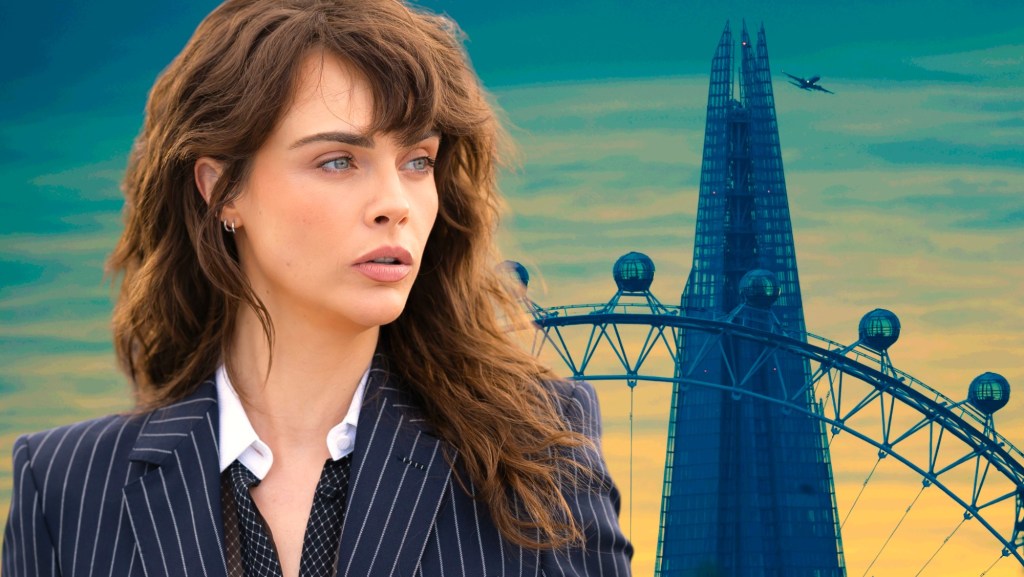
Like the tip of a spear thrusting from the London skyline, The Shard has become an appealing landmark for filmmakers over the years. Jon Watts staged the climactic scenes of Spider-Man: Far from Home around the skyscraper. Christopher McQuarrie filled the screen with shots of The Shard for Mission: Impossible – Fallout. And the tower was poised to become the centerpiece of The Climb, a British indie film that cast Cara Delevingne as a fearless eco-protester who scales Western Europe’s tallest building.
The Climb’s producers spent around three days shooting sweeping aerial shots of London, but the vertigo-inducing footage only served as a metaphor for the free-fall the film experienced within weeks of pre-production. The Climb ultimately collapsed, owing furious crew and suppliers more than £300,000 ($400,000) in unpaid wages and invoices. The demise is hardly a unique story in the indie film universe — high-profile British productions like Simon Pegg’s Angels in the Asylum have gone down amid similar rancour — but this has not dimmed the sense of injustice felt by those who lost money.
There are duelling accounts about what went wrong with The Climb’s funding and the ill-fated decision to press ahead with pre-production. Crew members believe that blame should be shared equally between producers and financiers, with some describing it as a cautionary tale. Ultimately, The Climb may be down, but it’s not out. Sources said director Hayley Easton Street (Something in the Water) is hopeful that a U.S. producer can help the film overcome the unfortunate tangle that left people out of pocket.
Protest Passion Project
The Climb was first unveiled by Beta Cinema at the European Film Market in February 2022, with Delevingne (Carnival Row) attached as a daredevil climber who protests against oil drilling in the Arctic by ascending The Shard. The film is inspired by the true story of six female Greenpeace activists who scaled the building in 2013. Easton Street, an experienced VFX art director with credits including Star Wars: The Force Awakens, wrote the script and was on board to direct (she declined to comment for this piece). There was significant interest, with Beta pre-selling into multiple European markets. Delevingne was a particular draw, while other cast included Hannah John-Kamen and Hero Fiennes Tiffin.

Greenpeace protester scales The Shard in 2013 (credit: Greenpeace)
When The Climb was introduced at EFM, it was teased that the movie would be filmed using “virtual production” technology, which essentially involves shooting live-action scenes against an LED screen featuring digital visuals. The hope was to create a cinematic experience on a modest budget, but some accuse those involved in delivering the technology of taking a central role in The Climb’s ropes unravelling.
Dimension Studio, a UK-based virtual production company run by Steve Jelley and his then business partner Steve Griffith, signed up to provide The Climb with its facilities. Jelley and Griffith also had an agreement with producer Eclipse Films to fund the £15M feature through their other venture, Singularity Entertainment. The Steves were based in a Great Portland Street office shared with VFX giant DNEG, where they eventually welcomed Sigmund Film, the special purpose vehicle company through which The Climb would be produced.
“You walked into those offices, and you were struck by all these images of James Bond and massive action movies. You immediately think: I feel safe,” said a crew member who worked on The Climb.
Sigmund Film was founded in September 2024 and prep work on The Climb started swiftly. Two years on from originally signing, Delevingne’s schedule no longer worked, meaning The Climb turned to another lead: Ivanna Sakhno, star of Ahsoka and M3GAN 2.0. Set designers were hired and dispatched to Rome to recce Dimension’s LED facilities at Cinecittà Studios, where a 25-metre-wide screen hugs a giant revolving stage. Around the same time, The Aerial Film Company and The Helicopter Girls were scrambled into the skies of London to capture shots of the city and The Shard. Securing such permissions is not straightforward, and the footage would serve as the backdrop to the scenes filmed in the virtual production studio. Designers even created a fake London news network for the film.
The Shard in 2020 (credit: Getty)
The flurry of activity all pointed to a project that was firmly in motion, but things ground to a halt in a matter of weeks. The Climb’s financing never materialized, prep was ceased, and by January 2025, the whole venture collapsed when rights to the film lapsed. Almost as soon as The Climb had begun its ascent to the screen, it had come crashing down. The chain of events that led to this moment is contested, with those involved denying culpability.
Conflicting Accounts Of Collapse
In written responses to Deadline questions, Singularity and Dimension boss Steve Jelley said Eclipse Films never satisfied its “conditions precedent,” a set of tasks a producer must complete before financing is released, including signing off a budget and cast. Jelley added that Singularity and Dimension were not consulted on the decision to begin prep and “had no idea” the production was spending money it did not have, despite crew members being housed at its offices. “Singularity and Dimension acted in good faith and provided to Eclipse everything that they were entitled to,” Jelley added.
Eclipse managing director Andrew Berg said Singularity committed to “fully fund” the film and signed a “deal term sheet,” according to an email he sent crew members who lost money in December 2024. “It has been incredibly drawn out and ridiculous,” he wrote of his dealings with Singularity/Dimension. In the same email, Berg added that Singularity was involved in “every step” of getting production underway, including setting up Sigmund Film and its bank account. In short, his position is that fulfilling the “conditions precedent” was a collective effort and Singularity was along for the ride.
Deadline has seen evidence that Singularity helped Eclipse secure a loan for pre-production. Singularity was also involved in communication about budget, not least because Dimension planned to supply the virtual production tech, which, along with VFX, was due to cost more than £6M, per a draft spending plan seen by Deadline.
A 2024 still from Dimension’s virtual production facility at Cinecittà Studios (credit: Dimension/YouTube)
Crew members point the finger of blame at both financier and producer. “There was never the slightest doubt [Singularity/Dimension] knew what was going on all the time,” said one freelancer. Another creative added: “Eclipse Films started us up, almost on a whim, on the promise of the money, just hoping that it would all come through … They decided to risk it all.”
Eclipse had the rights to The Climb for six years and initially planned to shoot in early 2023, but by January 2025, the film reverted to director Easton Street. Efforts were made to extend, but trust had broken down because debts to crew and suppliers had not been settled, and financing was not guaranteed. Easton Street was also said to be working for months without pay. In March 2025, Singularity made an offer to pay The Climb’s team 30% of what was owed, with the remainder being transferred on the first day of principal photography — but only if Easton Street handed over rights to the film. This offer was rejected by those owed money, some of whom believed Easton Street was being held to ransom.
Sigmund Film was liquidated last summer, owing £340,019 to crew and suppliers, including £61,000 to The Aerial Film Company, which captured dramatic shots of The Shard. Individual freelancers were owed tens of thousands of pounds at what was a perilous moment for the independent film sector. One person left out of pocket summed up the mood like this: “Play your film financing games by all means, but don’t hire crew if you haven’t got the money — that’s really nasty, and you should be exposed. It’s what makes this industry so volatile.”
Beta Cinema was another of the losers. The sales house sunk money and resources into packaging, marketing, and pre-selling the feature. Pre-sales did not close, meaning buyers have not lost cash, but a source said Beta was disappointed that it was unable to deliver a finished film for partners. Beta declined to comment.
Sympathy For Suppliers
In his December 2024 email, Berg, the producer for Eclipse Films, said he was “incredibly sorry” for how the project unfolded. Eclipse also lost money, with the insolvency report showing that the company was owed nearly £80,000. Berg, whose previous credits include 2017 Imelda Staunton pic Finding Your Feet, declined to comment.
In response to Deadline questions, Singularity’s Jelley said: “Dimension and Singularity have sympathy, especially for the individual crew members, and all the suppliers that have lost money. When the situation came to light, all parties tried to help address the issues, even if they were not of our making. The producer is responsible for paying the crew.” Jelley added that lessons had been learned from The Climb. Dimension now only takes on prep work under agreed contract terms, while Singularity required producers to “provide transparency” on financial commitments before discussions take place about funding.
Luke Newton and Lucy Hale will star in ‘White Mars‘
David Urbanke/Claire Leahy
Singularity has another known project: White Mars, a sci-fi feature film starring Bridgerton’s Luke Newton and Lucy Hale (Pretty Little Liars), which has also made use of Dimension’s virtual production tech. The film is in post-production and is expected to reach the screen, but it’s not been without difficulty. “That was also a very complicated movie,” said a source familiar with the process. “The [Dimension] technology is so advanced that it’s not like making a traditional film, and there was a lot of suck it and see.”
Easton Street retains the rights to The Climb and has been developing the project in America, with tentative conversations being held with potential backers at the Cannes Film Festival. The Climb may have taken a plunge, but there is hope yet that it can rise from the ashes, even if those who lost money are unlikely to ever be repaid.
If you would like to get in contact with the author of this story, please email jkanter@deadline.com.