
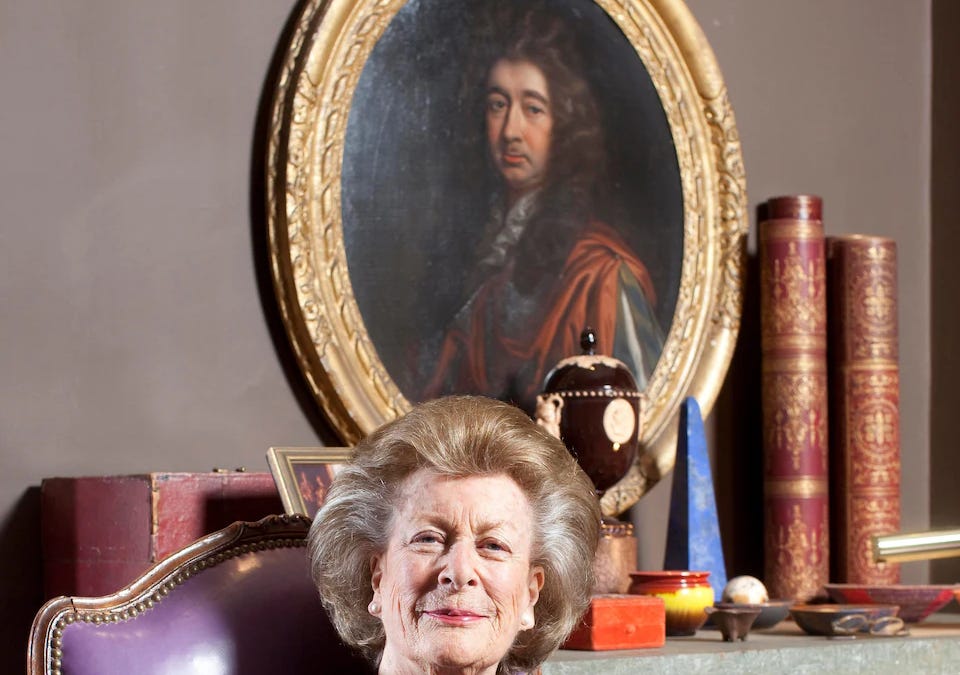
 Lady Pamela Hicks in the sitting room at Albany on Piccadilly in London, her home for more than three decades
Lady Pamela Hicks, who died last week at age 97, was royal several times over: a first cousin of Prince Philip, third cousin of Queen Elizabeth II, and great-great granddaughter of Queen Victoria. Born Pamela Carmen Louise Mountbatten on April 19, 1929, she participated in and witnessed momentous events in the British royal family starting in the 1930s when she grew close to then Princess Elizabeth and her sister Princess Margaret. Elizabeth was three years older, and Margaret was a year younger. By the time Pamela (nicknamed “Pammy”) was in her teens, she had observed and heard a great deal. Her keen powers of observation continued well into her tenth decade.
 Far right: Lady Pamela Mountbatten as a bridesmaid at the wedding of Princess Elizabeth to Prince Philip, November 20, 1947
In November 1947 she was a bridesmaid at the wedding of Princess Elizabeth and Prince Philip. By then she was living in South Asia where her father, Lord Louis Mountbatten, was serving as Britain’s last Viceroy overseeing India’s independence and partition into self-governing India and Pakistan. Four years later, in February 1952, she was with Elizabeth and Philip in Kenya when King George VI died and the princess became Queen Elizabeth II. Lady Pamela accompanied the new Queen and Philip on their six-month tour of 13 Commonwealth countries after the coronation in May 1953. In 1960 she married interior designer David Hicks, and after their first child, Edwina, was born on Christmas Eve in 1961, the Queen served as a godmother at the christening.
 Lady Pamela Hicks holding her daughter Edwina with her godmother, Queen Elizabeth II, at the christening in 1962
“The boat hadn’t even left the harbor”
Hers was a charmed life marred by an unspeakable tragedy on August 27, 1979, when her 79-year-old father, by then 1st Earl Mountbatten of Burma, was assassinated near Classiebawn Castle, the family’s estate in the Republic of Ireland. Also murdered when an IRA bomb blew up her father’s fishing boat were her 14-year-old nephew, Nicholas Knatchbull, a 15-year-old local boy named Paul Maxwell, and her older sister Patricia’s mother-in law, 83-year-old Doreen, Dowager Lady Brabourne. Patricia, her husband John, Lord Brabourne, and her son Timothy, Nicholas’s twin brother, were severely injured. Pamela was at Classiebawn, and as she recounted to me, “I didn’t hear the explosion. My children heard it. The boat hadn’t even left the harbor. Patricia was unconscious in the water. John was less hurt but had many broken bones. He was conscious, though. Timmy was hurt, and Nicky and my father were dead.” (Doreen Brabourne died later in the hospital).
Lady Pamela took the tragedy with her usual resilience, a trait she had learned in a peripatetic childhood. She went on with life with dignity, informality and charm. I discovered that her perceptive and often amusing recollections humanized the members of the royal family she knew intimately as relatives as well as cherished friends. Starting in 2008, she and I had a series of conversations, and I quoted some of her observations in three of my books. Elizabeth the Queen: The Life of a Modern Monarch, Prince Charles: The Passions and Paradoxes of an Improbable Life, and George VI and Elizabeth: The Marriage That Saved the Monarchy.
None of her bracingly outspoken comments were off bounds. As so often happens, I could only include in my books a portion of what she told me. By way of a tribute to her long and eventful life, I’m sharing with my Royals Extra readers more of her insights and vivid descriptions for the first time. Today’s installment will focus on Queen Elizabeth II and Prince Philip, including highlights of the famous Commonwealth tour, her thoughts on the royal couple’s relationship, and the Queen’s complaint about her dentist. Next week I’ll recount Lady Pamela’s views on King Charles’s sensitivity and quirks when he was the Prince of Wales, Princess Diana (not a fan), and Queen Camilla (suitable and usefully bossy), as well as King George VI and Queen Elizabeth (his leadership and her invaluable support).
“Handsome and rather stout”
Lady Pamela and I first met in September 2008 at Albany, the exceedingly private apartment building on Piccadilly in London where she lived in a “set” (the Albany term for apartment) that had been decorated by her husband David, who had died in 1998. It is an intriguing sanctuary dating from the eighteenth century, the home of politicians, writers, academics and other prominent figures. To reach Set 1-3 on the first floor, I climbed a narrow stone staircase. At the front door, Lady Pamela greeted me, looking “handsome and rather stout,” as my notes recorded.
 The sitting room in Lady Pamela Hicks’s set at Albany in London
“Classic David Hicks,” I wrote, “a sitting room with brown walls, a high ceiling, and odd touches like purple leather upholstery on the chairs. Decorating the walls and tables were oval portraits and classical pieces, with a bust of Lord Palmerston above the mantelpiece.”