
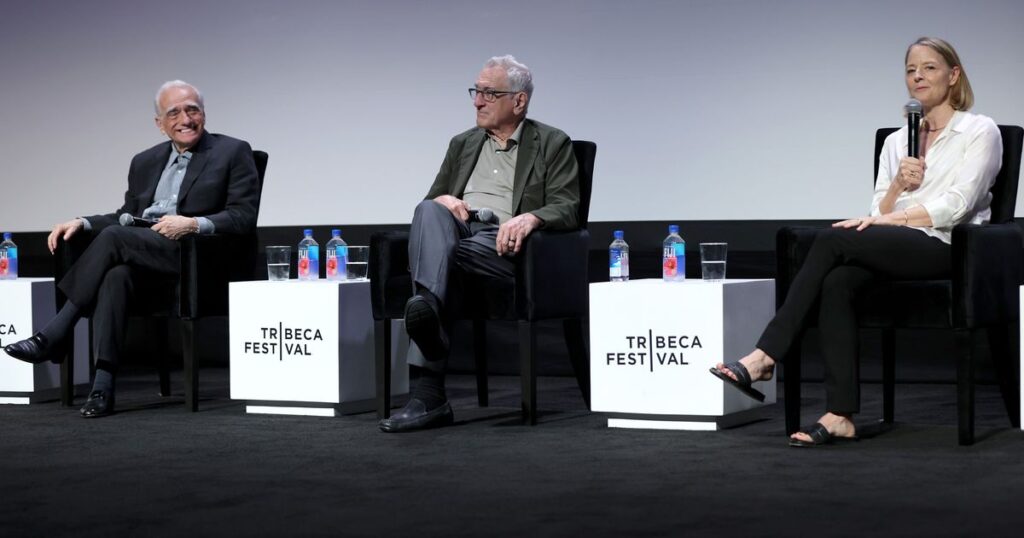
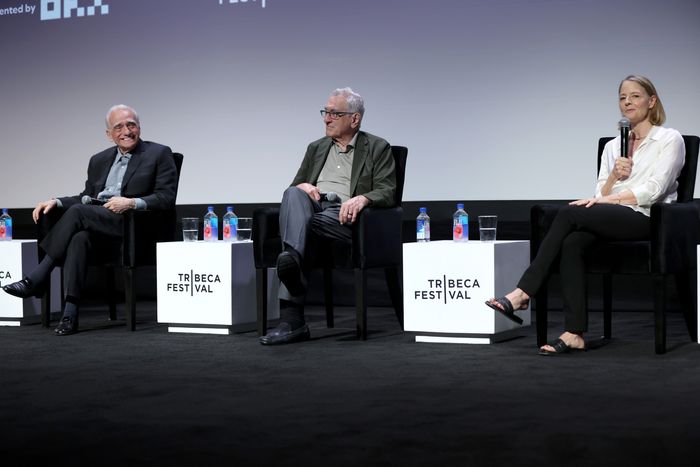
Photo: Dominik Bindl/Getty Images for Tribeca Festival
“So, Taxi Driver’s about a disaffected young man who has problems connecting romantically with women and hyperfocuses on politicians in the wrong ways and wants to be the hero in his own story but is clearly wrongheaded about it. Why do you think this is relevant today?”
On that note, moderator W. Kamau Bell kicked off a spirited, 30-minute, pre-movie Q&A ahead of the Tribeca Festival 50th anniversary screening of Taxi Driver, director Martin Scorsese’s howl of loneliness, despair, and violence — a film that is both a potent time capsule of a New York City that no longer exists and a psychological profile of a kind of young man who is still very much with us.
“I mean, you have no idea what impact the film will have later on,” said star of the film (and co-founder of the Tribeca Festival) Robert De Niro with a shrug. “It just has something that I’m not sure that I can relate or explain to now, what’s going on today — but then I do understand that people are lonely. Especially today with the internet, especially after the pandemic, as far as being alone, being more isolated, getting into their own worlds, getting into worlds that they shouldn’t get into, being turned into something, just getting obsessed with something, whatever that would be.”
Not that any of them thought they’d still be talking about this movie, and their motivations for making it, half a century later. “Taxi Driver, I thought, was a labor of love, and nobody would see it, you know.”
Screenwriter Paul Schrader, also in attendance, recalled writing the script after going into the hospital with an ulcer, the result of a state of loneliness and isolation quite similar to Travis’s. He settled on the metaphor of the taxicab as a “yellow coffin” that his protagonist was sealed inside, he said.
The personal nature of that pain came through in the script. Reading it, Scorsese remembered, he felt that “the script is so tight and so strong … each page was like a razor blade. You had to be very careful. And I said, ‘I could do this, I know this, I know who he is.’” De Niro agreed. “I identified with Travis in ways,” he admitted.
And yet, if they identified with him too strongly, and made the character too sympathetic (rather than empathetic), they’re paying tribute to a monster. Co-star Jodie Foster pinpointed that tricky balance. “The truth and the beauty of Travis Bickle’s character, I think, is that he presents an idea of this meaning that he wants and he wants to be a part of, but there’s no real self-understanding,” she explained. “He just allows the eyes to witness his descent, his unraveling, and his attempts to connect, and he doesn’t really understand himself. And I think that’s the anti-hero, that’s the draw of the anti-hero.”
“It was falling apart,” Scorsese said of the city circa 1975, and that’s not an overstatement. Taxi Driver was shot during a sweltering summer heat wave, which only exacerbated the garbage that was piling up on the streets due to a sanitation strike. New York City was perilously perched on the brink of bankruptcy, and massive cuts were implemented to city services in a doomed attempt to balance the budget.
But within that chaos, creative people were thriving. “It was alive!” Schrader said with a gleam in his eye. “I came here in ’66, and I remember sitting on the curb at MacDougal Street … and saying, ‘This is the greatest fucking place on earth.’” And ultimately, the creativity and the chaos gave Taxi Driver its distinctive flavor. “There was something in the shoot of this film; you could feel the temperature, you could feel a kind of violence all around you,” Scorsese said. “Like in Do the Right Thing, in a sense, you really felt it all around at night — and we were out at night most of the time — and you could taste it in a way. It permeated the picture.”
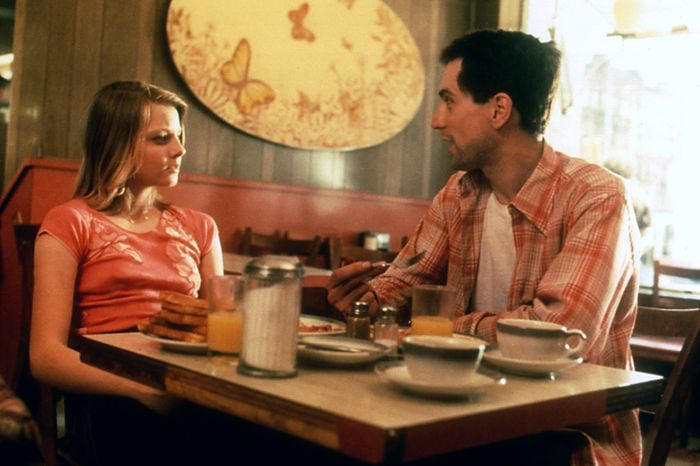
Jodie Foster and Robert De Niro in Taxi Driver.
Photo: Courtesy Everett Collection
“I was a bit of a witness — I mean, I was only 12 years old when I made the movie,” Foster explained. “Being on set with these guys, being in this moment with those guys, was just such a gift. And at the time I’m not sure I 100 percent understood that, but I was watching and listening, so I probably remember more than everybody.” She remembered De Niro taking her to a diner, like the one in a scene they share, and going over the script, and then sitting in silence. “And then finally he introduced improvisation,” she recalled, “which I’d never done before, didn’t understand, and it was like a lightbulb went on in my head. I remember getting all happy, and I came home, came up the elevator, and came to the hotel, and knocked on the door, and I said to my mom, ‘Oh my god, I think I might want to be an actor. This is amazing.’ I thought acting was just saying words people wrote. I had no idea that there was anything more to it.” And then, directly to De Niro, she continued, “You probably didn’t realize that at the time, but it was a life-changing opportunity for me.
“I got to look over the shoulder of these extraordinary filmmakers, extraordinary directors,” she continued, “and say, ‘Why did he do that?’ ‘Why did he say that?’ ‘Is that true, or is that true?’ And that really was my film school.”
“It was not in the script,” Schrader said, about Taxi Driver’s most-quoted line of dialogue. “Bob asked me about it once, and I said, ‘Well, it’s just like a kid who’s 8 years old, standing in front of a mirror with his cap gun, going bang, bang, bang, bang, bang. He’s talking to himself.’ And I never elaborated on what exactly he was saying — I figured, you know, that was up to the actor; the actor’s job is to come up with something. So that was the last I heard.”
“I remember just being on the floor with earphones on, and you just started playing with the gun, and then this stuff started coming out,” Scorsese said. “And I remember saying a couple of times, ‘Yeah, do it again, do it again’ … You got into kind of a trancelike state.”
There have, through the years, been theories about where the ad-lib came from — that De Niro picked it up from a Bruce Springsteen concert or from a New York underground comedian. But for the record, when asked directly, De Niro cleared the air: “I came up with it.”
“What advice would you give to young filmmakers in the audience?” is a fairly standard closing question at a film festival Q&A, but with this group of people, it’s still going to yield some gems. “Don’t copy anybody,” Schrader advised. “There’s a hundred thousand people who can do exactly what you were trying to copy. If you have anything left in you, any nugget of original knowledge, that’s all you have to give. So mine it, explore it.”
Scorsese shared a bit of wisdom from Schrader about working in the Hollywood system: “You say, ‘Put me in that lion cage, give me a whip, give me a chair, I’m gonna beat these’ — and sometimes you win, and sometimes the lion wins.”
“We have all the technology, you can do anything, really, and there are no excuses anymore,” Scorsese said. “But the key thing is your own will. The will to do it and not be shaken by any hindrance at all … Because in a sense, what makes a film a hit? Nobody knows.”
Sign up for the Vulture Daily
An entertainment newsletter for the pop-culture obsessed.
Vox Media, LLC Terms and Privacy Notice
See All