
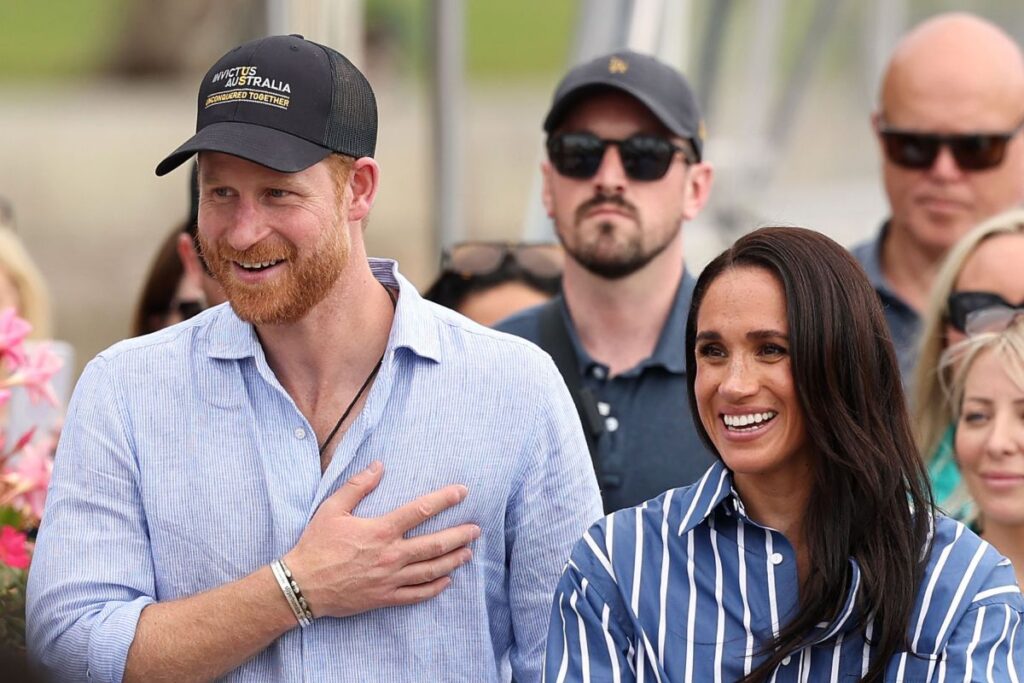
Press reports that Prince Harry and Meghan Markle have been victims of a double standard over a security gate being built at the home of Princess Kate’s sister conflate two very different areas of government.
The Duke of Sussex has been campaigning since 2020 to get his Metropolitan Police bodyguards reinstated after they were removed when he quit the palace to begin a new life in America.
More recently, James Matthews, the husband of Kate’s sister, Pippa, has been under pressure from a local hiking group after installing a security gate on the couple’s country estate. The conflict is being reviewed by a planning inspector.
Read More on Analysis
 Why It Matters
Several reports have suggested that Harry and Meghan were angered by an apparent double standard. However, Newsweek understands that the Sussexes have not been briefed on the issue and have expressed no view.
Additionally, much of the reporting does not make clear that the two decisions are fundamentally different, engaging different areas of law and different areas of government.
Suggestions of Security Double Standard
Pippa and James Matthews moved into Barton Court in the fall of 2022 and installed a new gate on their land to enhance security, prompting an objection from walking group West Berkshire Ramblers, who argue that it blocks what was effectively a public footpath. The Matthews’ lawyers dispute this.
The local council triggered an inquiry by the planning inspector, who heard arguments between the two camps on June 3. The BBC reported that planning inspector Ken Taylor said he expects to reach a decision by August.
Following the inquiry, several reports suggested that the gate had effectively been approved and framed the dispute as evidence of a double standard compared to the treatment of Harry and Meghan.
Radar ran the headline: “Royal Family Rift Deepens as Meghan Markle and Prince Harry Are ‘Infuriated’ by Security Arrangements Linked to Kate Middleton’s Sister Pippa.”
The story quoted an anonymous source. The couple has never commented publicly on the Matthews family or their gate.
The Daily Express followed up with: “Prince Harry and Meghan Markle’s ‘fury reignited over Pippa Middleton security battle,'” while Sky News Australia went with: “‘Double standard’: Prince Harry and Meghan Markle ‘infuriated’ after Pippa Middleton secures luxury Berkshire estate with electric security gates.”
None of the reports noted that the planning inspector had not yet reached a decision. Not only has the inquiry not seemingly returned any result, but the two disputes are very different.
Newsweek approached the West Berkshire District Council and a representative of the Sussexes for comment.
Pippa and James Matthews and Their Security Gate
It is true that James Matthews has argued that he needs the gate to protect his family’s security and privacy, which are clearly linked to his wife’s status as the sister of a future queen.
However, the planning inspector is not assessing what level of security the family deserves. In Britain, there is a “right of way” that grants the public permission to walk on private land under certain circumstances.
The dispute does not concern whether the Matthews family should have security, but whether the location of the gate interferes with a claimed public right of way. The key legal question is whether the pathway has been used openly and continuously by the public for at least 20 years—a threshold that can establish a right of way under English law.
If the inspector finds it has, he may rule that the gate blocks a public path. If he finds it has not, he may rule that the gate can stay. Either way, it is a planning matter rather than a security determination.
Quoted by the Evening Standard in May, Matthews said: “There are implications for my family, due to their high public profile, which means there is a need for a higher level of security than would otherwise be the case if the circumstances were different.
“Therefore to improve security for my family, before we moved in, I arranged for an electric security gate to be erected on the drive.”
“In the period after the footpath application, unfortunately there has been a continued need to enhance security and the gates at Station Road have therefore been upgraded in the summer of 2025 and kept closed.”
It is this statement that appears to have formed the basis for the stories alleging a double standard.
Whether the inspector is persuaded by Matthews’ argument about security or not, the West Berkshire District Council previously outlined the terms of the inquiry, saying it was focused on “the legal principle that a public footpath can be deemed to exist if it has been enjoyed by the public for an uninterrupted period of 20 years, without force, secrecy or permission, or if evidence infers that a public footpath has been dedicated by a landowner at some point in the past and that dedication has then been accepted by the public (i.e. by being used by the public).”
In reality, the only decision so far officially reached was by the council, which determined that the inquiry would be necessary because, according to a notice seen by Newsweek, evidence “shows that a right of way…subsists or is reasonably alleged to subsist over land in the area,” suggesting it is a “public footpath.”
Far from giving the Matthews family special treatment, the council therefore appears to have given a boost to the campaign against the gate. It will be up to the planning inspector to determine whether he agrees.
Prince Harry’s Police Protection Dispute
Harry brought a judicial review against the British government over the removal of his police protection team in 2022 and lost in May 2025 when the Court of Appeal upheld an earlier decision by the High Court.
The case focused on whether the decision-making process was lawful, including whether, as Harry’s legal team argued, an additional risk assessment should have been carried out.
Home Office lawyers argued that Harry had previously been granted a police team because he was a working royal representing the Monarchy, a status he lost when he quit.
They further suggested that leaving Britain took him out of the cohort of people considered eligible for police protection, but that a bespoke system had nevertheless been created through which bodyguards were sometimes granted on a case-by-case basis for specific visits to the U.K.
Sir Geoffrey Vos, Master of the Rolls, the second-most senior judge in England, wrote the Court of Appeal judgment, seen by Newsweek, and acknowledged Harry’s strength of feeling in disagreeing with the decision.
Vos added: “None of that disagreement supports a legally sustainable public law claim to vitiate the decisions taken in the decision letter or subsequently. Those decisions were taken as an understandable, and perhaps predictable, reaction to the Claimant [Harry] having stepped back from Royal duties and having left the UK to live principally overseas.”
After the Court of Appeal upheld the government’s right to strip Harry of the police officers, the prince gave an interview to the BBC saying there was a “good, old-fashioned establishment stitch-up” and suggested that his father, King Charles III, had blocked his efforts: “I never asked him to intervene—I asked him to step out of the way and let the experts do their jobs.”
Analysis
Beyond the fact that the planning inspector does not appear to have returned a decision in the gate dispute, the news reports about a double standard treat the two processes as if they are assessing the extent to which two different royal couples deserve security.
In reality, the Matthews family is locked in an argument over the intricacies of English planning law, while in Harry’s case, the Home Office was tasked with working out how to deal with a situation that the existing rules had not anticipated.
Harry told Oprah Winfrey and wrote in his book, Spare, that he never imagind his police team would be removed, even when he moved overseas.
By the time the case got to court, his lawyers had abandoned this position and instead sought the return of around-the-clock protection while he was in Britain, when they argued that he had returned to the cohort of people considered eligible for as long as he was on U.K. soil.
Ultimately, Home Office officials did not give Harry what he wanted, but they did not completely remove the team either, limiting his protection to specific instances negotiated on a case-by-case basis.
Either way, none of those options are comparable to an inquiry about whether planning laws permit the installation of a gate on a public path sometimes traversed by ramblers at a country house in Berkshire.