
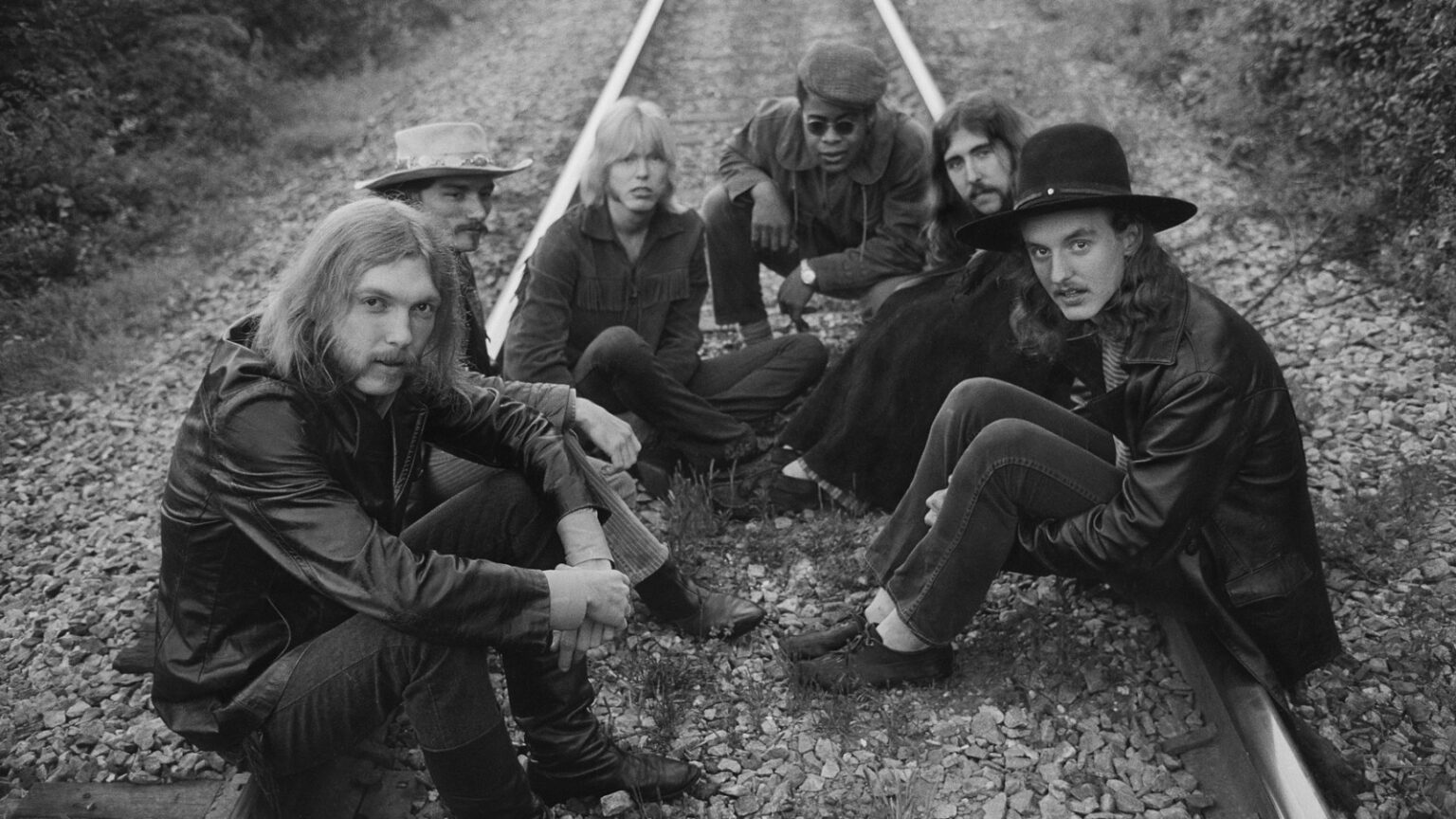
Jaimoe doesn’t have to look too far for a reminder of the past and the friends and bandmates he’s lost. On any given day, all he has to do is glance down at his right calf.
On this particular day, Jaimoe is chilling in a recording studio near his home in Bloomfield, Connecticut, where he’s lived for more than 35 years. Although he’s stout and his scalp is dotted with white hair, he still exudes the formidable intensity of his early days as the co-drummer and percussionist with the Allman Brothers Band. Gripping a pair of drumsticks, dressed casually in a T-shirt and leisure slacks, he’s recalling the bond he had with Duane Allman, the band’s walrus–’stached guitarist and guiding light. Like the times they’d visit pawn shops together and unearth guitars and old drum kits. Then Jaimoe pauses, flashes a quick, playful grin, and rolls his right pant leg up to his knee.
And there is it: the last of the original Allmans band tattoos.
The story — which was documented in a 1971 Rolling Stone cover story — goes like this. The Allmans were in San Francisco, having just played a typically ferocious set at Winterland, when they decided to formalize their bond with the help of Lyle Tuttle, a famed local tattoo artist. In honor of the psychedelic shrooms they’d consume together, they chose a mushroom and had one of each tattooed on their lower right legs. On Jaimoe’s calf, it’s a small, somewhat smudged mushroom that’s darkened in, unlike the more colorful ones the other band members received. “This is the only one like that,” he says. “The ones that were colored, they don’t look anything like this.”
In his time with the Allmans, which was most if not all of the band’s existence, Jaimoe stood out in multiple ways. A jazz devotee before he joined up with the group, Jaimoe instilled the improvisatory looseness of that genre into the band’s blues foundation. “In some ways he’s one of the most defining members,” says guitarist Warren Haynes, who joined the Allmans in 1989 and stayed pretty much through their final shows. “All six of those original guys had distinctive personalities and brought a lot to the table. But what Jaimoe brought was so unique. The Allman Brothers would not have been the same without him. That [jazz] dimension would have been missing. It played such a big role in the sound of the music.”
Editor’s picks
Jaimoe made himself known physically as well. A rare Black musician in the world of Southern rock of the Seventies, he had a muscular physique derived from the days, he says, “when I was from eight to junior year in high school and wanted to be Mr. America.” Combined with his garb, which could include berets and glasses, Jaimoe was simply one of the coolest-looking guys in music. “He was this Black guy playing drums, looking very Black Power with his sunglasses and Army jacket,” says Bert Holman, who saw the original lineup of the band and would eventually become their manager. “He was always this enigma.”
But these days, Jaimoe stands apart in another, more poignant way. With the deaths of Gregg Allman, guitarist Dickey Betts, and band co-drummer Butch Trucks all in the past decade, Jaimoe is now the last surviving member of the first and classic Allmans lineup from 1969. That realization hits Jaimoe periodically, as it does as he stares at his tattoo and recalls how Duane sat on a stool and got the first one. That was only fitting, since he was the founder of the band, but Jaimoe was the first band member Duane recruited.
“I was the first one and I knew I would be the last,” he says after a moment of silence. “Some things you just know.”

Jaimoe with the Allman Brothers Band’s 1977 lineup.
Michael Ochs Archives/Getty Images
Jaimoe will turn 82 next month, and he admits that the last decade or so have been rough. Now pulling up both his pant legs, he reveals a scar on each knee from surgery, then points to his right shoulder. “This is titanium!” he says. “They call me the bionic drummer.” He walks with the help of a gold-plated cane given to him by later ABB recruit Derek Trucks, Butch’s nephew, and his left sclera, which has long been a lazy eye, is more pronounced.
Related Content
Last summer, he was hospitalized for dehydration — the result, he says, of drinking a bit too much wine and beer. “Not knowing I was depleting shit in my body,” he says with one of his occasional boisterous chuckles. He then spent weeks in a rehabilitation clinic, which wasn’t all bad. “They took me to this room with a big-ass chair like an electric chair and put you on it and bathed you,” he says. “That was pretty cool.”
Leaning forward, he points to his lower back, where three screws were inserted during another procedure. “When we did that operation, the doctor said it usually takes about four hours and it took six,” he says. “He said, ‘Man, you’re really tough.’ I said, ‘Doctor, I’ve been sitting on my ass doing this since I was 16 years old. I ought to be fuckin’ tough.’”
Johnie Lee Johnson, as he was known at birth, did indeed begin pounding the skins as a teenager in Mississippi, including in the marching band of his all-Black school. Athletics appealed to him, but music more so, and he eventually worked his way into playing behind soul and R&B acts like Otis Redding, Joe Tex, Patti Labelle and the Bluebelles, and Clarence Carter.
That circuit also led to his nickname, when saxophonist Rudolph “Juicy” Carter looked at the drummer one day and said “Jaimoe.” “I said, ‘Who the fuck is Jaimoe?’” he recalls. “‘That’s you, motherfucker. You’re Jaimoe.’” Jaimoe isn’t entirely sure what inspired Carter to pick that name; maybe he was saluting Bahamian singer Jamo Thomas. But the name stuck, becoming his legal moniker many years later. During a later ABB tour, Haynes watched, amusedly, as Jaimoe checked into a hotel and watched as the clerk was trying to grasp if “Jaimoe” was his first, last, or combined name.
Disillusioned with life on the so-called chitlin circuit, especially the low pay and overall treatment of musicians, Jaimoe accidentally fell into a new life when his friend, singer and songwriter Jackie Avery Jr., began raving about an otherworldly young guitarist named Duane Allman who was recording in Muscle Shoals, Alabama. “I was on my way to New York to become a starving musician playing jazz,” Jaimoe says. “It sounds funny and shit, but that’s what was happening. I was tired of being in rhythm and blues bands.” Jaimoe admits his knowledge of the blues that Allman loved was limited: “I didn’t know a goddamn thing about the blues. And I didn’t want to know anything about it. I wanted to know more about Miles.” But once he and Allman began wailing together on drums and guitar, Jaimoe sensed a new frontier ahead. “Duane was interested in doing this,” he says, raising his right hand in a sweeping motion.
Jaimoe still remembers how he and Allman clicked on multiple levels: “We’d be in the park and he’d find four-leaf clovers. All the time! I had a different relationship with Duane.” The two became the starting point for what would become the Allman Brothers Band, which soon added Betts, Butch Trucks, bassist Berry Oakley, and Duane’s kid brother, the bluesy vocalist Gregg. “People talk about these ‘family bands’ and all that stuff, but the Allman Brothers really was like a family,” he says. “When we stayed in a hotel, our road manager Twiggs would get us rooms where each room had an adjoining door. All the doors were left open so you could go straight down through all the rooms and see everything going on. Anything that was happening, you knew about.”
In the new documentary Gregg Allman: The Music of My Soul, Jaimoe reflects on his chemistry with the singer. “Everything that Gregory was, was fine with me,” he says in the film, which premieres June 17 as a special one-night-only event in theaters. “Because we did what we did together…most of it just being human beings, and unrestricted Black and white brothers.”
Jaimoe (who was called Jai Johanny Johanson in their early album credits) introduced the band to his John Coltrane records, which fueled their long, snaky jams. But the band came close to imploding when Duane was killed in a motorcycle accident in 1971, right after the band’s At Fillmore East album cemented their rock-star status. Jaimoe remembers hearing the news of Duane’s death while he was at a friend’s apartment. In the first of many moments during a conversation, he pauses and mulls for several minutes, and one can feel the weight of history on him, as if he’s still digesting it. “Someone called me and said he didn’t make it,” he finally says, somberly. “I don’t know, man. Life is strange things.”
The Allmans carried on, with the post-Duane Brothers and Sisters album propelling them to genuine superstar stature. But the tragedies and setbacks that would haunt the band for decades more (Oakley died in a motorcycle accident of his own in 1972) also came to include Jaimoe. Starting with an injury incurred when he was tossing around a football with members of Percy Sledge’s band, he began having recurring back pain that affected his relationships with his bandmates. “I was impatient and got irritated easily,” he said at the time.
The Allmans broke up in 1976 after Gregg testified against the band’s road manager, Scooter Herring, who’d been arrested on drug charges. The rest of the group was incensed at Allman, with even the normally low-key Jaimoe issuing a rare public statement, saying, “I can no longer work with or for Gregg Allman, but I still pray for God to help him and all of us.” With Allmans keyboardist Chuck Leavell and bassist Lamar Williams, a school friend who had replaced Oakley, Jaimoe joined Sea Level, a largely instrumental jam band that made several albums.
In 1978, Jaimoe reunited with the Allman Brothers Band again when they reformed, but a few years later, he was fired in a dispute over the band’s business affairs. Jaimoe stayed in Macon, Georgia, where he taught drums and played with a friend in a local band. When the Allmans reunited yet again in 1989 for a tour to promote a box set, Jaimoe was back behind the drumkit. “I may be a drummer, but I’m not a fool,” he says. “I knew that for where I needed to be and where I needed to go and get the things I wanted, that was the best exposure for me right there. More money and better exposure. It made sense to me to be back in the band.”
“He felt vindicated,” says Holman, who says that part of the stipulation for Jaimoe rejoining the band was that he would drop a lawsuit against them.
For the next roughly 25 years, Jaimoe, along with Butch Trucks, held down the beat for the Allmans as they entered a new era. There were creative peaks, especially once Haynes and Derek Trucks injected new energy into the band, but also plenty of ongoing upheaval, culminating in Betts’ firing in 2000. “It had worn itself out,” Jaimoe told RS in 2017 about the situation with Betts. “He said, ‘I need to get myself straight,’ and that’s what he would do. Sometimes Gregory and Butch would say, ‘We’ll get somebody to play until you get back.’ This time he didn’t go get himself straightened out.”
“Jaimoe was always in the middle,” says Holman. “The power base for a long time was Butch and Dickey on one side and Gregg on the other. Jaimoe would frequently go along with the majority unless he felt strongly about it and he’d speak up. Jaimoe understood the concept that what is most important is best for the band. And he said to Dickey, ‘I’m gonna go with the majority.’”
Jaimoe declines to name a favorite lineup of the band, preferring another perspective. “Do you cook?” he asks instead. “You start cooking something or your wife starts cooking something and your daughter comes along and puts something in it, crumbs or water or something. And it changes it. Whenever you mix anything with other things, it’s a different chemical reaction.” Says Haynes of the way Jaimoe handled the turmoil, “There was always shit going on, but he would always have some beautifully philosophical way of looking at it.”
With Allman’s health in question, the Allman Brothers played their final show in 2014. During their last show, Haynes remembers looking at Jaimoe, who smiled and seemed proud of their legacy. “Nobody really changed over the last 45 years or some shit,” Jaimoe told RS a few years later. “We just got better at what we did, or we fucked up. It was always the same.”
Derek Trucks, Butch Trucks, Jaimoe, and Gregg Allman at New York’s Beacon Theater in 2014.
Taylor Hill/FilmMagic
Ask anyone who knows Jaimoe, and you’ll hear the same description: Much of the time, he doesn’t say too much, but one should listen closely when he does. That trait becomes painfully clear when talk turns to the musical Brothers he’s lost in the last decade. He says he was able to talk to the man he frequently refers to as “Gregory” a few times before Allman’s death from liver cancer in 2017. “Gregory called me and said, ‘Hey, bro, when you coming down?’” he says, which itself indicated an urgency. “He never made too many phone calls.”
Picking up his sticks, Jaimoe starts drumming on the couch, then stops and decides he doesn’t want to reveal anything too personal about their last exchanges. “It was sensitive,” he says. “I wouldn’t want to talk about it.” After a pause, he adds, “He was married seven times? Or eight? I remember asking him, ‘Why you want to get married?’ And he said because he didn’t like being alone.”
Jaimoe recalls seeing Betts sitting in the row behind him at Gregg’s funeral, and he says the two made up enough to have a conversation before the fiery guitarist came out of retirement to play a few shows before his own death in 2024. It sounds as if he and Betts found common ground after so many years. “I don’t know how many concerts he did, but I guess he figured out he couldn’t do them or how easy it wouldn’t be,” Jaimoe says. “The thing about talking to somebody is you find out everybody is basically on the same page.”
The death of Butch Trucks, who died by suicide in 2017, brings on a much more melancholy reaction. “I knew there was something [happening] because he kept calling me,” Jaimoe says quietly. He pauses, starts thwacking his drums on the couch where he’s sitting, stops, then resumes again. “Two or three times in four or five hours or something. What does he want? Butchie always wanted something.
“Was he taking Xanax?” he wonders. “That’s a calmer downer or something?” Once again, he pounds out a beat on the furniture and stops. Speaking generally of those who died by their own hands, he eventually says, “It makes no sense. So, I don’t know. Why the fuck did they do that?”
“Butch was a shock,” Holman says. “I think Jaimoe is still struggling with it.”
In the years after the Allman Brothers Band played their farewells, Jaimoe kept busy with his own bands, often in Connecticut, where he moved with his new wife Catherine. (They have three daughters, the youngest 16.) He’s sat in with Friends of the Brothers, one of the leading ABB tribute bands. Lately, he’s been working on a memoir, co-written with author and Allmans historian Alan Paul, to be published next year. He’s also considering more gigs with Jaimoe’s Jasssz Band, his longtime side project, where he gets to not only play jazz but also other styles of American music.
As the last of the original Allmans, especially after Gregg’s death, Jaimoe also felt a sense of unfinished business. It was Jaimoe who reached out to the members of the last, post-Betts incarnation to reunite for a tribute show at Madison Square Garden in early 2020. “He called all of us and said, ‘We need to play, we need to do a show,’” Haynes says. “He’s a man of few words sometimes, so we all listened and everyone had the same reaction, that it needed to happen.” As Jaimoe simply says, “I missed playing.”
Trending Stories
The timing for what was called the Brothers show in March 2020 ended up being tricky: It took place two days before the pandemic lockdown. Yet no one seemed to be happier about the show, where the musicians dug into the Allmans repertoire to a roaring crowd, than Jaimoe. Afterwards, he immediately asked Holman about doing another. “I said, ‘Right now, Jaimoe, the whole world is caving in,’” the manager says. The Brothers did end up doing a few more such shows a couple of years later at the same venue. Jaimoe says another Brothers tribute is in discussion, once all the requisite arrangements with the various Allman family factions are worked out.
If that doesn’t happen, there are always the records to remind him of the heights that Jaimoe reached with the Allmans, which can still ameliorate the sadness. “Every now and then I’m somewhere, in a store or in a car on the radio, and I hear a tune we recorded,” he says. “And I go, ‘What the fuck is that? Where did that come from?’”