
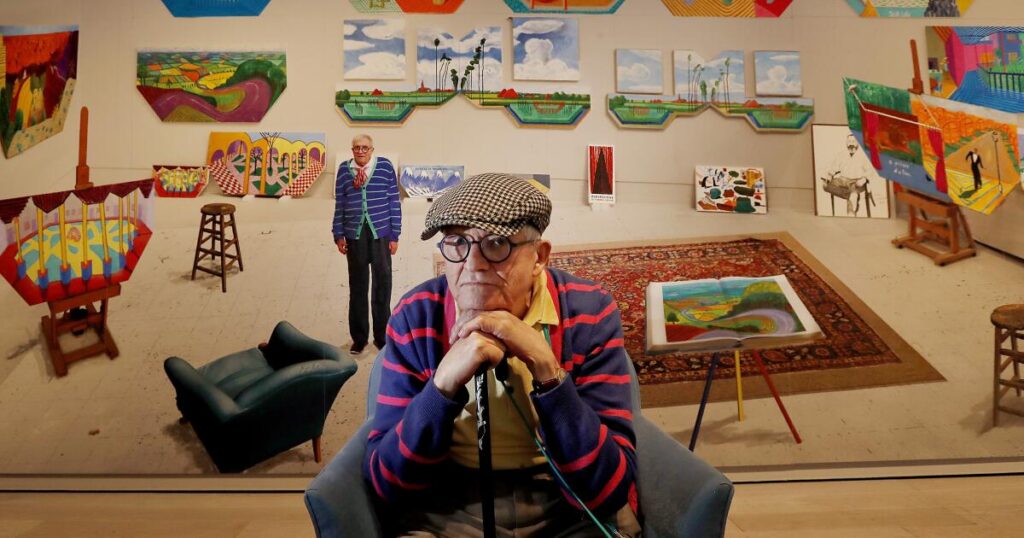
David Hockney, the innovative and prolific British artist who arrived in Los Angeles in 1964, soon celebrating its sun-drenched life and landscapes in colorful, wildly popular paintings, died Thursday at his home in London. He was 88.
His death was confirmed in a statement by his publicist Erica Bolton.
Calling himself “an English Los Angeleno,” Hockney immortalized the city’s sparkling swimming pools, palm trees and beautiful young men, then went on to experiment with intricate photo collages, portrait suites, painted and filmed images of Yorkshire landscapes, iPad drawings and more.
“Los Angeles will always be thought of by many people worldwide through the images that David created,” said Stephanie Barron, senior curator and head of the modern art department at Los Angeles County Museum of Art, which holds more than 150 works by Hockney in its permanent collection. “But for me one of David’s greatest gifts was his ability to look at the world with wonder and joy in whatever medium he decided to work in. … He was fearless in his embrace of technology, and I think that enormous curiosity ran throughout his career, and continued to the end. He was involved in looking at art history and the future simultaneously.”
Barron, who knew Hockney for 50 years, said LACMA staged more exhibitions of Hockney’s work during that time than any other artist. “David considered LACMA and the Tate his two museums,” she said.
Since his Pop Art paintings in the early ‘60s at London’s Royal College of Art, Hockney was rarely out of the limelight and, more importantly, rarely out of fresh ideas for how to draw, paint, film, print, photograph or otherwise express his creativity. The David Hockney Foundation owns more than 8,000 of his works, including about 200 sketchbooks, more than 230 self-portraits, opera designs and portraits of family and friends.
Hockney first visited Los Angeles in 1964 — attracted to its light and leisure and hopeful that it represented a less repressive atmosphere when it came to homosexuality. He moved officially to L.A. in 1976, and in 1978 he rented a multicolored home and studio complex nestled in the Hollywood Hills. There one might find a clutch of art world luminaries at the dining room table, a guest or two in the pool or on the bright blue porch, or, in the studio, a model for his newest opera set. The writer Christopher Isherwood and his partner, artist Don Bachardy, were among his many favored guests.
“For David in the 1960s, Los Angeles was an enigma — a unique city different from his native London or even from New York City where he had his first encounter with ‘America,’” his close friend and fellow artist Doug E. Roberts told The Times last year.
Hockney loved Hollywood — the people and the place — and liked to say he was brought up in England and Hollywood because of the time he spent at the movies. His peroxide blond hair reportedly was inspired when he was a student and saw Clairol TV ads claiming “blondes have more fun.” But it was his interest in everything from Elvis Presley to the Hubble Space Telescope and his sense of humor that set him apart. Time magazine art critic Robert Hughes once called him “the Cole Porter of modern art.”
He was open about being gay, even when homosexuality was outlawed in Britain. His early love affair with artist Peter Schlesinger, a younger man he met when teaching a summer drawing class at UCLA in 1966, inspired Hockney’s monumental 1972 painting “Portrait of an Artist (Pool with Two Figures),” a centerpiece of Jack Hazan’s 1974 film “A Bigger Splash.” The painting’s 2018 auction at Christie’s drew a record $90 million for a living artist.
He was a dedicated reader and student of art, paying homage in his work to Picasso and Cubism as well as to Monet, Matisse, Van Gogh and Cézanne. A lover of opera, he often had it playing loudly in the studio and enjoyed taking visitors on curated car trips through the Hollywood Hills or Malibu while listening to Wagner. He designed sets for major companies in Los Angeles, Chicago, New York, London and elsewhere over the years, and some of his set models were later shown in museums.
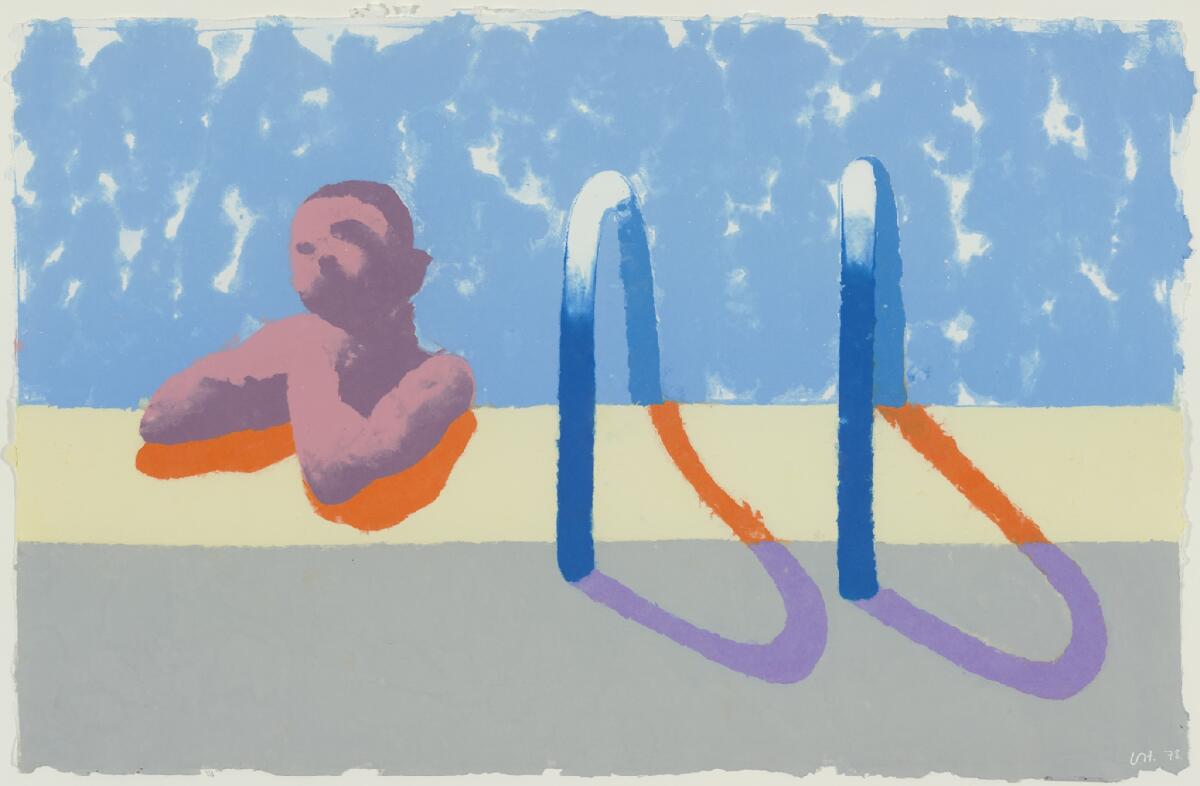
David Hockney’s work “Gregory in the Pool (Paper Pool 4)” was part of his solo exhibition “David Hockney: Perspective Should Be Reversed” at the Palm Springs Art Museum in Palm Springs in 2024-2025.
(From Palm Springs Art Museum)
His solo shows drew enormous crowds to the Los Angeles County Museum of Art as early as 1988. In 2017 a major retrospective of his work, keyed to his 80th birthday, was presented at New York’s Metropolitan Museum of Art, Paris’ Centre Pompidou and London’s Tate Modern. Chronicling Hockney’s arrival as an important artist in the “ravishing” Met retrospective, the New Yorker writer Andrea K. Scott called it “a revelation.” It was, she wrote, “a retort to all the eye-rollers,” including herself, who dismissed his work “as, at best, a guilty pleasure.”
In 2012 he received the coveted Order of Merit, which Queen Elizabeth II presented to him at Buckingham Palace.
David Hockney was born the fourth of five children to a working-class family in Bradford, England, on July 9, 1937. He has said he started “making marks on paper” at 8 and received private painting lessons before moving on to Bradford School of Art in 1953. His father, Kenneth, was a pacifist and a conscientious objector in World War II, which made the family somewhat outcast in its small hometown. Hockney’s mother, Laura, was a devout Methodist who kept a detailed diary that later proved priceless to Hockney’s biographer, Christopher Simon Sykes, who noted that when Laura learned that Hockney was gay she wrote, “I commend my boy to God and leave it to Him to decide.”
The family supported their son in his passionate pursuit of art, and the first painting he sold was a portrait of his father in 1955. He later attended the Royal College of Art in London from 1959 until his graduation in 1962, receiving the school’s Gold Medal.
After college he did not slack off, noted Sykes. In his 2014 book, “Hockney: The Biography,” Sykes pointed out that the artist’s first flat had a chest of drawers near the bed on which he had painted, in large capital letters, the words “get up and work immediately.”
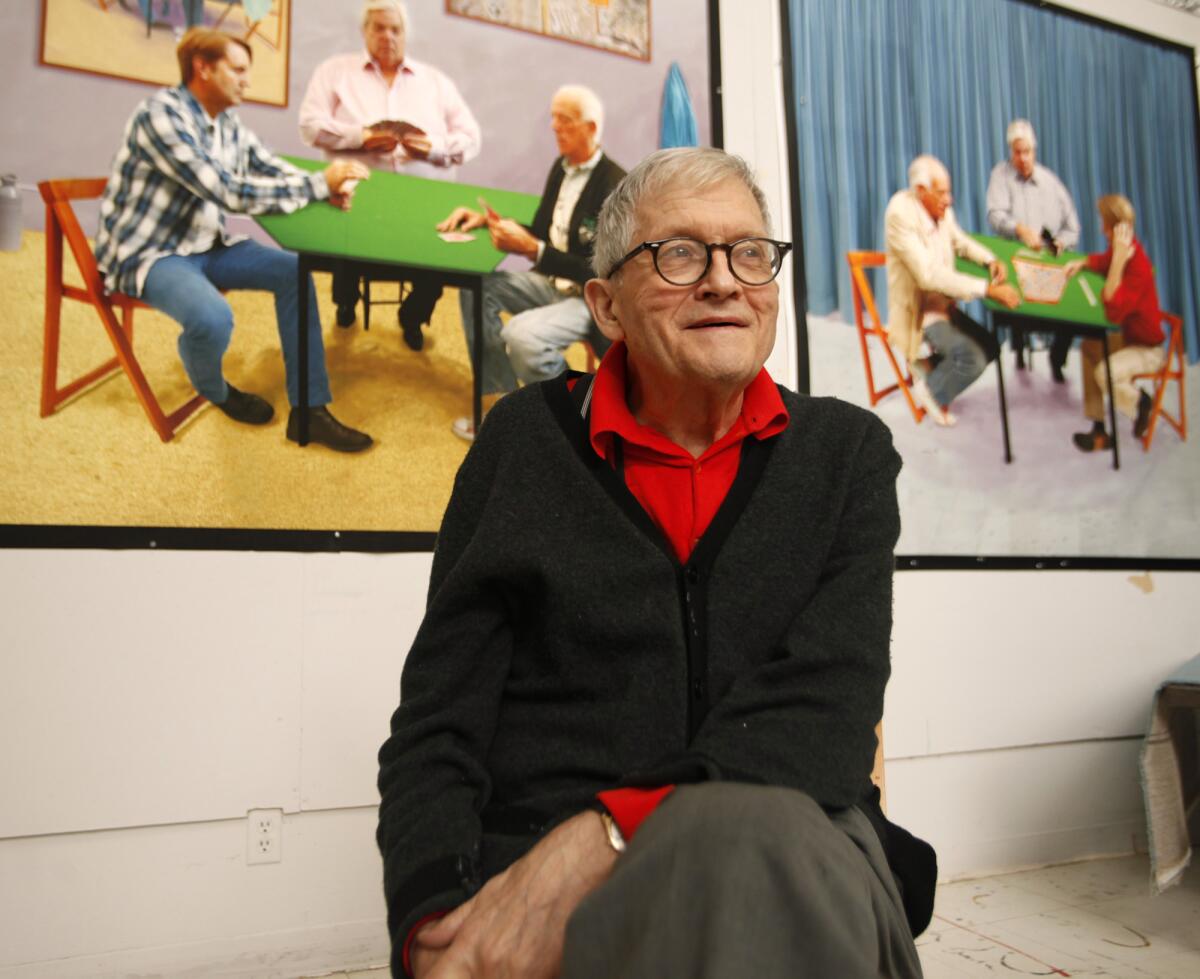
David Hockney sits in his studio in the Hollywood Hills in February 2017.
(Los Angeles Times)
Hockney lived by that command for the rest of his life, turning out canvas after canvas, photo after photo. In the ’80s came his extraordinary multi-image photographic collages of friends including Isherwood and Bachardy and such landmarks as the Brooklyn Bridge, Grand Canyon and Pearblossom Highway.
“The Polaroids started oddly enough when I’d just finished a long period of work in the theater, which is of course playing with perspective and illusion,” he once told The Times. “People say, ‘You are a painter, and photography is a sideline.’ But nothing is a sideline for me.”
That included his continuing fascination with technology. The artist’s long career swept in artworks made not only on cameras and canvases, but on such things as fax machines and photocopiers. Hockney liked to experiment, whether it was with state-of-the-art printing devices or centuries-old painting techniques.
He went several times to a show of portraits by Jean Auguste Dominique Ingres at London’s National Gallery in 1999 and was greatly taken with the photographic quality of Ingres’ 19th century drawings. Certain that Ingres had used something optical to achieve that quality, Hockney bought himself a camera lucida, a small device that works like a prism. He then applied Ingres’ methods — as Hockney imagined them — to his own portraits of friends and family, and in 2001 he published “Secret Knowledge,” exploring his theories on early artistic uses of optical devices.
The artist was an accomplished draftsman, and drawings accompanied nearly every step of his career. He had his inside jacket pockets tailored to accommodate his large drawing tools of sketchbooks, pencils and, later, an iPad. In 2010, the first of several Hockney iPad drawings graced the cover of the New Yorker, and many have been featured in the artist’s exhibitions since then.
Hockney went home to England for Christmas for 30 years, often visiting his mother in the coastal town of Bridlington. It was just a few hours away from Bradford, where, as a teenager in the 1950s, Hockney would ride his bicycle to work in the fields.
In 1997, when his good friend Jonathan Silver was dying, Hockney stayed in Yorkshire for four months. It was Silver, Hockney told The Times, who suggested he paint Yorkshire again, something he hadn’t done since he was a student.
By 2005, Hockney was painting the countryside en plein air, his easel — or, sometimes, easels — set up outdoors in the midst of what he was painting. When his paintings grew larger, he would add more canvases, resulting in paintings of nine or more canvases. Later he equipped a Jeep with nine small carefully mounted high-definition cameras to film Yorkshire’s rolling hills, trees and skies, then showed the films on multiple screens for friends and, later, in exhibitions.
Based in Bridlington in the family home, with a huge studio a few miles away, Hockney went on to paint Yorkshire in every season, a project he knew would take him a long time to complete. “As we say in Hollywood,” he would quip, “I’m on location.”
Hockney returned to Los Angeles full-time in 2013 but hardly slowed down. “Most people die of boredom,” he said in 2018. “I’m not bored yet. I’m still curious. I’m still excited by pictures. I say that when I’m in the studio, I feel like I’m 30, but when I leave it, I know I’m 80. So, naturally, I stay in the studio.”
As his hearing worsened, he left his home less. Rather, he brought the world to him, inviting painting, photography and film subjects to perform for his camera or sit for portraits in his studio.
At 82, he also set up a studio in France, a country he felt was more hospitable to smokers like himself, and rented a large home in Normandy. He told reporters he wanted to be closer to the Bayeux Tapestry, his favorite artwork, where he could create work inspired by the tapestry and which he hinted might be his swansong. “It is going to be marvelous,” he told the Art Newspaper. “I can’t think of anything better than to watch the arrival of spring in Normandy in 2019. Van Gogh would have loved it.”
Isenberg is a former Times staff writer.