
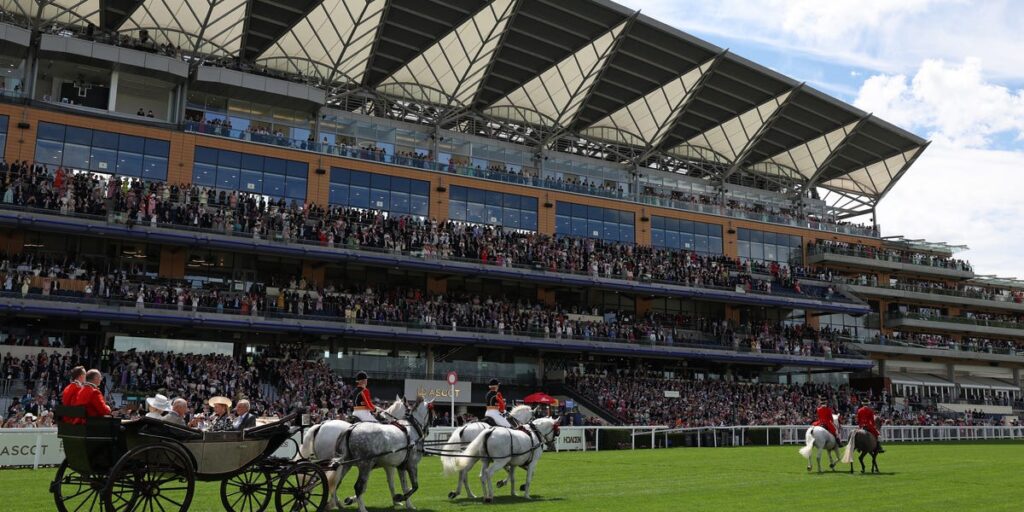
Royal Ascot 2026 has officially begun. Today, June 16, King Charles III and Queen Camilla greeted spectators as they led the Royal Procession at the storied racecourse in Berkshire, England, just outside London. Accompanied by the Duke and Duchess of Wellington, the royal couple arrived in a horse-drawn carriage, signaling the start of the five-day racing event that remains a cornerstone of the British summer social season.
Through Saturday, June 20, more than 350,000 visitors are expected to attend Ascot, drawn by a spectacle that combines world-class horse racing with centuries-old tradition, fashion, and royal pageantry. But what is the history behind the famed venue where it all unfolds? Read on for ELLE Decor’s look back at the origins and evolution of Ascot Racecourse.
1711: Queen Anne Founds the Racecourse
Royal Ascot began as a competition called East Cote. It was the brainchild of Queen Anne, who reigned from 1702 to 1714, and whose hobbies included horse racing and hunting. While out riding, she had the idea that East Cote—then a rural area outside London—seemed to be the perfect place for “horses to gallop at full stretch.” The first race included seven horses, all English hunters, running in three heats that were each roughly four miles long. A designer named William Lowen laid out the track with the help of carpenter Benjamin Cluchett and painter John Grape. The winner received Her Majesty’s Plate, which was worth 100 guineas.
1793: First Permanent Structure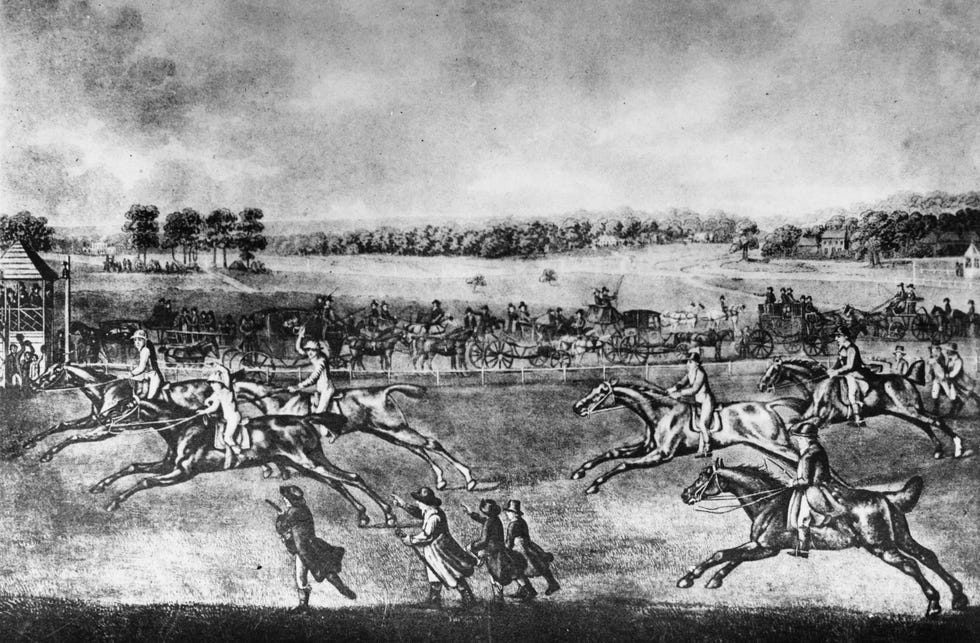 Hulton Archive//Getty Images
The Oatlands Sweepstakes under way at the Royal Ascot race meeting at Ascot Racecourse, Berkshire, 1791.
The race quickly grew in popularity and scope over the following decades, becoming a staple on the London social circuit. Horse-racing was just one element of Ascot that drew the crowds: among the other activities were “cockfighting, prize-fighting, gaming tents, jugglers, ballad singers, ladies on stilts, and freak shows.” As the event flourished, the need for a permanent structure became apparent. In 1793, Windsor builder George Slingsby designed and built stands for spectators that seated 1,650 people. This format lasted until 1838.
1839: Second Structure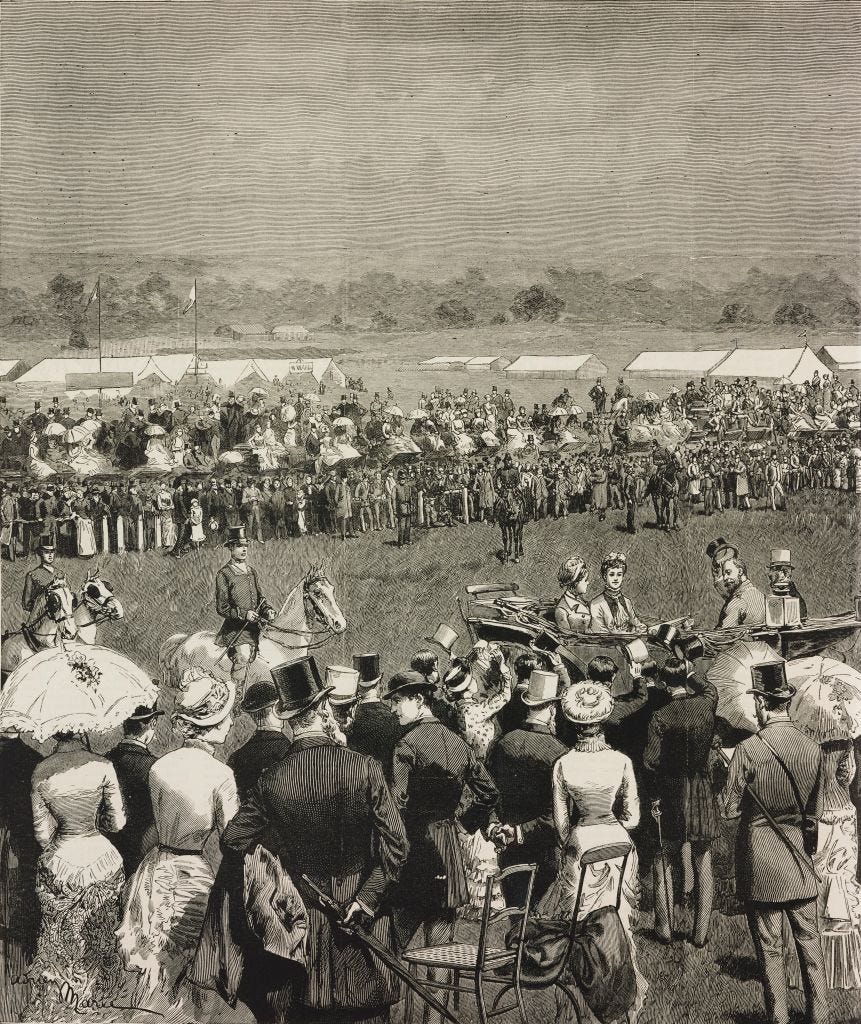 DEA / BIBLIOTECA AMBROSIANA//Getty Images
The Cup Day at Ascot, arrival of Albert Edward and Alexandra, Prince and Princess of Wales, on the racecourse. Illustration from the magazine The Graphic, volume XXV, No. 655, June 17, 1882.
Before Slingsby’s structure was demolished, King George IV commissioned a separate, two-story viewing platform with an adjacent lawn for the monarch and his guests. This lawn is what is known today as the Royal Enclosure. It was where the royal family and invited friends watched the race after the Royal Procession, which became a tradition starting in 1825. The Royal Enclosure has a strict dress code that is still enforced: Gentlemen must don a waistcoat and tie plus a top hat, while ladies must wear knee-length (or longer) dresses or skirts and a hat.
In the 1830s, planning began for a structure between the betting stands and the royal stands as a replacement for the Slingsby–designed structure. The new platform took ten months to build and debuted on May 20, 1839. Roughly 3,000 spectators could fit in the lower section of the stand, which also contained a betting hall.
Early 1900s: Redevelopment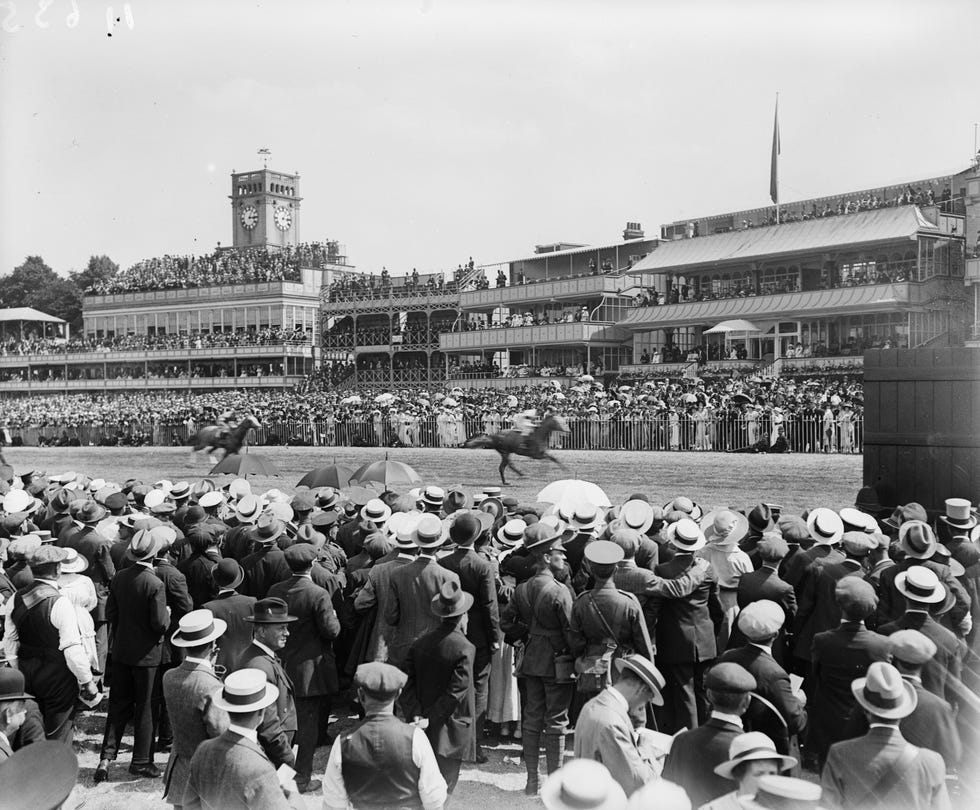 Roper//Getty Images
June 1919: Spectators at the Royal Ascot Races get a good view of the racecourse.
Soon after ascending the throne in 1901, King Edward VII ordered that all three stands in the Royal Enclosure be razed by the end of summer. Five hundred laborers worked day and night shifts to build a trio of replacement stands—including one that had elevators—that opened the following May and cost £56,000. Seven years later, a Five Shilling Stand (later called the Silver Ring Stand) was constructed for £30,000.
1960s: Rebuilding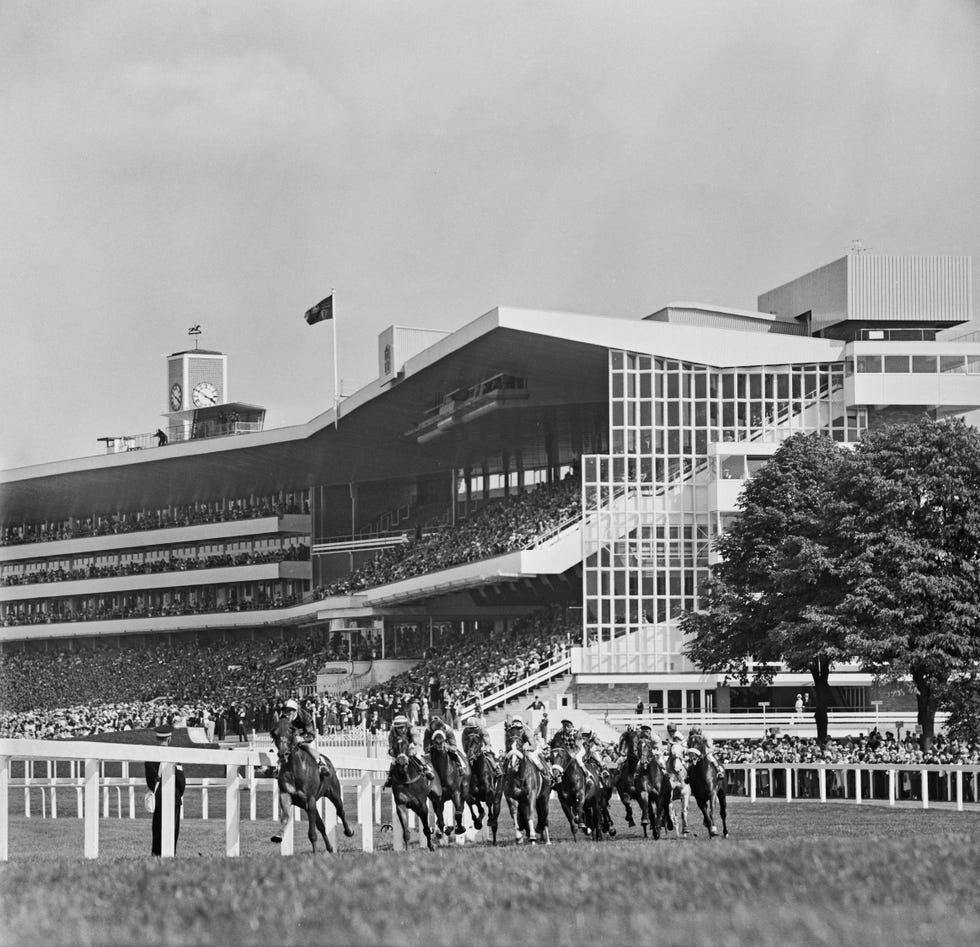 Evening Standard//Getty Images
The Jersey Stakes at Royal Ascot on June 17, 1964.
Britain’s previous monarch, Queen Elizabeth II, took the throne in 1952. A decade later, Ascot’s Victorian Grand, Alexandra, and Iron Stands were taken down and replaced with a modernist concrete structure called the Queen Elizabeth II Stand. Debuting in 1961, the state-of-the-art building cost £1 million, could seat 13,000 people, and contained 280 private suites. In total, it took 550 workers 11 months to build. A few years later the Members’ Stand opened, and the Royal Enclosure doubled its capacity to 7,500 people thanks to a new stand that matched the grandstand’s modern style.
2004–06: Current Version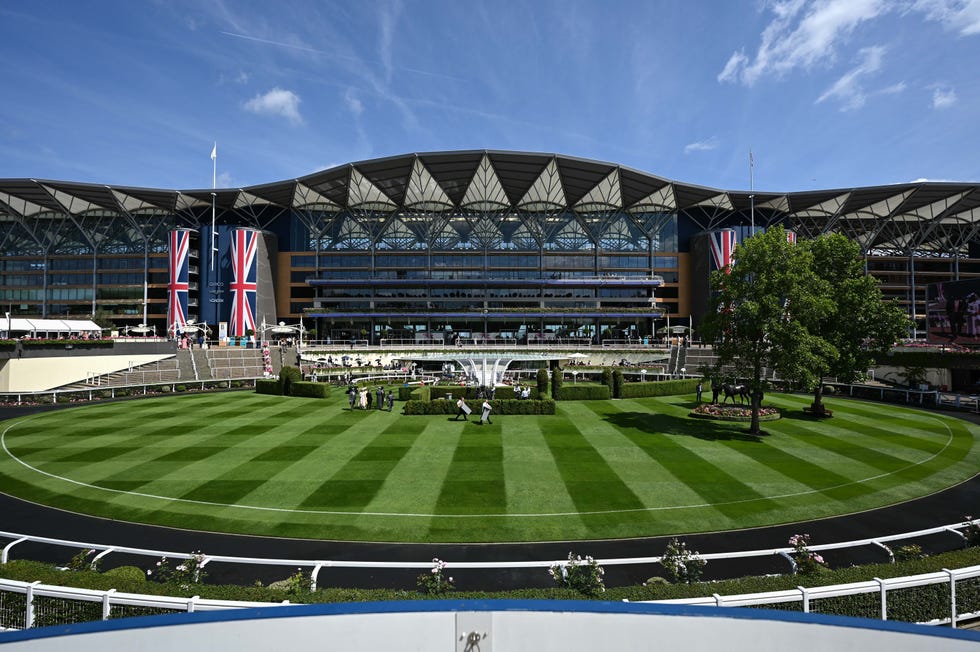 Anadolu//Getty Images
A general view of the racecourse on the second day of the Royal Ascot, held annually in Ascot since 1711 on June 18, 2025 in Ascot, United Kingdom.
Queen Elizabeth oversaw a second Ascot update between 2004 and 2006, during which time architecture firm HOK Sport (since rebranded as Populous) masterminded a total reimagining of the 180-acre campus. “The brief for the project was simple,” said architect Rod Sheard. “They told us to build the best racecourse in the world.” The entire project ended up costing £200 million and includes an 80,000-capacity grandstand that stretches 1,575 feet, with an undulating canopy, tree-like support columns, and a central atrium that allows light to flood the entire length of the building. Among the other upgrades were renovations to the 19th- and early 20th-century perimeter buildings and a track realignment.
Even in 2026, the facility continues to improve. Per People, the King and Queen noted recent refurbishment of the weighing room and changing facilities, as well as the addition of 1,200 solar panels on the grandstand roof. If the past is any indication, these updates won’t be the last.

Geoffrey Montes is an associate editor at ELLE Decor with a serious love for all things real estate and design. Before that, he worked at Architectural Digest, Galerie, and Preservation magazines, covering everything from jaw-dropping listings to world-famous architects and design events like Salone del Mobile and Homo Faber.