
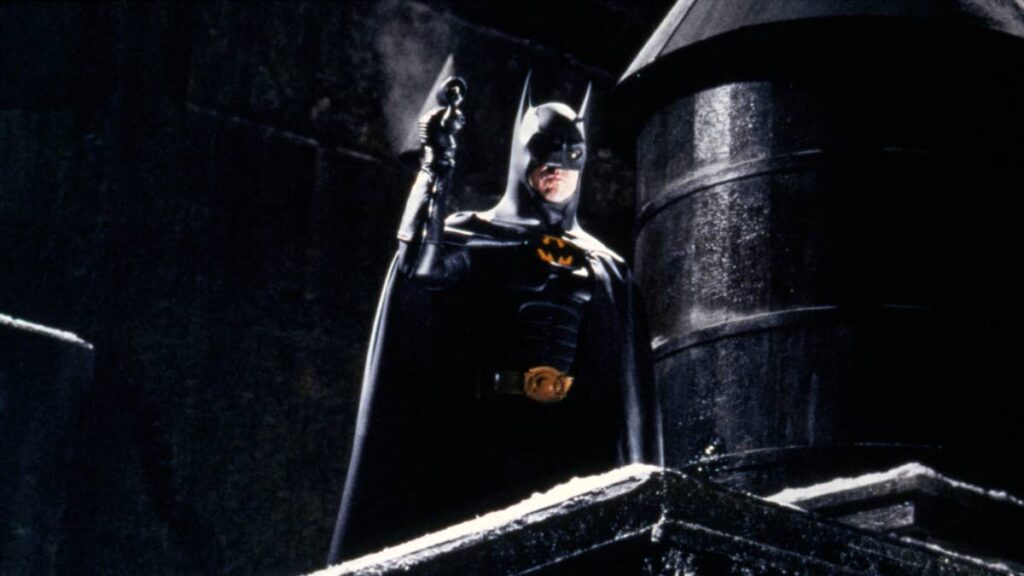
34 years today, one of the most controversial movies featuring Batman was released in theaters, a movie which changed the trajectory of adaptations for years to come before eventually being named one of, if not the, best of the bunch.
That’s right, we’re talking about Batman Returns.
Released on June 19, 1992—despite having a Christmas setting—the movie continued Tim Burton’s partnership with Warner Bros. and star Michael Keaton, following the massive success of their 1989 film.
This time around, Burton added a trio of new characters to the mix, including Michelle Pfeiffer as Selina Kyle/Catwoman, Danny DeVito as Oswald Cobblepot/The Penguin, and Christopher Walken’s Max Shreck.
The plot revolves around Penguin, abandoned by his parents at birth due to his deformities, plotting to kidnap all the first-born sons of Gotham as revenge.
Catwoman, meanwhile, joins the party after a mousy Selina is tossed out of a window by her boss, Shrek, and is revived as the leather-loving burglar. Though she initially aligns herself with Penguin, she becomes more of an anti-hero as the movie progresses, while also forming a romance with Bruce Wayne.
While the movie was met with parental backlash, mixed reviews and smaller box office returns than its predecessor, it was celebrated with the top slot on respected entertainment website IndieWire’s 2024 ranking of all the many Batman movies.
‘Batman Returns’ Met with Mixed Reviews
When the first Batman movie hit theaters in 1989, it was a smash hit. Made for less than $50 million, it went on to rake in over $400 million at the box office. The movie would hold the record for being the highest-grossing superhero movie of all time until 2002’s Spider-Man.
A sequel was quickly put into development, with Burton and Keaton both returning. The idea behind the second movie, however, was much darker and more “Tim Burton” than the original, with a plot about murdering kids, Catwoman’s bondage-inspired getup, and Batman himself breaking the “no kill” rule.
The vibe shift led to mixed reactions from critics upon its release.
In its review at the time, Variety praised the performances of the villains, while criticizing the script for not giving Batman himself as interesting a role. “One of the pic’s main drawbacks, as with the first, is that Bruce Wayne/Batman remains a relative cipher, a symbol of the force of good rather than a psychologically dimensional character on a par with the evildoers,” they wrote in 1992.
Giving the movie 2/4 stars, Roger Ebert wondered whether Burton was the right director for a Batman film, criticizing the darker approach to the source material. “I give the movie a negative review, and yet I don’t think it’s a bad movie; it’s more of a misguided one, made with great creativity, but denying us what we more or less deserve from a Batman story,” concluded Ebert.
The Washington Post also gave major kudos to Pfeiffer’s work in the film, but felt that, overall, the movie’s “mood is so suffocatingly somber it might have been shot in the belly of an architect.”
While the New York Times felt the movie was an improvement over its “sluggish” predecessor, they too found the character of Batman “bland,” and warned parents about taking their children to the film.
“A cartoonish spirit and a taste for toys do not make it a children’s film,” read the review. “Parents should take into account the film’s nightmarish setting, its characters’ mean-spirited sparring and the fact that children are abandoned, kidnapped and threatened with murder during the course of the story.”
Batman Backlash Continues
Still, the movie was a box office success, making $266 million against a $50-$80 million budget. That, however, was a pretty big drop from the haul of the first film.
In addition to the dip in profits, parents also reportedly complained to the studio that the movie was too grim and scary. McDonald’s also faced backlash for its Happy Meal tie-ins for the same reason, while an overall drop in merchandising sales was apparent across the board.
While Burton was initially interested in making a third film for Warner Bros., he soon realized they wanted to continue without him.
“I remember toying with the idea of doing another one. And I remember going into Warner Bros. and having a meeting,” he shared in the Shadows of the Batdocumentary.
“And I’m going, ‘I could do this or we could do that.’ And they go like, ‘Tim, don’t you want to do a smaller movie now? Just something that’s more [you]?’” he recalled. “About half an hour into the meeting, I go, ‘You don’t want me to make another one, do you?’ And they go, ‘Oh, no, no, no, no, no!’ And I just said, ‘No, I know you!’ So, we just stopped it right there.”
Director Joel Schumacher was then brought on board to rehab Batman’s image for the next film, Batman Forever. The goal was to produce a lighter film that also had licensees and retailers back on board.
Keaton, however, quit the movie a year before its release, later saying in a 2013 interview that “I could see that was going south” after Schumacher was hired. Rene Russo, who was set to play Dr. Chase Meridian, followed him out the door. The two were later replaced by Val Kilmer and Nicole Kidman.
The more family-friendly overhaul paid off, with Batman Forever banking $336 million against a $100 million budget. However, the big swings went too far with Schumacher’s critically panned follow-up, Batman & Robin, which made nearly $100 million less than its predecessor and is considered one of the worst films in the series.
A new Batman movie wouldn’t happen again until Christopher Nolan’s Batman Begins in 2005, which saw the pendulum swing back toward darker, grittier storytelling.
Batman Returns is streaming now on HBO Max.
This story was originally published by Men’s Journal on Jun 19, 2026, where it first appeared in the Entertainment section. Add Men’s Journal as a Preferred Source by clicking here.