
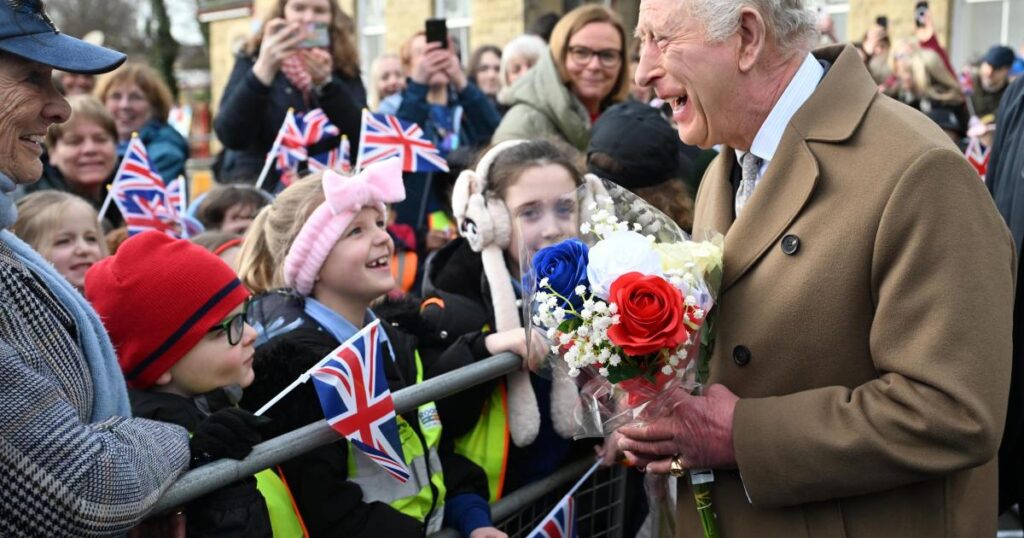
Charles is set to become the first head of state to share his personal tax information publicly in an attempt to boost public trust as the royal family continue to lose popularity.
He will publish his financial details as part of the royal household increasing the “clarity and accessibility” of the monarchy’s finances by producing a new report on the subject.
Prince William, meanwhile, has not disclosed the tax he has paid since becoming heir to the throne.
But campaigners from Scottish anti-monarchy group Our Republic have said this small piece of transparency is not a “true demonstration of the will to change”.
READ MORE: Andy Burnham ‘understands Scotland because he’s from north England’, MP claims
A spokesperson for the organisation said: “This rare moment of transparency is a small step by a monarchy that knows the tide is turning against them but is incapable of taking the radical actions necessary to restore public trust.
“They could reveal every law they have secured exemptions to so they can be removed. They could end the cloak of secrecy only their lobbyists are afforded with our Government. They could end the protection of Andrew and ensure he can no longer hide behind their wealth and prestige.
“But they won’t. This isn’t a demonstration of a true will to change, it’s a stalling tactic.
“In the end the inability to change is simply baked in to the nature of the monarchy. It can only exist by maintaining the broken constitutional status quo, it can only continue the illusion of a special status afforded to a single bloodline by hiding behind a veil of pomp, pageantry, and secrecy.”
The King’s private sources of income could include money from investments or trading profits, funds generated by his private estates of Balmoral and Sandringham and private savings.
(Image: PA)
The Duchy of Lancaster estate, a private portfolio of land, investments and office, retail and industrial property, also provides the Charles with an annual income, which in 2024-25 was £26.8 million.
Charles voluntarily pays income tax on all his private income, and capital gains tax on relevant elements of his assets, as laid out in the Memorandum of Understanding on Royal Taxation 2023, agreed by Government.
Monarchs are not obliged to pay income tax, inheritance tax on what they receive from a previous monarch or capital gains tax.
Later this week the King’s total personal tax information for the 2024/25 financial year will be published, alongside other reports on royal finances.
READ MORE: Edinburgh MSPs call out ‘horrific’ anti-muslim attacks in the capital
His 2025/26 tax details will be released next year when their audit has been completed.
Accounts detailing the Sovereign Grant, which funds the official duties of the royal family, will be published at a press briefing this week alongside a separate extensive new royal household report on royal finances.
Figures from last year showed the Sovereign Grant stood at £86.3 million, comprising £51.8 million for core elements like travel and payroll costs and £34.5 million to fund the Buckingham Palace Reservicing Programme.
Graham Smith, chief executive of UK-wide anti-monarchy group Republic, told The National there is much more the King needs to explain about what he earns and why he avoids certain taxes.
He said: “We need to know where his income is coming from as well as what tax he is paying and any claim regarding tax can’t be pitched as something which he should be proud of in terms of being a large taxpayer, he needs to explain why he is such a large earner and the focus needs to be back on the public sources of that income and the secrecy around his private investments.
“We also need to know why he avoids so many taxes including the inheritance tax, which I think was estimated around £600 million, and the voluntary nature of income tax and the avoidance of capital gains tax on the Duchies.”
An Ipsos poll over the weekend showed support for the royals at an all-time low.
William receives an income from the Duchy of Cornwall, a billion-pound hereditary estate featuring The Oval cricket ground and Dartmoor Prison, providing the heir to the throne with funds independent of the monarch.
The prince received nearly £23 million last financial year from the Duchy and voluntarily pays the highest rate of income tax, once official costs have been deducted, but the amount he pays in tax is not disclosed.
Smith added: “William also has questions to answer. Why are we effectively paying William and Charles a personal income of more than £20m each from the two Duchies? These are public assets.
“The main issue remains however: why does the monarchy cost the country well over £500m a year, far more than they admit to?”
Speaking about the new report a Buckingham Palace spokesperson said: “Our aim is to explain all elements of royal finances in a way that further enhances clarity and accessibility, while also placing it in its historical and constitutional context.”
Alongside the new publication and the Sovereign Grant report, the Duchy of Lancaster’s accounts will also be published at another press briefing.
A Buckingham Palace spokesperson said about the changes: “In order constantly to improve, and to encourage wider understanding of our accountability, the royal household has been considering options to enhance this transparency still further – and can today announce additional measures in keeping with our public service priorities.
“To put it simply: we continue to modernise and evolve.”