
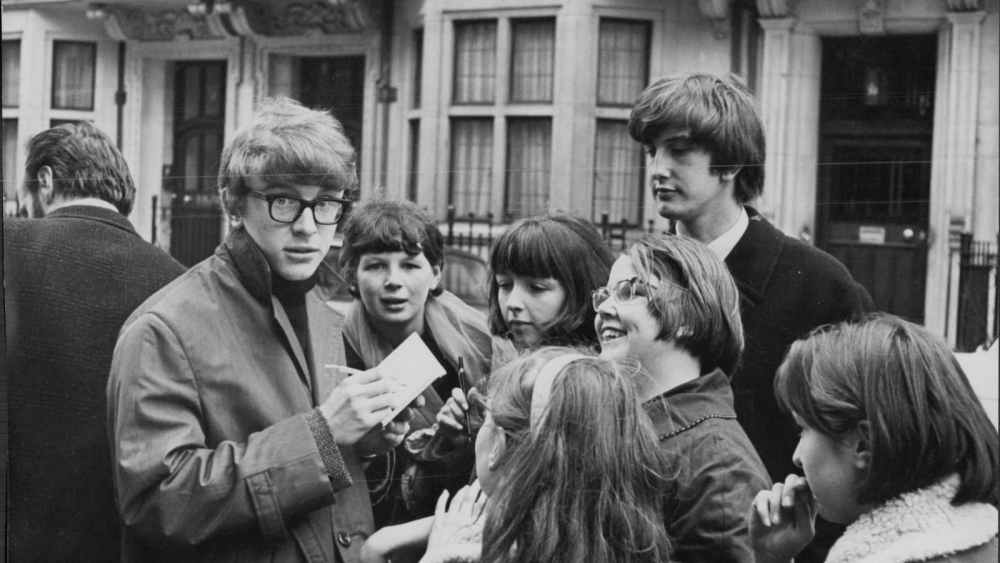
A movie about a fabled musician of the ’60s and ’70s doesn’t need to wallow in boomer nostalgia. The artists of that era are hardly stuck in time — the best of them are timeless. (Obvi!) And Peter Asher, who was one-half of the 1960s British pop duo Peter and Gordon before going on to become one of the most powerful record producers of the 1970s, is a figure of talent and charisma and fascination, even if part of that was his genius for being in the right place at the right time.
Having said that, there are moments in “Peter Asher: Everywhere Man,” Daniel Geller and Dayna Goldfine’s lightly engaging documentary memoir (it’s built around Asher’s autobiographical stage show, which we see clips of him performing at the Bimbo’s 365 Club in San Francisco), when my Geiger counter of boomer solipsism began to click into overdrive. Asher has a track record of achievement, but he’s also someone with major boomer vibes; he’s got an aura, a mystique, a history of associational cool. “Everywhere Man” is well worth seeing, as long as you go in knowing that it’s a bit too infatuated with its subject, in that rose-colored Boomers “R” Us way.
But let’s give the man his due! Born in 1944, Peter Asher grew up in a prosperous London family (his father was the endocrinologist who identified and named Munchausen syndrome; his mother was a professional oboe player). At the posh Westminster School, he formed a bond with the only other kid who was toting a guitar around — Gordon Wally, who had longish hair and a voice to match his desire to be Elvis. He and Peter started singing together and discovered that their voices chimed. They landed a weekly gig at the Pickwick Club, a place frequented by hip young celebrities (Michael Caine, Sammy Davis Jr.), and that’s where they attracted the attention of EMI Records.
Here’s where the story gets sprinkled with fairy dust. One of Asher’s two younger sisters, Jane, had an acting career going, and she was on the panel of a youth-pop show called “Jukebox Jury.” This meant that in April 1963, she got to meet the Beatles; almost instantly, she began dating Paul McCartney. They had a serious and rather famous relationship (until he met Linda). Paul spent so much time over at the Ashers’ that they offered him a room in the upstairs of their townhouse (right next to Peter’s room), and Paul essentially moved in. That’s how he wound up giving Peter a song he was working on called “A World Without Love.”
If the Beatles had recorded “A World Without Love,” it would have been a meh Fab Four track (John Lennon hated it). But Peter and Gordon, doing their British imitation of the Everly Brothers, sang it in genteel English accents and made it so infectiously twee that it was irresistible. Paul went on to write several of their other singles, like “I Don’t Want to See You Again” and “Nobody I Know,” proving that if you’re going to be a lightweight pop duo, it helps a lot to have the Paul McCartney of 1963-64 composing your material. (Their other signature song, “I Go to Pieces,” was written by Del Shannon.)
Peter and Gordon were early teen idols — Peter, especially, was the cute geek next door — and that’s where they fit into the British Invasion. Amusingly, it’s only during the closing credits of “Everywhere Man” that the film brings up something that has always been obvious — namely, that Mike Myers used Peter Asher, with his floppy hair and toothy grin and horn-rims, as a key inspiration for Austin Powers. When we see Peter and Gordon on TV in the mid-’60s, with Peter wearing a ruffled shirt and paisley jacket, the comparison is undeniable, though maybe it would now be more accurate to call him the missing link between Austin Powers and Ed Sheeran.
Peter Asher remains beloved for that mid-’60s Carnaby Street snapshot moment of pop fame, but the truth is that he wasn’t put on earth to be a pop star. And he knew it. He traveled down other roads, teaming up with John Dunbar and Barry Miles to open a bookstore and avant-garde art gallery that were both called Indica, named for the second half of the scientific term for cannibas (the gallery was the fabled one where John Lennon met Yoko). He introduced Marianne Faithfull (who was then married to Dunbar) to the Rolling Stones, and he got drawn behind the recording console when Paul Jones, the ex-lead singer of Manfred Mann, asked him to produce his first solo album. Asher did, and was off and running. He was hired by McCartney to be the head of A&R at Apple Records, the company launched by the Beatles in April 1968, and was the one who brought in James Taylor, producing his first album — which, in fact, was ornately overproduced, and didn’t make much of a mark.
In the stage-show memoir the movie keeps cutting to, Asher, now in his early eighties, with sparse red hair and tortoise-shell glasses, describes all of this in his mild and menschy way. He was, and remains, one of the squarest stars in pop history — a nerdish Englishman so polite he doesn’t actually seem to have a sense of humor. There’s a way that he admits he was almost a Zelig figure, drifting through the counterculture. Paul McCartney and James Taylor were major artists who kind of landed in his lap. Then again, Asher, once he moved to L.A., was instrumental — literally — in orchestrating the strikingly spare sound of Taylor’s second album, “Sweet Baby James,” choosing musicians like Russ Kunkel and Carole King. In doing so, he helped to create the singer-songwriter era and also the new age of the session musician, which he ushered in by listing the musicians who played on “Sweet Baby James” on the album cover (which had never been done before).
His other superstar was Linda Ronstadt, and that’s where Asher did some of his greatest producing. Just listen to the intoxicating sonic precision of “You’re No Good” or “Heat Wave.” In 1977, Asher appeared on the cover of Rolling Stone along with Taylor and Ronstadt (the only time, as far as I know, that Rolling Stone has ever featured a record producer on its cover), and that helped seal his mythology. His career after that was notably hit-or-miss, and his life crashed into the age of cocaine, a drug he could handle, but his wife, Betsy, could not; she wound up in a mental institution.
I must say that Peter Asher produced one of my favorite records of all time: “In My Tribe,” the 1987 album by 10,000 Maniacs. It’s a joyful masterpiece, and the sound of it is incandescent. I’m personally in favor of more documentaries about record producers, including films that go deep into the weeds of the music itself. Let’s start with George Martin and Giorgio Moroder, then move on to Quincy Jones and Gary Katz and Nile Rogers. The difference will always be that none of those producers had the first act Peter Asher did — being a pop star who emerged from the same magic ecosphere as the Beatles. That lends every note of his story a mythic glow, even if it wasn’t always earned by what he did.