
20. The Midland Hotel, Morecambe — Poirot: Double Sin (1990)
The gleaming Art Deco Midland Hotel, curving away from the Morecambe promenade since 1933, earned its place in television history when David Suchet’s Hercule Poirot — accompanied by Hastings and Chief Inspector Japp — used it as his base in the Double Sin episode.
The hotel, doubling as a fictional seaside resort, was the perfect fit for a production dripping in period elegance. Every bit as stylish on screen as in real life.
19. Sunderland Point — The Ruby in the Smoke (2006)
One of Lancashire’s most hauntingly isolated spots earns its place on this list courtesy of the BBC’s adaptation of Philip Pullman’s Victorian thriller, starring a young Billie Piper as Sally Lockhart.
The bleak tidal headland near Morecambe — cut off at high tide and largely unchanged for centuries — provided atmospheric riverside and coastal locations for the production.
If you visit on a grey winter’s day, you will understand immediately why a film crew chose it.
The Ruby in the Smoke, 2006 (Image: BBC)
18. Helmshore Textile Museum — North and South (2004)
Margaret Hale arrives in the forbidding industrial north, and nothing quite says “this is not Hampshire any more” like Helmshore’s Victorian mill.
The BBC’s beloved adaptation of Elizabeth Gaskell’s novel used this Rossendale mill to conjure the fictional Darkshire cotton town of Milton.
Richard Armitage glowering among the looms has never quite left the national consciousness.
17. Towneley Hall, Burnley — Whistle Down the Wind / Juliet Bravo
The grandest house in Burnley has been pulling double duty for film and television crews for decades.
It appeared alongside Downham village in Bryan Forbes’s 1961 classic Whistle Down the Wind, and its imposing interiors and grounds have since featured in the long-running ITV police drama Juliet Bravo, set in the fictional Lancashire town of Hartley.
A working museum by day, a backlot by night.
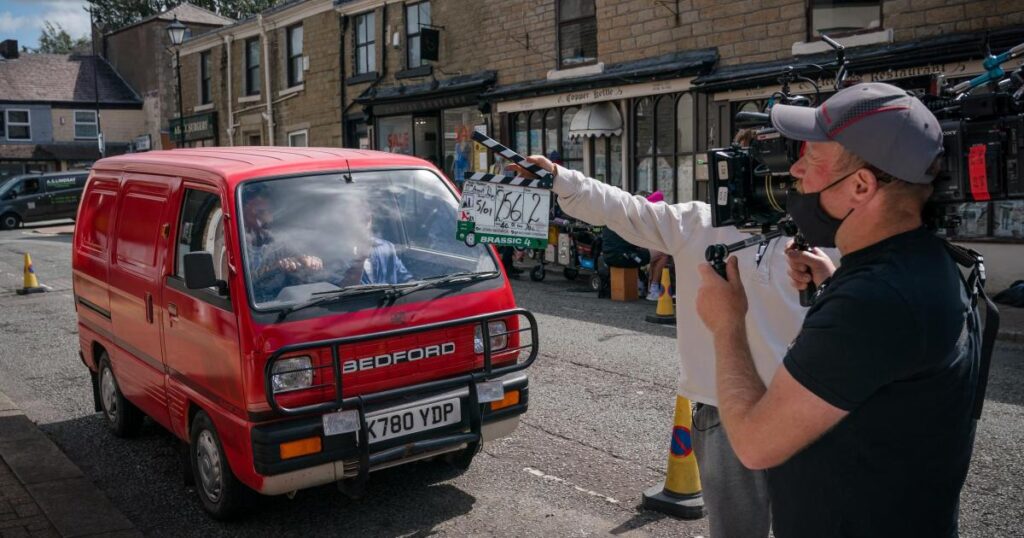
16. Bacup, Rossendale Valley — Brassic (Sky, 2019–present)
Joe Gilgun based his riotous Lancashire comedy on his Chorley upbringing, but it was Bacup that became the fictional town of Hawley on screen.
The terraced streets and East Lancashire geography of Rossendale have featured in every series since its debut, giving the show a distinctly rooted sense of place.
15. Blackpool Tower Ballroom — Phantom Thread (2017)
Paul Thomas Anderson’s Oscar-winning drama found room for Blackpool’s most extravagant interior.
Daniel Day-Lewis appears beneath the chandeliers of the Tower Ballroom, whose gilded balconies and famously sprung dancefloor provide one of the film’s most striking English settings.
14. Clitheroe town centre and castle — Greatest Days (2023)
Gary Barlow approved, Clitheroe delivered.
The Take That musical film descended on the Ribble Valley market town in 2022, filming a climactic song-and-dance number in the town centre that involved hundreds of local extras.
Clitheroe Castle, St Mary Magdalene Church and the surrounding countryside all featured in a production that amounted to a love letter to Lancashire.
A gold star has since been unveiled at the market to mark the occasion.
13. Rivington Pike — A Monster Calls (2016)
J.A. Bayona’s devastating fantasy film drew on this dramatic Lancashire landmark as part of its visual landscape.
The area around Rivington Pike featured in location shooting, although many of the film’s most visually striking sequences were enhanced with compositing and CGI.
12. Burnley — Bank of Dave (Netflix, 2023)
Dave Fishwick’s real-life battle to set up a community bank was always going to be filmed in Burnley — and the production made extensive use of locations across the town, including its streets and civic buildings.
Rory Kinnear as Dave and Joel Fry as the barrister he wins over became a memorable on-screen pairing when the film landed in early 2023.
11. Colne — Monty Python’s The Meaning of Life (1983)
Following the success of The Life of Brian, the Monty Python team returned with The Meaning of Life, a wildly inventive comedy-musical built around a series of sketches exploring the absurdities of human existence.
Lancashire earned its place in Python history when filming arrived in Colne during the early 1980s.
Streets around the town featured prominently in the famous “Every Sperm Is Sacred” sequence, one of the film’s best-known and most enduring musical numbers.
10. Hoghton Tower — Peaky Blinders, Cracker, Casanova
The dramatic hilltop manor near Blackburn has been one of Lancashire’s most reliably bankable film locations for decades.
It appeared as St Hilda’s Orphanage in Series 5 of Peaky Blinders, has featured in Casanova, Cracker and various Sherlock Holmes adaptations, and continues to attract production companies to this day.
With its sweeping entrance drive, ancient banqueting hall and panoramic views, it is, quite literally, born for the camera.
9. Blackburn — Kidnapping by Indians (1899)
Long before Hollywood codified the Western, one of the genre’s earliest — and possibly very first — examples was filmed in Lancashire.
Kidnapping by Indians, a two‑minute silent film made by pioneering Blackburn filmmakers Mitchell and Kenyon, was shot in fields near the town using local actors and mill workers as its cast.
8. Cleveleys Seafront — Andor (Disney+, 2022)
In May 2021, a small Lancashire seaside town became part of the Star Wars galaxy.
The Cleveleys seafront doubled as the planet Niamos for Episode 7 of Andor, with Diego Luna and a squad of imperial troops marching past the beach huts.
The council unveiled a permanent bronze marker on the seafront in 2025. Not bad for a Tuesday in Wyre.
7. Queen Street Mill, Burnley — The King’s Speech (2010)
Colin Firth’s Prince Albert, stammering through a factory speech, did so among the thundering looms of Queen Street Mill in Harle Syke.
The world’s last surviving 19th-century steam-powered weaving shed has also appeared in Peterloo and the BBC’s A Christmas Carol.
It is one of the most remarkable buildings in the north of England — and its Oscar-winning cameo is entirely deserved.
6. Morecambe Bay — The Bay (ITV, 2019–present)
ITV’s long-running crime drama takes its name — and its soul — from Morecambe Bay, and the wide grey expanse of sand and sky is as much a character as any of its detectives.
Now into its fifth series, The Bay has put Morecambe firmly on the television map.
5. Leighton Hall, Carnforth — Possession (2002)
Neil LaBute’s film of A.S. Byatt’s Booker Prize-winning novel needed English country-house grandeur in abundance, and Leighton Hall near Carnforth duly obliged.
The Gothic Revival house — home to the famous Gillow furniture-making dynasty — provided both exterior and interior scenes.
4. Lancaster Castle — Redcon-1 (2018)
Few Lancashire locations come with quite as much ready-made atmosphere as Lancaster Castle — and Chee Keong Cheung’s zombie action film Redcon‑1 made full use of it.
Parts of the film were shot inside the castle’s former prison, its thick stone walls and claustrophobic corridors transformed into a quarantine zone overrun by the infected.
Lancaster Castle (Image: LCC)
3. Downham and the Ribble Valley — Whistle Down the Wind (1961)
Worth revisiting at a higher placing.
The entire Ribble Valley — its farms, its stone villages, its Pendle backdrop — is the film. Bryan Forbes used the landscape not just as a backdrop but as a moral force; the wide Lancashire fields surrounding Downham give the story its sense of innocence and isolation.
No other location on this list so completely belongs to a single film.
2. Stonyhurst College — Three Men and a Little Lady (1990)
Long before it was easily compared to fictional screen institutions, Stonyhurst had already earned its place on film.
The college’s striking architecture and secluded setting made it an ideal stand-in for an English boarding school in Three Men and a Little Lady, reinforcing its reputation as one of the north’s most cinematic buildings.
1. Carnforth Railway Station — Brief Encounter (1945)
There is no competition.
David Lean filmed much of his masterpiece at Carnforth station between February 5 and 16, 1945, when wartime blackout restrictions meant the London stations originally planned were too dark for shooting.
Celia Johnson and Trevor Howard’s agonising, unconsummated love affair — played out at the station’s refreshment room clock — transformed this modest Lancashire junction into one of the most romantic locations in cinema history.
Pilgrims still come. The clock still stops the heart.