
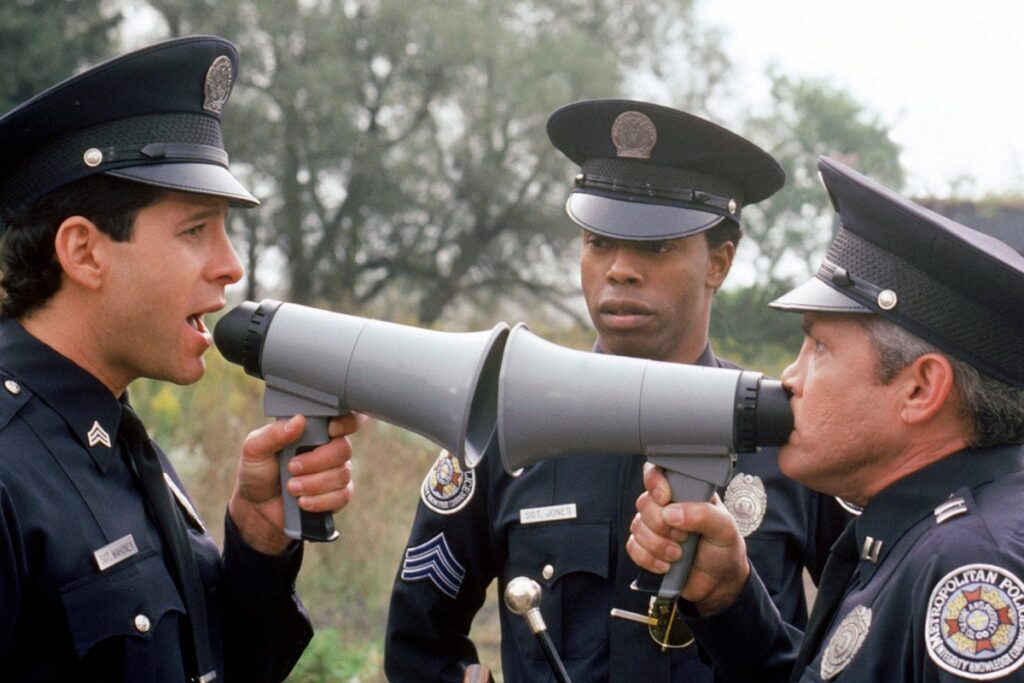
The Police Academy reboot spent years in limbo, with plans dating back to 2008 and New Line Cinema even tapping Scott Zabielski to direct in 2012 before Keegan-Michael Key and Jordan Peele came aboard as producers in 2014. Behind-the-scenes tensions and a post-Ferguson climate that made a broad cop comedy harder to position ultimately helped stall the project, despite Steve Guttenberg signaling interest as late as 2018.
Seven films between 1984 and 1994 turned Police Academy into a pop comedy fixture, racking up roughly $540 million and a devoted fanbase that still quotes its gag-heavy chaos. That kind of nostalgia usually guarantees a comeback, yet the reboot effort that began in 2008 never made it to cameras. As New Line Cinema cycled through names like Scott Zabielski, and producers Keegan-Michael Key and Jordan Peele came aboard, private creative friction kept piling up. Then the national reckoning on police violence after Ferguson in 2014 made a lighthearted take on cops far harder to sell, and the project quietly stalled.
A comedic classic that struck gold
Some franchises don’t just arrive, they stick around like a catchphrase you can’t stop repeating. Police Academy did that in 1984, leaning into the simple, irresistible premise of a city mayor opening the police school to anyone willing to sign up. Under director Hugh Wilson, the movie treated its recruits like lovable chaos magnets, and audiences showed up for the ride.
The numbers still tell the story cleanly. The first film brought in $149.8 million worldwide, then the series kept rolling with 6 sequels released between 1985 and 1994. Combined, the 7 films reached about $540 million worldwide, a rare feat for a broad studio comedy.
The reboot that kept getting close
The attempt to bring it back started quietly in 2008, with original producer Paul Maslansky helping set the reboot in motion. Years passed, scripts shifted, and the project kept searching for its modern identity, the kind of slow churn that can either forge a comeback or drain the fun out of it.
There was a real moment of momentum in 2012, when New Line Cinema named Scott Zabielski to direct as the screenplay was being reworked. Then, in 2014, Keegan-Michael Key and Jordan Peele joined as producers on what was being framed as Police Academy 8, and suddenly the idea felt less like nostalgia and more like a new comedy engine.
Behind-the-scenes friction, told out loud
Years later, the inside version of the story became clearer. On his podcast Funny You Ask, comedian Ike Barinholtz said he and David Stassen had written a draft for the reboot, with Key and Peele at one point eyed for leading roles. According to Barinholtz, the team was told to make it modern and R-rated, then ran into pushback over what the original film “would” or “wouldn’t” do.
That tension wasn’t just about jokes. Barinholtz also described pressure to include the original cast, and the kind of constant note-giving that can freeze a project in place, especially when everyone believes they’re protecting what fans love.
When the national mood changed the math
Timing became its own obstacle. As development continued, the killing of Michael Brown in Ferguson, Missouri on August 9, 2014 sparked protests and a sharper national focus on policing. Barinholtz said the reaction was immediate: people questioned whether it made sense to launch a cop comedy at that moment, especially with Key and Peele attached.
Even as Steve Guttenberg said in 2018 that the reboot was still on the table, it never crossed the finish line. For now, Police Academy remains a franchise with a very American afterlife: endlessly rewatchable, constantly pitched for revival, and still waiting for the right conditions to laugh again.