
Sign up for the Slatest to get the most insightful analysis, criticism, and advice out there, delivered to your inbox daily.
This article contains spoilers for Season 5 of The Bear, including the finale.
Great meals are rare; great desserts are even rarer. Even some of the best restaurants’ inspiration runs dry when it comes to the final course, sending you out the door with a mouth full of sugary blandness that dulls the pleasure of everything that’s come before. Perhaps the smartest thing The Bear does in its fifth and last season is not linger too long once the final dish is served, devoting the vast bulk of its running time to a single night in the life of the titular restaurant, and only shifting into elegiac mode for its closing hour.
In its third and fourth seasons, Christopher Storer’s FX series became almost fatally entranced by its own greatness, especially as his co-showrunner Joanna Calo’s influence diminished and Storer, who has a directing credit on 17 of the show’s last 19 episodes, grew more intent on holding the reins himself. Even as chef Carmy (Jeremy Allen White) was learning the pitfalls of being an anxiety-riddled control freak, The Bear seemed incapable of grasping the point, coming to life only when it set Carmy aside and shifted the focus to its other characters. Storer, Calo, and their writers built a fully populated fictional universe, filled with unknown or underappreciated actors who shone every chance they got. But the more engrossing Marcus (Lionel Boyce) or Tina (Liza Colón-Zayas) or Richie (Ebon Moss-Bachrach) got, the more frustrating it was that the show kept pivoting back to its familiarly (and familially) tortured genius, whose biggest problem was his inability to get outside his own head. (It was also The Bear’s biggest problem.)
The Bear’s final season, now streaming in its entirety on Hulu, lacks the stand-alone episodes that were often the series’ high points, but the good news is that it’s because its focus is so intense there’s no real way to depart from it. Seven of its eight episodes take place over the course of a single day—a day that may turn out to be the Bear’s last. Uncle Jimmy (Oliver Platt), whose money bankrolled the Berzatto family dream, had already put Carmy and Co. on a short financial leash, but after one of his other investments collapses, there’s suddenly no leash at all: The restaurant’s crew had months to prove it could be a viable business; now, they’ve got hours. Suppliers are calling in tabs and stopping shipments, employees are wondering if their next check will clear, and Chicago is being pummeled by a torrential rainstorm whose intensity is almost biblical. And, to make matters worse, Resy is down.
The reduced circumstances and the threat of imminent closure force a return to the framework that initially made The Bear so engrossing, the focus on a group of scrappy kitchen workers giving everything they’ve got just to put food on the table and a smile on their diners’ faces. Every piece of wagyu has to be accounted for, every dwindling ingredient stretched as far as it can go, even if it means reducing the size of every dish. (Like the rest of the food industry, the Bear has discovered the magic of shrinkflation.) The pricey Vermont butter Carmy once insisted he could never accept any substitute for gets dumped into a sauce just to thicken it, and by the end of the night, they’re scraping bottom, inventing new dishes on the fly just to fit the few scraps they have left. With a potential Michelin reviewer in the house and the cupboards almost literally bare, Carmy has a wave of inspiration that requires only a single egg—which turns out to be lucky, since the entire restaurant only has two eggs left.
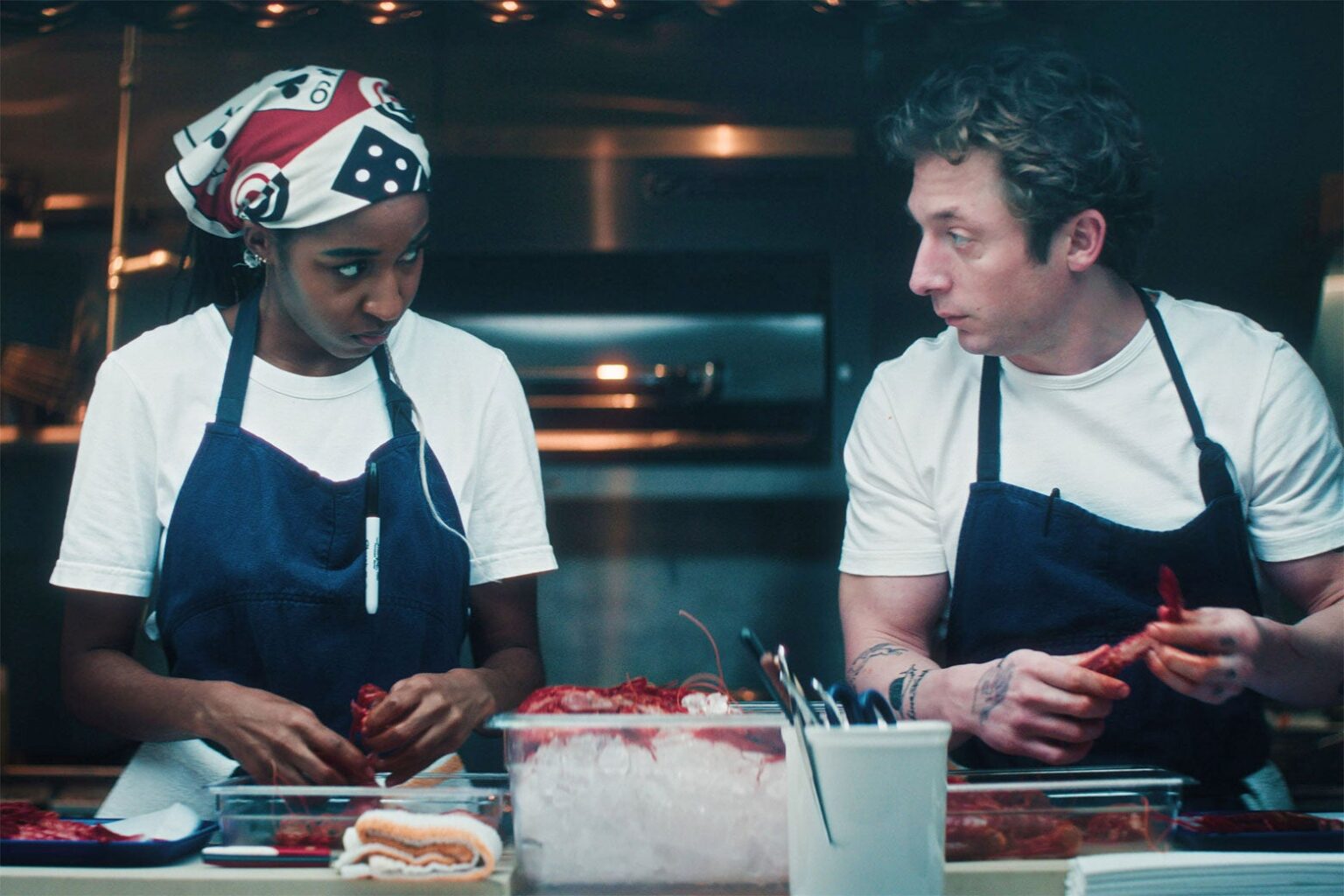
As in a movie by Richie’s favorite filmmaker, Michael Mann, The Bear’s final episodes are driven by the pleasure of watching highly trained experts do what they do, the difference being that we’ve been with these characters long enough to remember when they were still getting their feet wet. We know Sydney (Ayo Edebiri) is more than ready to fill Carmy’s shoes, and that Tina can handle taking her place as chef de cuisine, that Richie can cope with any curveball the dining room throws his way (although not with Sydney’s demand to cancel a few reservations to lessen the load, because he can’t stand the thought of leaving anyone disappointed). Rather than informing us how much they’ve grown, Storer wisely just lets us watch them work, the way it was when the Bear was still the Beef. He even contrives, via a burst pipe, to get the staff out of their upscale duds and back into the misprinted “Original Berf” tees from way back when.

Sam Adams
House of the Dragon Has Finally Arrived
Read More
It’s a tricky thing to applaud artists for scaling back their ambitions, but in this case it’s more of a long-overdue course correction, focusing on what works and discarding what doesn’t, even if that means leaving some long-running plot threads dangling. It’s a little hilarious to reach the end of a series that’s devoted so much screen time to Carmy’s tempestuous romance with the moon-eyed Claire (Molly Gordon) and realize it’s hardly going to address the issue at all, but I’m happy to accept a lack of closure if it means skipping one more scene about whether Carmy has room in his life for anything except his art. (It’s even funnier that Gordon finally does show up, but only as a wordless presence at a birthday party for Richie’s daughter.) That goes for Carmy’s relationship with his monstrous mother, too. Perhaps it’s sloppy storytelling to leave it unresolved, but if it means less of Jamie Lee Curtis’ grotesquely caricatured performance, so much the better.
Plus, it means more time for Sydney, who gets to take Carmy’s place and the credit for the Michelin stars—plural—we always knew were coming. More time for Tina to take charge and realize that the responsibility she feared she couldn’t handle is actually thrilling to wield. Time for Ebra (Edwin Lee Gibson) to put his schooling to work and pull the Bear’s irons out of the financial fire through the magic of franchising. And time for Richie to kindle a romantic spark with his longtime crush Jess (Sarah Ramos), who, it turns out, is just as nervous about him liking her.
Cousin Richie, the G.O.A.T.
FX
A Canceled Star Is Back. His Hateful New Movie Is One of the Most Disturbing Things I’ve Seen Lately.
Alamo Drafthouse Used to Be a Shrine of Cinema. Then It Did Something So Unthinkable That Even Its Most Die-Hard Fans Revolted.
Pacino. Scorsese. Oscar Isaac. Why Did These People All Sign On to Such a Terrible Movie?
Perhaps the biggest surprise in The Bear’s finale is how it ends: not on Carmy or on Syd, but with Richie and Jess holding hands on a flight to Japan. The show resisted, both commendably and mercifully, the pressure to make Carmy and Syd a romantic item, although ’shippers at least get a fierce hug that lingers just long enough to feel like it might turn into something else. But the guy who once belted out “Love Story” has earned one of his own. (Given his fondness for ’80s movies, he probably doesn’t miss the resonance with Say Anything either.) Richie isn’t an artist like Carmy or Syd, but he took the idea that the purpose of restaurants is to make people feel cared for—hospitality, that purest distillation of the industry they serve—most to heart. He was the one who ran out for deep-dish pizza so his diners could have a taste of the real Chicago, who floated in an extra table so that an elderly couple could have their anniversary dinner on time. And he actually grew, deeply but believably, along the way. The working-class stiff with a chip on his shoulder has grown to love sharing the pleasures of fine dining, even if he might be the first person to refer to Thomas Keller as “the homie from Napa.” “I used to be a people hater,” he reflects towards the conclusion of the Bear’s supremely chaotic night. “Now I’m a people lover.”
Nearing the end of its final episode, The Bear gives Carmy one last tortured monologue, the kind where Jeremy Allen White acts like looking anywhere near the camera might make him burst into flames. But it’s played at least partly as a joke, a response to an architect’s query about why he wants to give up cooking and intern at her firm. The last season’s most powerful moments are often its quietest: Richie and Jess entwining their fingers, gradually working up the courage to give a little squeeze; Marcus revealing that the candle he set on his estranged father’s table has been keeping the sauce for his dessert warm all night. It’s not just the sweetness that’s moving. It’s the surprise.
Get the best of movies, TV, books, music, and more.