
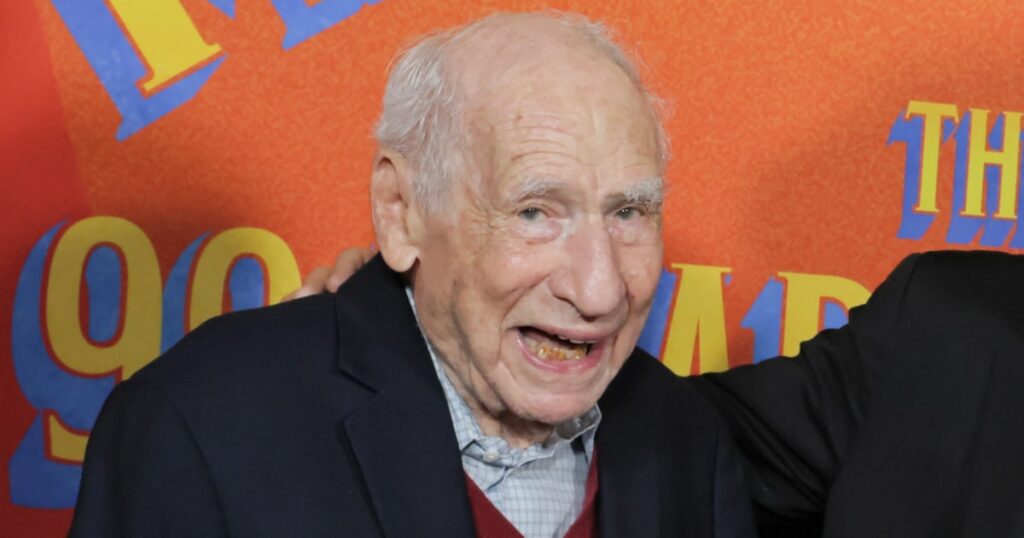
Leave it to the 2,000 Year Old Man to have the best longevity advice.
Comedy legend and father of satire Mel Brooks celebrates his big 100th birthday on June 28. The “Young Frankenstein” director has previously opened up about his secret to long life, and it turns out, it has a lot to do with his sense of humor.
“I think laughing keeps you healthy and happy,” Brooks, who’s best known for being at the helm of a number of boundary-pushing films including “Blazing Saddles” and “The Producers,” told People.
The comedian, who was born in 1926 in Brooklyn, has stayed busy in the autumn of his life. Last year, it was announced that Brooks is reprising his role as the beloved character Yogurt in the upcoming 2027 sequel to “Spaceballs,” his 1987 “Star Wars” parody film. He was also the subject of HBO documentary “Mel Brooks: The 99 Year Old Man!,” which was released in January.
Brooks — whose contemporaries Carl Reiner and Sid Caesar both made it into their 90s but have since died — told People that his career in comedy has been integral to his health and mental well-being.
The Health Benefits of Good Humor
“It’s an amazing sound, people laughing at something I created,” Brooks told People in January. “Making comedy is a great job. It keeps you sane and happy. It gives you a reason to be alive.”
Research has shown that laughter is, indeed, among the best medicines. In a 2016 longitudinal study published by the journal Psychosomatic Medicine, Norwegian researchers found that women who scored highly on the cognitive component of sense of humor, or the ability to detect humor, were associated with 48% less risk of death from all causes. Mortality due to cardiovascular diseases in particular, the study said, was “significantly lower” in women with high scores on the cognitive component.
A separate 2023 study also showed that spontaneous laughter is associated with a greater reduction in cortisol levels. The study suggested that laughter could be a potential supplementary medical therapy to improve wellbeing.
Laughter isn’t just important for physical health. It’s beneficial for mental well-being, too.
“If a patient can have a moment of levity in the face of crisis, I think it helps them better cope and better deal with the uncertainties of their problems,” Edward T. Creagan, a Mayo Clinic expert and oncologist, said in 2024.
Hopefully this means that Brooks has many years ahead of him. But he’s previously said he doesn’t really think about death.
“I gave up after 60 thinking about it because if I did, I’d be thinking about it all the time. So I don’t think about it much. When and if it happens it’s going to be a sad day — for everybody but me,” Brooks told the Associated Press in 2021.
“I enjoy living,” he told the outlet. “I’d like to do it as long as I can.”