
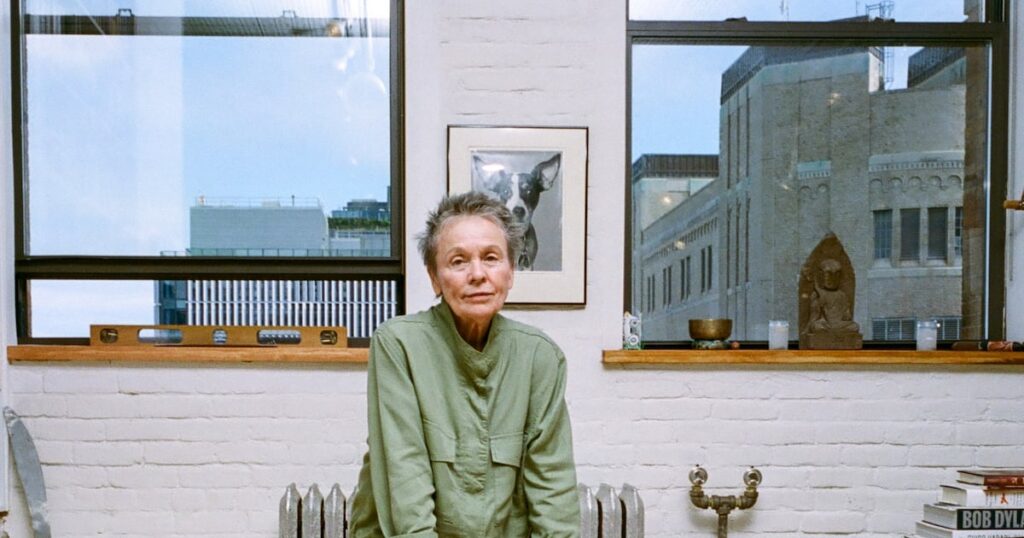
The day before we talk, on the anniversary of her wedding to the late Lou Reed, Laurie Anderson woke up in Paris with his song Sunday Morning ringing in her head.
She recites the words: “‘Sunday morning, and I’m falling. I got a feeling I don’t want to know. Early dawning, Sunday morning, it’s all the streets you crossed, not so long ago.’ And, you know, it ends up with such a great line,” she says. “‘Watch out. The world’s behind you.’”
Anderson never planned to get married, she says, “but I was trudging along a dusty road in Colorado, I was on tour, and I was talking to Lou [on the phone], and I said, ‘There’s so many things I never did. I never learned Greek. I never went to Egypt. I never got married.’
“Lou really loved the idea of marriage. He said, ‘I’ll get on a plane right now.’ And he did. We got married the next day. We were together for 21 years.
“Like many marriages, it was very wonderful, very complicated. So [yesterday] I thought, ‘Here I am in Paris. It’s my anniversary. I’ve been celebrating alone for quite a while. I’m going to celebrate with some other people tonight …’
“And because he did his very last concert in Paris, I had so many images of him walking along the street in his long black coat. I could just see him … What a great chance to celebrate love, and also, at the same time, death.
“For me, and the tradition that I’m in, that’s the purpose of death: the release of love. And I could really feel that.”
Before this interview, it was gently suggested to me that, going by previous experience, Anderson might not want to talk about Lou Reed. I hadn’t been planning to mention him. Anderson is, after all, an equally important cultural figure.
In 1981 she had a huge pop hit with O Superman, a wonderfully avant-garde pop song contained on her album Big Science. But she is also a pioneer of electronic music, of spoken word, of film-making and of multimedia art.
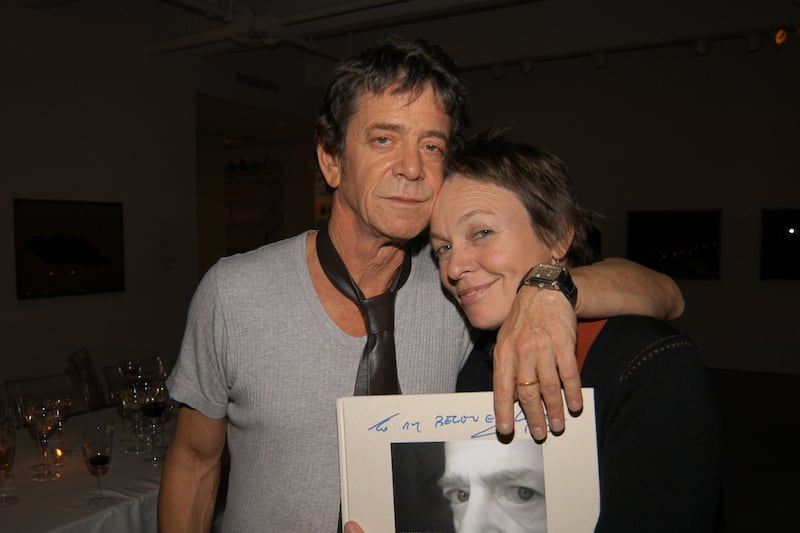 Lou Reed and Laurie Anderson in New York in 2005. Photograph: Patrick McMullan/Getty
She has been an artist-in-residence at Nasa. She has performed concerts designed for dogs. I saw her perform once, at Borris House Festival of Writing & Ideas, in 2022, improvising with the Irish musician and broadcaster Fiachna Ó Braonáin; he was clutching a large recorder while Anderson used a sampler app on her phone.
She brings up Reed’s anniversary unprompted as she speaks over the phone from France. In her worldview there’s no demarcation between life, art, politics and love. This comes out of her interest in Buddhism.
“I don’t draw any lines,” she says. “Being an artist and a Buddhist are exactly the same for me. Fortunately, Buddhism doesn’t require you to believe anything, and nobody’s in charge. This is like crack for an artist. ‘I’m in charge? Okay. I’ll take it.’”
She is, at the moment, practising how to “feel sad without being sad … This is a very, very useful distinction, because there are many sad things in the world. If you pretend that they’re not there you’re an idiot.”
But there’s a qualifier, she says. “We are here not to suffer. We’re here to have a really, really, really, really good time. That’s the whole point. I tell myself this 10 times a day: Feel it. Don’t be it.”
Anderson has also become quite interested in Mary Magdalene, whom she found, to her surprise, fitted perfectly in a Buddhist tradition.
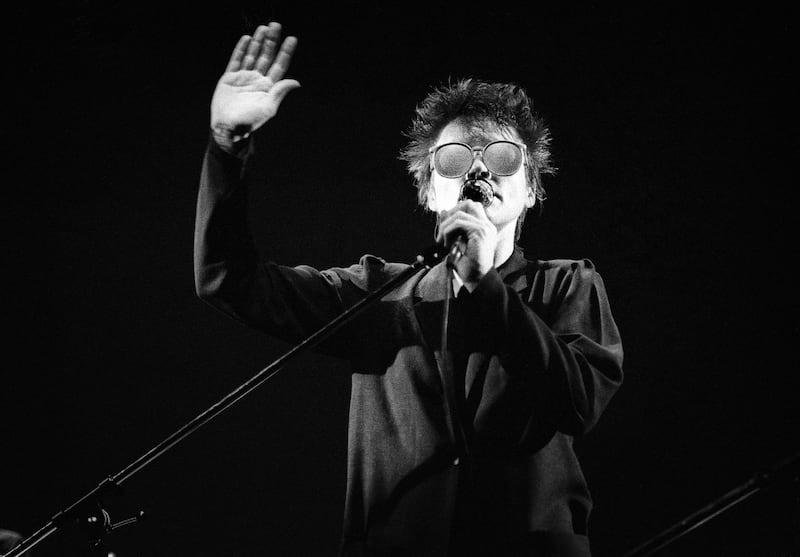 Laurie Anderson on stage in Amsterdam in 1982, the year her influential and critically acclaimed album Big Science was released. Photograph: Rob Verhorst/Redferns
“What all of these different translations are revealing is that she was saying that this kingdom of freedom, of truth and goodness, is accessible through your mind …
“She’s not talking about access [to knowledge] through the pope or through the priests or through anybody … This was not good news for people who want to go through the channels of power.”
It’s good news, however, for someone like Anderson, “who is very attracted to this idea that we live only in the present and no one’s in charge and it is through our minds that we can access everything.”
One of her big influences was the composer John Cage, who was obsessed with randomness and musical processes and how they mark the passage of time.
“He got a lot of things from Buddhism, as many American artists did in the 1950s. People came from Japan. They came back from India, where their minds had been blown by their teachers.”
A lot of these composers began experimenting with hypnotic drones. “This was a huge influence on me,” she says. “And it also influenced, for example, Philip Glass and a wonderful artist who I recently heard in Knoxville, Charlemagne Palestine, and [William] Basinski with his ‘disintegration loops’.
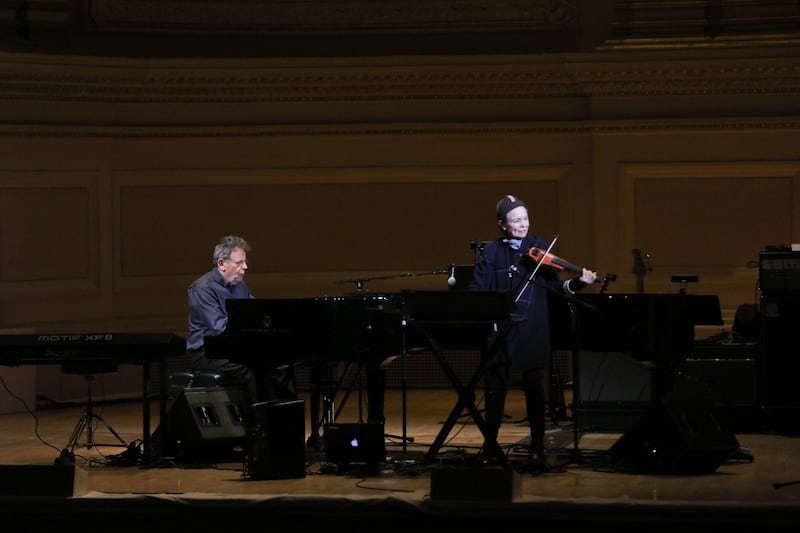 Laurie Anderson performs with Philip Glass at Carnegie Hall in New York in 2017. Photograph: Rebecca Smeyne/The New York Times
“Listening to them is a way of really freeing my mind and letting things go … I grew up with music that was changing its mind every four bars. With Beethoven you’re happy, you’re sad, you’re depressed. There’s a lot of emotion packed into these things, but it’s also very histrionic in ways.”
She pauses.
“Not that I don’t love that stuff. I love all music – with one exception, and that’s musicals.”
Why musicals? Anderson laughs.
“If I hear a musical I have a nervous breakdown. In fact, I was trapped in one [recently], and after about five minutes I had a very strange heart situation. My blood pressure dropped to almost nothing, and I ran to the bathroom and I fainted.
“A friend scraped me off the floor and put me in an emergency truck to the hospital. I’m sure there are many wonderful musicals. I just have a blind spot.”
‘We do not have free speech in the United States any more. You cannot say the word ‘genocide’ or you will be cancelled’
— Laurie Anderson
How has her approach to art changed? “I’m not the kind of artist who wants to express myself,” she says. “That was never my goal. I don’t care if you know me … I’m somebody who likes to point and say, ‘Look over there. That’s a weird plant I’ve never seen before. What’s going on? Why is that happening?’
“I always did that, and it hasn’t really changed that much, sad to say. At various times it becomes more about one thing than another. There are various shifts. At times like this I will become more political, my own version of political.”
Republic of Love, the show she is bringing to the National Concert Hall in Dublin shortly with the jazz band Sexmob and some other musical guests, is an exploration of the current state of the US. It involves spoken word and music and reimaginings of works by Anderson, Reed, Bob Dylan, William Burroughs and Gertrude Stein.
“It started in Vienna last spring,” Anderson says. “They were doing a big festival of music and dance and theatre and literature. And the theme of the festival was the rise of fascism in Europe. They asked me to come and do a two-hour talk about government and love.
“And I was, like, whoa, I don’t often get assignments like this, but what a great time to talk about ‘stories’. Yesterday our megalomaniacal leader posted himself as a huge Jesus helping a sick person. And then when people said, ‘That’s a little over the top,’ he said the pope is not good for the market. And then his next post was an image of Trump Tower on the moon. What a moment to be an artist!”
Sometimes there’s blowback for being outspoken, Anderson says. “I have been cancelled in Germany. It’s very painful to be doxed and accused of anti-Semitism [for criticising Israel’s actions in Gaza].
“We do not have free speech in the United States any more. You cannot say the word ‘genocide’ or you will be cancelled. You can’t say anything that isn’t praise for Israel.
“One of my heroes at the moment is [Jorge Luis] Borges, who said ‘censorship is the mother of metaphor’. I’ve always used that as a way to speak in code to people. But I’m dropping some of those codes these days.”
![Laurie Anderson: '[I use AI] all the time. I do lots of things with it. It’s also extremely dangerous.' Photograph: Ebru Yildiz](https://www.inbella.com/wp-content/uploads/2026/06/7MWWAAO5BVFL5FDIZY6Z3KGR3E.jpg) Laurie Anderson: ‘[I use AI] all the time. I do lots of things with it. It’s also extremely dangerous.’ Photograph: Ebru Yildiz
Laurie Anderson: ‘[I use AI] all the time. I do lots of things with it. It’s also extremely dangerous.’ Photograph: Ebru Yildiz
The right have “taken the reins of the stories, and they’re riding really hard. So you better get a good story, or you better be able to see through theirs. It’s a story war.”
How important is collaboration for Anderson? “I’m trying to make a lot of room for the musicians [in this show], because they’re all composers. They all have their own ways of thinking about music, making it, presenting it …
“I feel so lucky to get to play with these people, because they have new ideas every night. And it just happens organically. I really love improv. I used to hate it.”
Why? “Because my shows had a lot of elements in them, and they were timed, and it got a little on the rigid side,” she says. So the composer and musician John Zorn “says, ‘Hey, do you want to do an improv show?’ I was, like, ‘I don’t know. What does that mean? Who starts?’
“And he says, ‘It depends.’ I said, ‘Well, what key?’ and he says, ‘I don’t know. Let’s see.’ I thought, ‘This sounds like a very bad idea,’ but we started, and I was, like, ‘I’m free.’”
Anderson takes that spirit into everything now, she says. “You and I are talking right now. We’re just coming up with things that are based on what the other person’s saying and going back and forth. I love conversation.”
‘I think it’s always good to remember that you really don’t need anything except a way to be inside yourself and be expansive’
— Laurie Anderson
She has long been an early adopter of new technology. At the beginning of the pandemic, Anderson was an artist-in-residence at the Australian Institute for Machine Learning, in Adelaide, experimenting with what was, at the time, the world’s largest language supercomputer. She used it to, among other things, reinterpret the Bible.
“The three languages that make up the Bible – Hebrew, Aramaic and Greek – you can control how much of each language will be used in each translation … The question was, if you emphasise the Greek, would the Bible be more rational? If you emphasise the Hebrew translation, would it be more mystical?”
They also mixed it up with everything Anderson herself had “ever written or muttered”.
“They sent me a 9,000-page book: the Bible according to me.”
She is fascinated by Donald Trump’s use of AI in his memes. “He is using it to very effective ends in his world, and creating this fantasy world that has nothing to do with anything.”
Anderson uses artificial intelligence “all the time. I do lots of things with it. It’s also extremely dangerous. I have another teacher who’s always quoting a cryptologist who said, ‘If you think technology is going to solve your problems, you don’t understand technology and you don’t understand your problems’.”
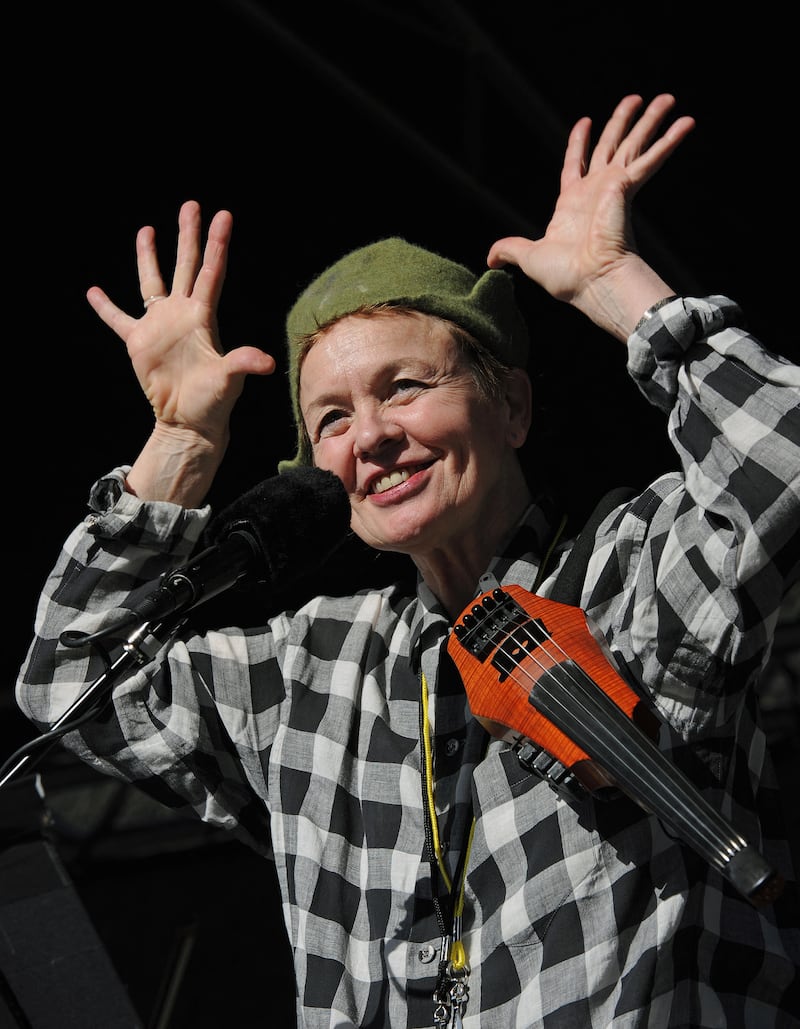 Laurie Anderson during her Music for Dogs concert at the Sydney Opera House in 2010, which almost 1,000 dog-lovers and their pets attended: Photograph: Greg Wood/AFP/Getty
But she thinks AI is too big a subject to generalise about. “It’s like when people say stuff about the United States. It’s not a small place. There’s 340-plus million people with a lot of different attitudes. It’s important to keep in mind only 70 million of those voted for the current king. And a lot of them are going, ‘Oh, I think I might have made a colossal mistake.’”
At 79, Anderson is still ridiculously prolific. Does she ever get creatively blocked? “Everyone does,” she says. “When I feel stuck I just try to relax and go, ‘So what?’ It makes me look around at where I am that moment, and that will give me, maybe not ideas for things, but a sense of, ‘Wow, I’m here. I’m not living in the future. I’m in this room doing this thing right now.’
“People are always thinking they don’t have enough. And I think it’s always good to remember that you really don’t need anything except a way to be inside yourself and be expansive.”
And then, on cue, she says, “Wow, the sun just came out. Oh my God, this is the greatest town in the world. The sun just came blasting out.”
Perspectives: Laurie Anderson with Sexmob – Republic of Love is at the National Concert Hall, in Dublin, on Saturday, July 11th