
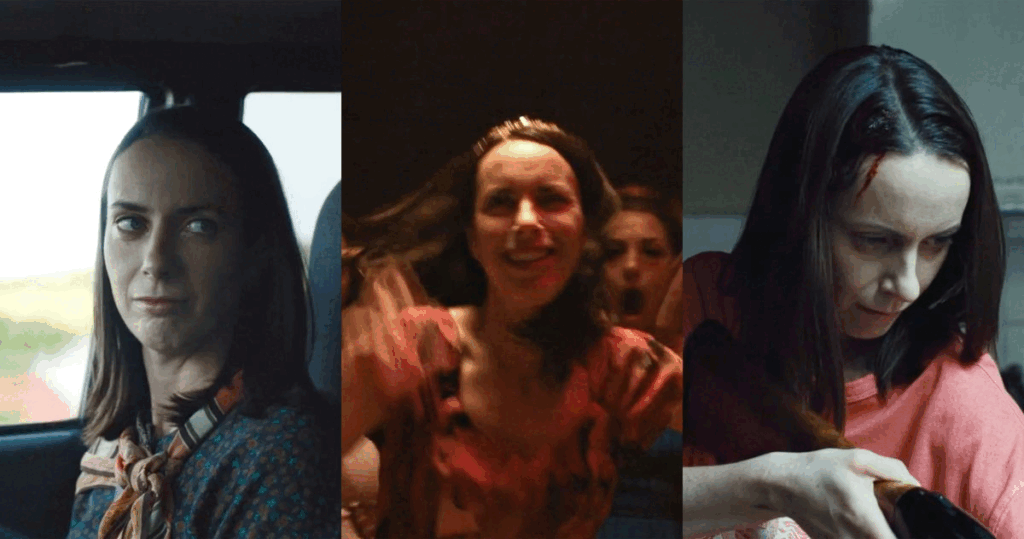
Before Widow’s Bay, Kate O’Flynn had never heard of a final girl. The actress didn’t care much for horror movies growing up, and she found gory slashers too stressful. “I’m highly sensitive,” she says. But she had seen some of the classics, including The Shining, in which Wendy Torrance and her baseball bat outlast the nightmares at Overlook Hotel. So when she was asked to do a second audition tape for a horror-comedy series called Widow’s Bay and received the note “Do a dash of Shelley Duvall,” she knew she stood a chance at nailing the part. “I understood that kind of neurotic stare.”
O’Flynn is gifted at channeling Duvall’s flailing, manic energy, telegraphed through a swish of dark brown hair and cartoon-wide green eyes — but her performance, like Widow’s Bay itself, goes beyond pastiche. Both are referential, packed with Lynchian flourishes and Stephen King Easter eggs, but at the same time like nothing else onscreen, a combination of slapstick humor and genuinely frightening jump scares that feels all its own. The Apple show about a cursed island town off the coast of Massachusetts and the mayor determined to make it the next Martha’s Vineyard is the buzziest new series of the year, riding a wave of word-of-mouth praise that helped it grow viewership 20 percent with each weekly release since it debuted in April. And O’Flynn is its breakout star, achieving fan-favorite status not by regurgitating girls-in-horror tropes but by bringing Royal Academy gravitas to a character who might have initially read like a wallflower. Over the course of ten episodes, Patricia transformed into the tonal lynchpin of the series. She might even win O’Flynn an Emmy.
Patricia is Widow’s Bay’s unconventional final girl, the somewhat sullen, charmingly awkward 40-something assistant to Matthew Rhys’s Mayor Tom Loftis and the sole survivor of a serial killer who haunted the teen girls of the community decades prior (though none of her neighbors or colleagues believe she was ever targeted). In the weeks since the show premiered, memes and unauthorized merch capturing Patricia’s dispassionate delivery, heroic shotgun wielding, and jerky dance moves have flooded the internet. “I want to give her a hug and also find her a bit creepy all at once,” reads one top Reddit comment. “Patricia is the love of my life,” declares another. Relatability is an overhyped virtue these days, but fans seem to see themselves in Patricia, whose teenage traumas have rendered her a social pariah desperate for connection. When even her attempts at enjoying life’s simpler pleasures — like some chicken parm and coconut cream pie at home with a glass of wine — go tragically awry, Patricia’s disappointment and exasperation are both hilarious and painfully palpable.
“She just came clearly to me,” O’Flynn tells me on a beautifully sunny day in southeast London’s Beckenham Place Park. We’re sitting at a picnic table at the Homestead Cafe among the bustle of young families and their expensive prams and designer dogs. The restaurant is famed for its pizzas, but we’re both enjoying a particularly delicious vegan sausage roll; O’Flynn is washing hers down with a black coffee. She says she was drawn to Patricia’s specificity — her idiosyncrasies, her desires — and the way creator and showrunner Katie Dippold evoked the fully formed world of Widow’s Bay on the page. It was clear to O’Flynn from an early script that “even the smaller characters weren’t just performing a function to serve the plot.” Patricia mattered. When Dippold saw O’Flynn’s audition, “It really felt like, Oh, this Patricia found a camera and sent in her tape,” Dippold says. “It wasn’t what I imagined, but at the same time, this is Patricia, so what can you do?”
Where Patricia wears her dark, shoulder-length hair in a lank curtain, as if trying to hide her face from the world, O’Flynn sports a high ponytail and a wide smile. At first, I almost don’t recognize her without Patricia’s ’70s-inspired wardrobe of neckerchiefs and plaid jumpers. (Later, she admits she did swipe a few of Patricia’s “really, really good bras — great under T-shirts.”) Today she’s wearing a blue LF Markey jumpsuit embroidered with colorful trucks and ladders and a pair of pink and white trainers. It isn’t just the cheerful outfit that distinguishes her from her character; O’Flynn is much more comfortable in her skin than Patricia has ever been. The character has a quick, stiff, lurching walk that renders any scene she’s in instantly funnier, but O’Flynn is loose and graceful, at ease. Patricia’s perfectly realized New England accent, honed with the help of a dialect coach, is often a quiet, exasperated grumble, while O’Flynn’s speaking voice is slow and thoughtful, yet clear and almost singsongy in the manner of a northerner who’s lived in London for more than 20 years.
Patricia was introduced in the Widow’s Bay premiere, but she truly arrived in the fourth episode, “Beach Reads.” Ridiculed by her former classmates one too many times, Patricia attempts to follow what she thinks is a self-help manual for throwing a perfect party — “Sunset Cocktails” with free drinks, as she puts it on the invite. The manual turns out to be a haunted spell book with which she unknowingly bewitches townspeople and tourists alike. Patricia is horrified when she looks in a mirror and, spell broken, realizes she’s wearing a freaky antler crown and making her guests punch with the blood and entrails of dead animals. In an instantly iconic and much-memed exchange, she yells at Dale Dickey’s Rosemary, her co-worker and another of the island’s offbeat civil servants: “You had your qualms? Why didn’t you say anything?” To which Rosemary responds: “You told me to be supportive!”
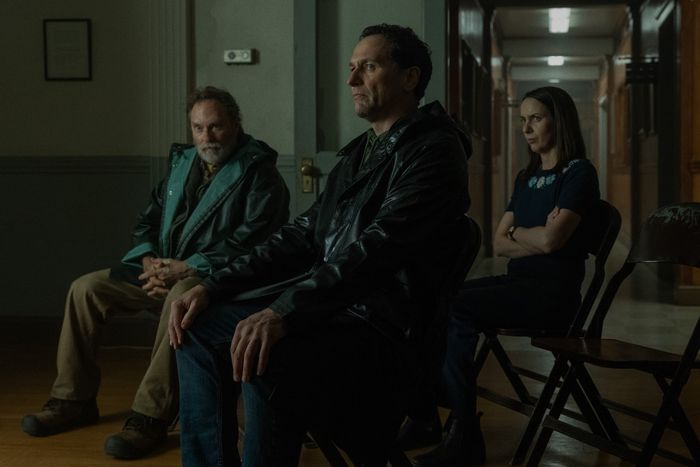
With co-stars Stephen Root and Matthew Rhys.
Photo: Robert Clark/Apple TV
“What I relate to is the small-town thing,” says O’Flynn, who grew up in Bury in northwest England, a market town in the historic county of Lancashire where she was raised by Irish parents in an era when footballer WAGs set the trends. “I remember not fitting in there,” she says as we stroll through the park. “These really bright women would kind of dumb themselves down or talk in a baby voice to get attention or be popular. That was never something I could do or wanted to do. My group of geeky girls were really into that 1995 BBC adaptation of Pride and Prejudice.”
O’Flynn left home in 2003 to attend the Royal Academy of Dramatic Art, one of the most competitive drama schools in the world. Alone in London at 18, she leaned into the unglided vowels and broad folksiness of her accent. “I was so overwhelmed by the change that I became this sort of chirpy northerner,” she remembers. “That was my distinctive, self-imposed identity in a group of 32. What makes you, you.” O’Flynn knew her whole life that she wanted to be an actor — “I can’t remember ever not wanting to do it,” she says. Growing up, she’d go to the cinema for major blockbuster moments like Titanic and She’s All That. (“My taste didn’t really develop until later,” she jokes.) She’d gone to some plays with her parents — more traditional fare — but it was getting into the youth theater at the Royal Exchange in Manchester as a teenager, through which she received a ticket for free performances every Monday, that introduced her to writing that “opened up the world.”
That writing was not exactly comedic. At RADA, she was classmates with Fleabag’s Phoebe Waller-Bridge and Sian Clifford, “but I don’t think any of us would be like, ‘We’re funny.’ We were too busy doing Jacobean tragedy really, really badly.” That led to more theater roles postgraduation, working for little or no pay through much of her early 20s, “one small project to another,” and collaborating with budding, as-yet-unestablished playwrights; she also did a lot of temping. In 2008, she got her break when British auteur Mike Leigh cast her in her first film role in Happy-Go-Lucky, where she played the sarcastic younger sister of Sally Hawkins’s overly cheerful elementary-school teacher. Leigh is known for making films in a collaborative, improvisational process with his performers and has stayed close with O’Flynn through the years. “He always comes to my plays,” she says. “He loves actors, and he sees you as an artist. I didn’t understand how rare it was to work in that way.” He’s since cast her in three more films, including a still-untitled project reuniting her with Marion Bailey and Paul Jesson.
Happy-Go-Lucky kicked off a spate of TV roles in British sitcoms and detective mysteries, but O’Flynn kept on in the theater, too, and in 2013 earned a Critics’ Circle Theatre Award for Most Promising Newcomer for her role as Racheal Keats, the daughter of a mother who abandons her family, in Port. A Laurence Olivier nomination for playing Laura in a 2017 revival of The Glass Menagerie followed. “She pulls a tremulous vitality — a gleam on the face, a quickened voice — from what seemed to be complete blankness,” The Guardian wrote at the time. Film and TV directors began casting her in roles that required comedic chops. O’Flynn stole scenes opposite Renée Zellweger as a high-strung newsroom manager in Bridget Jones’s Baby and in Amazon Prime’s much-loved but prematurely canceled historical romantasy series My Lady Jane, in which she offered a memorably deranged take on the doomed Mary Tudor as a villainous dominatrix.
Even so, her biggest challenge on the Widow’s Bay set was keeping up with the humor. Several members of the cast and writer’s room, including Dippold and co-star Jeff Hiller, got their start with the Upright Citizens Brigade, an improvisational sketch-comedy group founded by comedy bigwigs like Amy Poehler and Adam McKay. The U.K. doesn’t have this type of joke-a-minute culture, and the constant quipping and one-upmanship — “It’s like a team sport,” O’Flynn says — both impressed and intimidated her. In the first scene she shot, Stephen Root’s Wyck, the only person in Widow’s Bay who truly takes the curse seriously, attempts to board up the local bed and breakfast to prevent unwitting tourists from entering. “I was like, Oh my god, Stephen Root, a machine!” she remembers. “He was karate chopping, really going for it, getting take after take.” She preferred the more physical aspects of her role: throwing around her limbs to “The Rhythm of the Night” at Sunset Cocktails, or running, high-kneed and screaming, from the Boogeyman. Andrew deYoung, who directed Patricia’s final showdown with the masked killer for episode eight, “Your Baggage,” would yell “Feral, Kate!” and O’Flynn would oblige. “The way she moves, her gait, she’s just always huffing and puffing like a Muppet,” says Dippold. “I love nothing more than an off-camera kind of reaction, and you can always hear her sigh.”
Filming Widow’s Bay in central and eastern Massachusetts was O’Flynn’s first time in the U.S. since age 14 (“even then, it was just to Disneyland,” she says, so it hardly counts). She took her husband and 18-month-old daughter along for the summer, where they indulged in New England cuisine (“Everyone’s got an amazing ice-cream shop,” she says) and explored tourist traps like Salem’s Witch Museum. (“We took her out of that immediately because it was a bit too scary,” she says of her toddler.) But the culture shock hit harder than she expected. “I don’t want to disparage the U.K., but the work ethic? Oh my God,” O’Flynn says. “There’s a toughness. You guys work and work and work and work!” She wonders if that has to do with the relative lack of a social safety net in the U.S.; Americans really have to hustle for health insurance. “That felt different. Not that we’re, like, slacking off over here, but it’s a different energy.”
O’Flynn’s an avid hiker, and in 2018, she climbed to Everest base camp with one of her best friends, Jonathan “Johnny” Bailey, to celebrate his 30th birthday. The pair met while playing Romanov siblings in a 2009 production of The House of Special Purpose and have watched each other’s star rise in the years since. “I’m really in awe of how he’s navigated it,” she says. When I ask how she’s been managing the newfound attention for herself, though, she grows quiet. We’ve been chatting for over an hour by this point, the conversation flowing easily; this is the first time O’Flynn sounds a bit unsure, slow to choose her words.
“I’ll be honest, it is a surprise, how much she seems to resonate,” she says. Though she isn’t on social media herself, Dippold has been sending her some of the memes, the Patricia fan-cam edits set to Charli XCX songs; somebody even made an action figure. “It’s really heartwarming because she is, you know, not your obvious anything,” O’Flynn says. “She feels really real.” All of the characters feel real, I agree. “And everyone’s got an interesting face,” O’Flynn adds. That’s something British television has always done particularly well: showcasing actors who look like people, not over-fillered Instagram models of the kind we tend to get on U.S. screens. The women of Widow’s Bay capture all stages of life. Dickey wields Rosemary’s pack-a-day-for-half-a-century smoker’s cough with glee, and K Callan, who plays the mayor’s elderly secretary and turned 90 in January, gives a devastating monologue in the season finale. O’Flynn herself turned 40 in the middle of shooting, and the cast and crew lined up in the hallway of the mayor’s office set with director Hiro Murai filming her reaction as she walked through the parted tide to Rhys waiting at the end with balloons in hand. (“Am just glad a far greater audience knows now of her comedy genius,” Rhys said over email when asked about working together.) Then she and her family went to the beach.
Widow’s Bay will likely begin shooting season two next year. The week after we meet, O’Flynn will gather with her castmates to see a cut of their still-untitled Mike Leigh project for the first time; sometime later this year, perhaps at Venice, we’ll see her starring alongside Cate Blanchett in Sweetsick, the directorial debut of O’Flynn’s frequent theater collaborator Alice Birch. But for now, she’s unbothered by all the fuss and plans to relax into the summer with her family. “I guess what I’m really enjoying is the quiet,” she says. By now, we’ve lost our way in the park. I offer to look up where we are on Google Maps, but O’Flynn has lived nearby for ten years and prefers to approach a woman with a little white dog who happily points us in the right direction. We brave a patch of brambles and manage to make it out onto a more well-trodden path. “I can enjoy, like … this!” she says, gesturing at the silent grasslands around us. “I’m not having to hustle.”
See All