
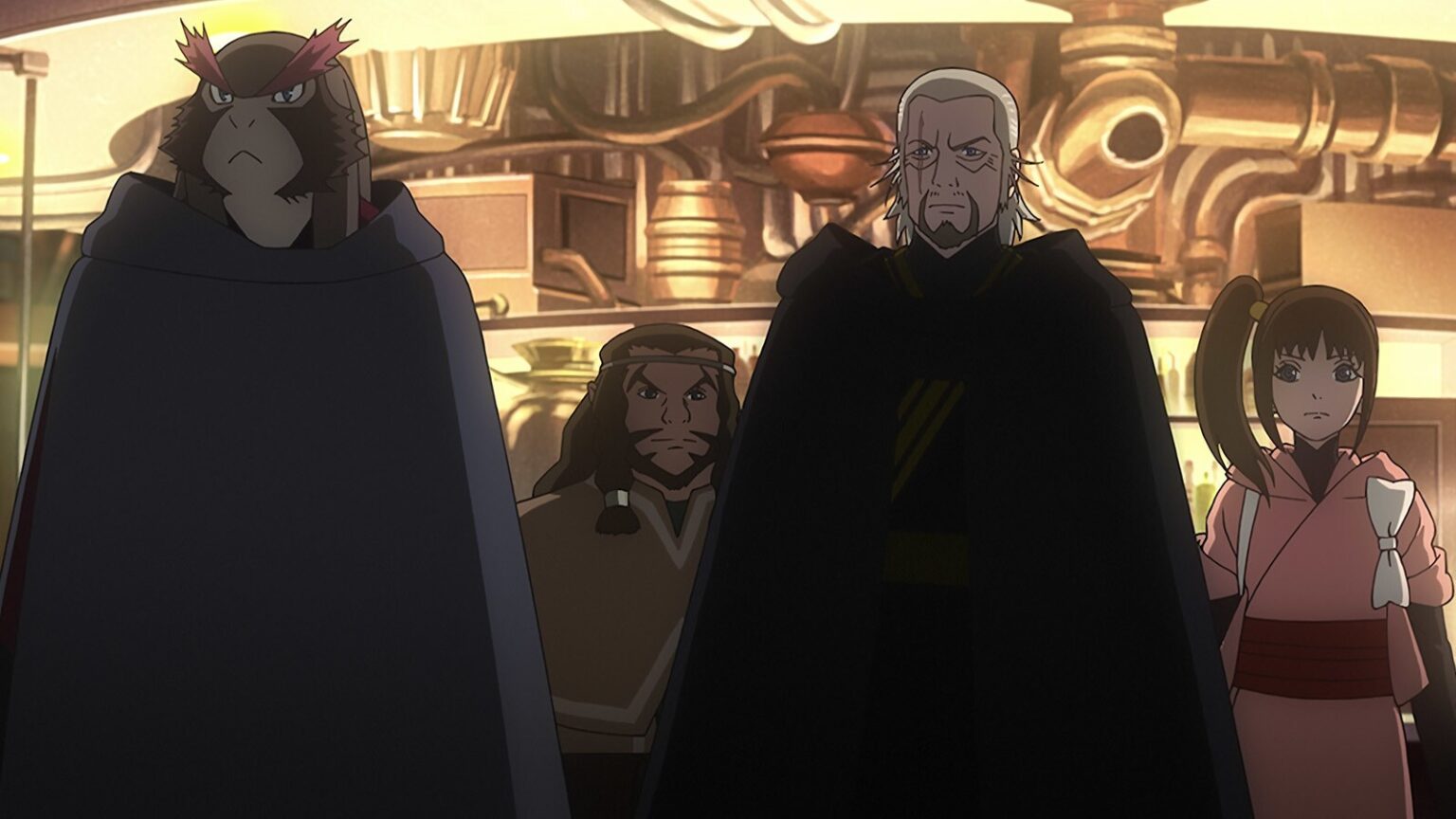
The series creators share their thoughts on Kara, Nawaam, and what it means to be a Jedi or a Sith.
Lucasfilm and Production I.G’s “The Ninth Jedi,” the tale of young Lah Kara’s quest to rescue her father, debuted in the innovative first volume of Star Wars: Visions. The fan-favorite story continued in the third volume with the poignant and unforgettable “Child of Hope.” Now, Star Wars: Visions Presents – The Ninth Jedi, an all-new limited anime series, continues Kara’s story August 5, exclusively on Disney+ and Hulu.
Ahead of revealing a new official trailer at Anime Expo, Producer Hitoshi Ito, Supervising Director Kenji Kamiyama, and Director Shunsuke Tada spoke to StarWars.com about creating the imaginative series, the foreboding new foe Nawaam, and what the future holds for Kara.
“I was very happy to hear that fans from all over the world especially liked The Ninth Jedi,” said Ito.
Kamiyama wanted to tell the complete tale of Kara’s adventures since their first foray in Star Wars: Visions. “When I got offered to make a short at the very beginning, I worked on it as if I was working for a feature film,” he said. “I was already building a lot of character backgrounds and settings.”
The series is set in the distant future, long after the Empire and the Rebel Alliance, when the Jedi have faded into legend. Lah Kara, the daughter of Lah Zhima, leaves her home alongside new Jedi allies to free her father from the clutches of Jedi Hunters. Kara’s father is the only known sabersmith in the galaxy, making the lightsaber – and Zhima himself – an invaluable asset.
In The Ninth Jedi, the color of a lightsaber blade changes according to the wielder’s alignment with the Force – a concept that stemmed from a delightful misconception. When Kamiyama watched the original Star Wars trilogy for the first time, he assumed that lightsabers automatically changed color; while he later became aware of his mistake, he brought that compelling idea into his vision of Star Wars.
Zhima raised his daughter Kara to respect and use the Force, but with some reservations. “He didn’t want his daughter Kara to be a Jedi,” said Ito, “because his understanding was that Jedi dispense justice. To succeed in that mission, they might sometimes need to kill someone. For Zhima, that was a challenge. But Kara is a new generation of Jedi, so overcoming that challenge and developing herself is a big theme in the latter part of the series.”
Her earnest personality and humble origins are reminiscent of another young hero setting off on an unexpected adventure that takes him far from home: Luke Skywalker.
“Luke was also an unknown boy and not talented in the beginning, [and] he gradually becomes a true Jedi,” said Tada. “We tried not to make Kara look like a Master from the beginning, but she’s gradually growing. In the original story of The Ninth Jedi, Kara’s not trying to win over her father or somebody else. She’s trying to win over herself and grow as a person.”
But Kara is a more modern hero, Kamiyama added.
“I feel like she’s a very modern character,” he said. “She already has a kind of natural talent in her. She doesn’t know at the beginning, but she’s naturally trained by Jedi. When she was chased by Jedi Hunters, the Jedi Hunters also saw something [in her] even though she didn’t know. And [her connection with] the Force is becoming stronger, although she doesn’t know how to use it.”
A hero always faces off against a villain, and in The Ninth Jedi, the masked General Nawaam – loosely inspired by Anakin Skywalker and Darth Vader – pursues his own idea of justice.
“A main [theme] of The Ninth Jedi is that things aren’t always black and white, dark and light,” Kamiyama said. “I asked myself if there are some problems that Jedi cannot solve. There’s a contradiction that Jedi want to make peace, but there are some things they can’t solve with the Jedi Order only. Everyone has to have some kind dark side to solve something, to be good. But do you call it a completely dark side? We wanted to create a new definition of a Jedi. Kara is pure light side, but Nawaam reflects the duality of humans.”
Kamiyama, Ito, and Tada enjoyed the process of exploring those themes and developing the characters of The Ninth Jedi alongside their collaborators at Lucasfilm. “There was a lot of creative freedom, and we have a mutual respect,” Kamiyama said. “It was a very, very fun experience.”
“This time, we developed together during script writing and setting,” Tada added. “That’s why I felt really, ‘Oh my gosh, I’m on a Star Wars team.’ I really felt that I’m part of the team.”
Follow Kara on her journey when Star Wars: Visions Presents – The Ninth Jedi premieres August 5, 2026, on Disney+ and Hulu.