
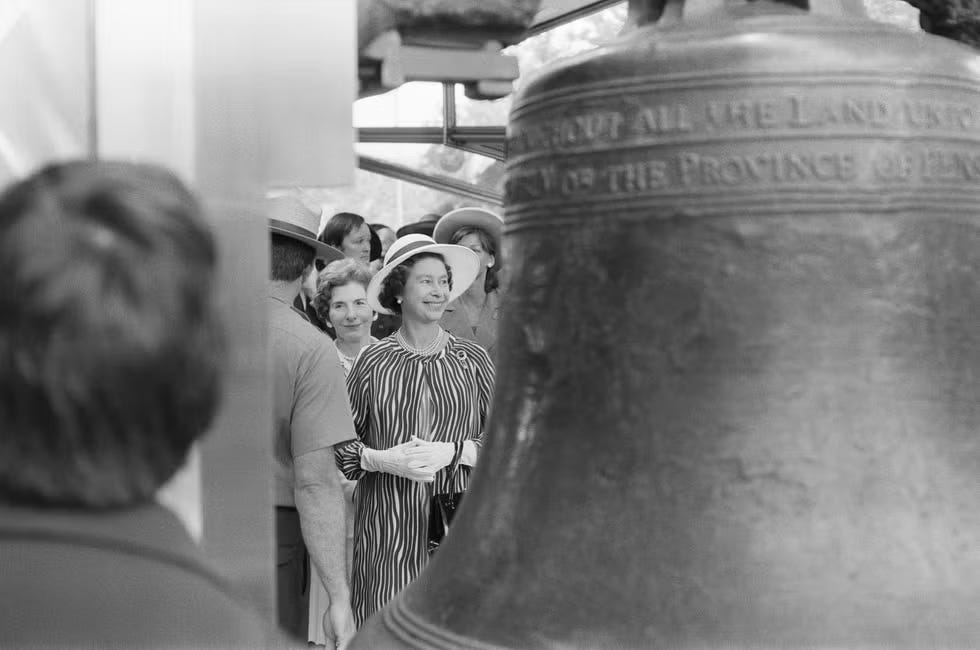
 Queen Elizabeth II in Philadelphia after donating a “Bicentennial Bell” to the United States, July 6, 1976
In July 1976, the United States was in a mood to celebrate its founding with a sweeping Bicentennial celebration featuring fireworks, a parade of tall ships, and a visit by the great-great-great-great granddaughter of George III, the king who was humbled by America’s forefathers. Queen Elizabeth II stopped in seven cities over six hectic days, following the guidance of her favorite private secretary, Martin Charteris, to “spread a carpet of happiness.”
The Queen looked as lovely as ever at age 50, and 55-year-old year old Prince Philip still made women’s hearts flutter. She was on the cusp of celebrating her Silver Jubilee marking 25 years on the throne, and her family seemed in good form. Twenty-seven-year-old Prince Charles was serving as an officer in the Royal Navy, Prince Andrew at 16 was attending Gordonstoun School in Scotland, and her youngest, 12-year-old Prince Edward, was a boarding student at Heatherdown Preparatory School. Her only daughter, 25-year-old Princess Anne—married since 1973—had been selected to compete for England in equestrian events at the Summer Olympics in Canada to be opened by the Queen in mid-July.
“Would conspicuously lack dignity”
President Gerald Ford, a genial and moderate Republican, was delighted to host Elizabeth II and strengthen Anglo-American relations. The mood of the nation was largely civil and settled after the tumult of the Watergate scandals, the resignation of Richard Nixon, and the end of the Vietnam War. When the visit was first proposed in 1972, British officials were dubious. Rowland Baring, the 3rd Earl of Cromer, the British Ambassador to the United States, had worried about “a certain degree of uninhibited zest about the American celebrations of the Declaration of Independence with which it might not be entirely desirable that The Queen should be associated.” He was concerned that the Bicentennial “would conspicuously lack dignity.”
She and her advisers disagreed, and she happily accepted America’s invitation in the spring of 1975. She would arrive in Philadelphia on Tuesday July 6, 1976, finessing the actual day commemorating American independence from England. “July 4th was really pushing it,” wrote David Walker of the British Embassy in Washington. “Forgiveness can only go so far.”
The Queen’s floating country house
The Queen, Prince Philip, and an entourage of 20 flew first to Bermuda. Among them was Virginia Airlie, the only American lady-in-waiting, who was married to the 13th Earl of Airlie, a friend of the Queen’s since childhood. (Farewell to the Only American lady-in-waiting to Queen Elizabeth II, Royals Extra, August 24, 2024) They then traveled to the United States on the Royal Yacht Britannia, the iconic 412-foot-long symbol of the monarchy that was retired in 1997 and now draws tourists to her berth in Edinburgh. The ship doubled as the Queen’s floating country house where she could deploy soft power before that term was invented, hosting dinners, lunches, receptions, and meetings wherever the ship docked.
The tour was jammed with engagements from morning until late at night and brimming with memorable occasions. Today as America celebrates its Semiquincentennial, I’d like to share some of my favorite moments—private as well as public—from the Queen’s historic visit five decades ago.
In the Spirit of ’76, I am providing this Royals Extra in full to all my subscribers, without a paywall. I am also offering an Independence Day sale, with a paid subscription discount of 20 per cent—$48 a year or $5 a month—that will be in effect for the next two weeks. I hope my free subscribers take advantage of this offer and become paying subscribers—support that makes Royals Extra possible. At the end of the sale, the price will revert to $60 a year and $6 a month, the cost since Royals Extra began in March 2023.
This is my 186th Royals Extra, a number I never envisioned when I started writing on Substack. I have always promised my subscribers that I would take you beyond the headlines and offer perspective and information about the British royal family you can’t find elsewhere. I would be so pleased if more of you are able to step up to paid subscriptions so you can read each Royals Extra in its entirety and have access to its archives. To all of my subscribers, please accept my gratitude as well as a salute to 250 years of American independence.
 Queen Elizabeth II and Prince Philip arriving in Philadelphia to kick off their Bicentennial tour, July 6, 1976
“We lacked that statesmanship”
Disembarking from Britannia in Philadelphia, where William Penn landed in 1682 after sailing from England to establish the colony of Pennsylvania, the Queen and Prince Philip were greeted by 5,000 exuberant admirers on the dock waving American and British flags. The monarch and her consort were driven to Independence National Park, where an estimated 75,000 people watched the Queen donate a new 6-ton Bicentennial Bell cast in the Whitechapel foundry in London that had made the original Liberty Bell in 1752. In her remarks, she expressed “sincere gratitude to the founding fathers of the great republic for having taught Britain a very valuable lesson. We lost the American colonies because,” she said, adapting language from a speech by Edmund Burke in 1780, “we lacked that statesmanship ‘to know the right time, and the manner of yielding what is impossible to keep.’”
She hosted a luncheon on Britannia and visited historic sites including Independence Hall where the Declaration of Independence was signed. That night she was the guest of honor at a dinner for 400 at the Philadelphia Museum of Art. Her dinner partner was Philadelphia’s flamboyant mayor, Frank Rizzo. Defying protocol, he wandered off to work the room, greeting other guests. Two of her ladies-in-waiting were incensed, but Elizabeth was unfazed, saying only, “What a fascinating man he is.”
“One plants one’s feet like this”
Susan Crosland, the American wife of Britain’s new foreign secretary, Anthony Crosland, marveled that “the Queen never faltered in the day’s walk-about under remorseless sun.” On Britannia the night before they landed, Elizabeth instructed Susan on how to maintain her stamina through long stretches of standing at receptions and other events. Recalling the moment in her memoir, Crosland wrote, “‘One plants one’s feet like this,’ Her Majesty said, hoisting her skirt above her ankles to show. ‘Always keep them parallel, make sure your weight is evenly distributed. That’s all there is to it.’”
The royal party was flown to Washington, DC on the 7th for a hectic 48-hour stay. They landed in a helicopter near the Washington Monument as the temperature rose near 90, and they proceeded to the South Lawn of the White House for the Presidential welcoming ceremony. Brass bands played “Rule Britannia,” and there were so many photographers that some of them sat on tree branches.
 At the welcoming ceremony on the South Lawn of the White House, President Gerald Ford had to turn his back to the Queen while giving his speech, July 7, 1976
The arrangement of the platform resulted in an awkward situation for the Queen when President Ford had to turn his back on her as he made his remarks. When her turn came, she tried to position herself at an angle, glancing at him periodically over her shoulder. Neither of the two leaders seemed to mind, and they both spoke cordially about the importance of Anglo-American friendship.
 The state dinner in a tent over the White House Rose Garden, July 8, 1976
Julia Child appeared
For the white-tie state dinner that night, the Fords covered the White House Rose Garden with a large tent (mercifully air conditioned) illuminated by oversize Japanese lanterns. The 224 guests included British-born Hollywood stars Merle Oberon, Cary Grant, and Bob Hope. Earlier in the day, Julia Child appeared with a television crew in the White House kitchen and made a film on how Executive Chef Henry Haller prepared the food. The menu featured glazed New England lobster with black truffles, stuffed saddle of veal, and ice cream with raspberries. The Queen wore a yellow organza evening dress and a stunning diamond tiara, necklace, and earrings.
Unusually, Buckingham Palace and the White House agreed to allow public television to broadcast the dinner live, with the caveat that the cameras avoid catching any glimpses of the Queen eating or dancing. For the first dance in the East Room, the band played “Getting to Know You,” as President Ford and the Queen waltzed. Later in the evening, they prompted giggles when they danced to “The Lady is a Tramp” by Rodgers and Hart. Elizabeth and Philip had such fun that they didn’t return to their accommodations across the street at Blair House until nearly 1 A.M.—more than an hour after their scheduled arrival.
The following night, British Ambassador Sir Peter Ramsbotham hosted a white-tie “return dinner” for 84 at the British embassy residence. Among the guests was film star Elizabeth Taylor wearing a tight sequined dress displaying her ample décolletage, accompanied by John Warner, the handsome future US. Senator. It was their first date, and she would marry him five months later. After the dinner, 1,600 guests joined the Queen and Prince Philip at a reception in the residence’s gardens.
 Elizabeth Taylor, John Warner, and Happy Rockefeller, the wife of Vice President Nelson Rockefeller, at the British Ambassador’s residence, July 8, 1976
“Elizabeth Taylor making her grand entrance”
Michael Shea, the director of the British Information Services who would later become the Queen’s press secretary, recounted what happened next. The Queen was being followed by a television crew carrying cameras and high-powered lights. “Then suddenly,” Shea recalled, “total darkness. The cameramen and photographers were racing back up the lawn to where the guests were coming in. I thought it must be the President arriving, but no, it was Elizabeth Taylor making her grand entrance, which left the Queen, with a very angry ambassador to guide her, stumbling along in the darkness. She was merely amused, seeing, for once, someone else at the center of media attention.”
The next day the Queen wanted to arrive in New York City by water as she had done in her first visit to the United States as monarch in 1957. The royal party flew to New Jersey, where they boarded the 44-foot royal barge from Britannia. Crossing New York Harbor past the Statue of Liberty, they landed in lower Manhattan.
 Queen Elizabeth II and Prince Philip being driven through New York City, July 9, 1976
Following a luncheon at the Waldorf-Astoria Hotel, they made their way uptown in an open-top limousine, waving to throngs crammed along the sidewalks. Canon John Andrew, the Rector of St. Thomas’s Church on Fifth Avenue, was waiting for them on the corner of Park Avenue and 61st Street after leaving the luncheon.
“Lord, here she comes”
He had known them well since the 1960s when he served as chaplain to Archbishop of Canterbury Michael Ramsey and they had “many meetings” together. “I heard great shouting, ‘Lord, here she comes,’” Canon Andrew recalled. “I was about to cross 61st Street and heard the great motorcycles. Suddenly without warning, the motorcade turned left in front of me, and the next thing I knew, there was a car with two people standing up in a convertible—the Queen and Prince Philip. She was very very close. ‘Oh,’ she said, ‘Look, there’s John Andrew!’ I forgot myself and waved my lunch program. ‘Hello, hello, I’ll see you tonight!’ I said. They went past and I thought, ‘What a bloody fool. What a thing to say to the Queen.’”
 Queen Elizabeth II with Marvin Traub, CEO of Bloomingdale’s, on a tour of the department store, July 9, 1976
“Bloomingdale’s knows what’s hip”
That afternoon the Queen visited Bloomingdale’s. She chose the department store because it had become a renowned cultural experience for savvy New Yorkers. The success and trendy cachet of “Bloomie’s”, which attracted 300,000 customers a week, was the envy of what Morley Safer of “60 Minutes” called “the firmly established grand old ladies of Fifth Avenue, like Saks and Lord & Taylor.” “We are attracted by the fact that Bloomingdale’s knows what’s hip,” said Blair Sabol, a sharp-eyed fashion and culture critic at New York’s Village Voice.
Bloomingdale’s CEO Marvin Traub whisked the Queen from one department to another on a half-hour tour as customers applauded. When she encountered a model in a mid-calf Calvin Klein dirndl skirt, she asked, “Gracious, do you really wear skirts that long here?”
That evening on Britannia, the Queen hosted three dozen distinguished guests for dinner followed by a reception for another 200. Canon John Andrew arrived with Sharman Douglas, the daughter of Lewis W. Douglas, a former American Ambassador to the Court of St. James’s, who had known the Queen since her father’s tenure in the late 1940s.
“You looked so funny standing all alone”
“Instead of the usual greeting of ‘How nice to see you,’ the Queen threw back her head, laughed and said, ‘You looked so funny standing all alone on the corner of the street,’” Canon Andrew recalled to me. “Sharman kissed her since they were great friends. Philip came over and said, ‘What’s all this about?’ He was wearing an awful silk red New York City ‘Big Apple’ on his dinner jacket. I said, ‘What the Hell is that?’ So, Prince Philip took it off and stuck it on my forehead and said, ‘THERE!’ which started the Queen off again laughing.”
Traveling northward overnight, Britannia docked the next morning at Long Wharf in New Haven, Connecticut where the Queen was cheered by an estimated 50,000 residents as she toured their city in less than an hour. “It was great, it was a joy,” recalled Ed Surato, a librarian in the New Haven Museum. The royal entourage flew south for a day of visits to the University of Virginia and Monticello before reuniting with Britannia in Newport, Rhode Island.
The city where “it all began”
The Queen hosted a black-tie dinner for 20 in honor of President Ford and First Lady Betty Ford on shipboard. Their final morning, Sunday July 11, Britannia dropped anchor in Boston Harbor to a 21-gun salute. Elizabeth and Philip toured the city’s revolutionary war-era sites, and in her speech at the Old State House, she noted that she was in the city where “it all began.” That evening as Britannia sailed to Canada, the Queen stood on the deck and waved goodbye as the ship’s band played “Auld Lang Syne.”
 Queen Elizabeth II and Prince Philip waving to a crowd of some 100,000 Bostonians from the balcony of the Old State House, July 11, 1976
Many years later, Anne Greenstock, whose husband Jeremy had served as private secretary to British ambassador Sir Peter Ramsbotham at the time, gave me her assessment of the historic visit. “I was sort of anti-monarchy to begin with,” she told me. “They spent 18 months getting ready for the Bicentennial visit. I got so cross with them. I said, ‘What are you two well-educated men doing spending your time figuring out what loo the Queen is going to use?’ But then she came, and she impressed everyone and charmed everyone. She did it all so well. She was so professional. All these deals that had been in the offing were then signed, like permitting Concorde to fly to Washington. I got the point.”
