
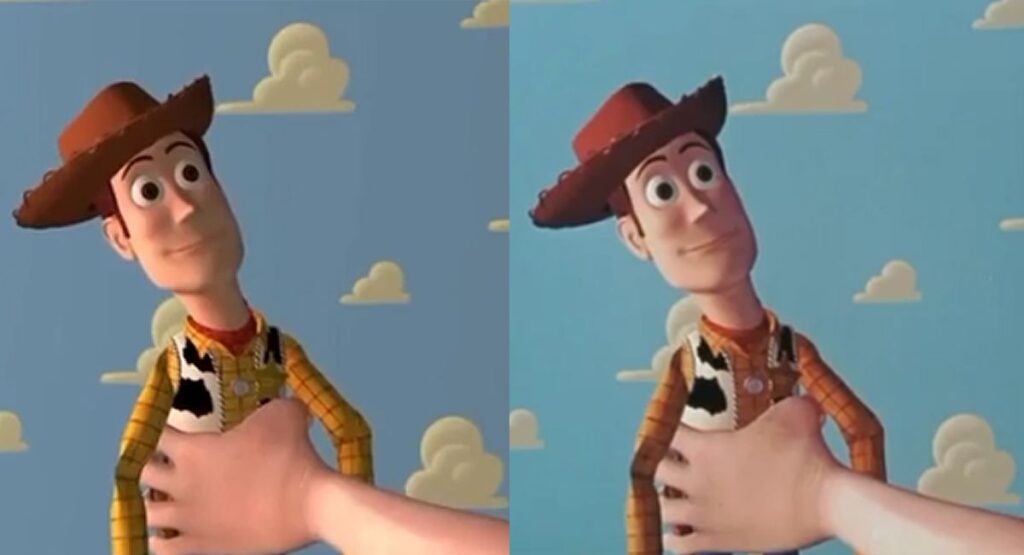
There’s been a lot of debate lately about what’s the best way – or even the right way – to watch a movie. Aspect ratio is one bone of contention, as demonstrated by the controversy over The Odyssey trailer. 35mm film vs digital remasters is another.
It seems that even Toy Story can’t escape the latter dispute. As Toy Story 5 passes the $800 million milestone to become already the ninth highest-grossing Pixar movie, social media is engrossed in a debate over how the original movie is supposed to look. The Pixar rules of storytelling might be timeless, but what’s the best way to enjoy them?
Woah this is a hauntingly gorgeous render pic.twitter.com/GqMnazVZz8June 25, 2026
Toy Story was a revolution when it arrived in cinemas just over 30 years ago as the first CG 3D animated movie. It introduced a new process and aesthetic that would come to dominate the industry and define the direction of mainstream animation up to the present day.
Latest Videos From

But although Pixar made Toy Story digitally, the movie couldn’t be shown as pixels in cinemas back in 1995. Every frame from the world’s first feature-length 3D digital animation would have to be printed onto traditional analog 35mm film – a process that took many, many hours of work.
Pixar knew that the movie shown in cinemas would look different to how it looked on a digital monitor, so it graded Toy Story accordingly. The digital colours were chosen based on how they would change after printing. The aim was to get the best look on 35mm film.
You may like
In an interview with Cinefantastique magazine at the time, art director Ralph Eggleston commented on the challenges this involved. “Blues have to be less saturated to look fully saturated on film, while the oranges look really bad on computer screens, but look really great on film,” he said, also noting that greens would “go dark really fast” on film.
The 35mm Toy Story was later also used as the source for VHS copies for home video. But within a few years later, digital technology had advanced. Today, films are screened digitally in cinemas and Pixar handles its own transfers. If you watch Toy Story on Disney+ or on DVD, you’e not watching a copy of the 35mm film but a newer direct digital transfer.
Here’s where the controversy arises. Pixar used monitors calibrated to mimic film stocks to perfect the look of the 35mm Toy Story, but they didn’t try to give the later digital transfer the colours that fans remember.
When the digital version of Toy Story was first released, it was hailed as a thing of beauty, free of the grain and other artifacts that blighted film. But today, through the gaze of nostalgia, opinions have changed. Fans rediscovering the 35mm version through scans doing the rounds on social media suddenly see the Toy Story they remember: brighter, softer and warmer.
Así luce el scan de 35 mm de Toy Story (1995). Una belleza. Y muy diferente a la versión digital con la que muchos ya estamos acostumbrados pic.twitter.com/msjNLnuPRUJune 24, 2026
Love this version of Toy Story. The lighting and characters look so much better in a warmer tint, and the fuzzy softness of film hides the lower quality textures. https://t.co/l9AirjF4rK pic.twitter.com/ABTIYF0qxBJune 24, 2026
“I thought Toy Story’s animation aged poorly, but 35mm scans show it was mostly the render for digital that was botched, this movie is actually gorgeous,” one person writes on X. “The digital remaster was great but made it look more plastic, 35mm is better,” someone else thinks.
What to read next
One fan goes further: “I believe seeing images in this format does something good for your soul, the grain and color mimics what we actually see with our eyes.”
So what’s really the best way to see digital movies that were designed with 35mm film projection in mind? The Blu-ray Toy Story seems to look more like the 35mm movie but still feels colder. If the 35mm version is so universally preferred, it feels like Pixar’s missed a trick by not making the film readily available in the version that so impressed audiences in 1995.
But like with other examples in the 35mm vs digital debate, from Seven to The Matrix, the apparent preference for physical film may be more to do with nostalgia and how people remember the movie making them feel than about how the filmmakers themselves think it should be seen.
Before digital projection, filmmakers often weren’t very happy with the prints of their movies. The 35mm scans that used for restorations are often copies of copies, and the look of scanned images from original prints of the same movie can vary wildly between sources, casting doubt on which one is closest to the original film. We might subjectively prefer the look of a 35mm scan, but that doesn’t mean it’s the definitive version of the movie.
A Disney special effect from the 1930s is still blowing people’s minds today.