
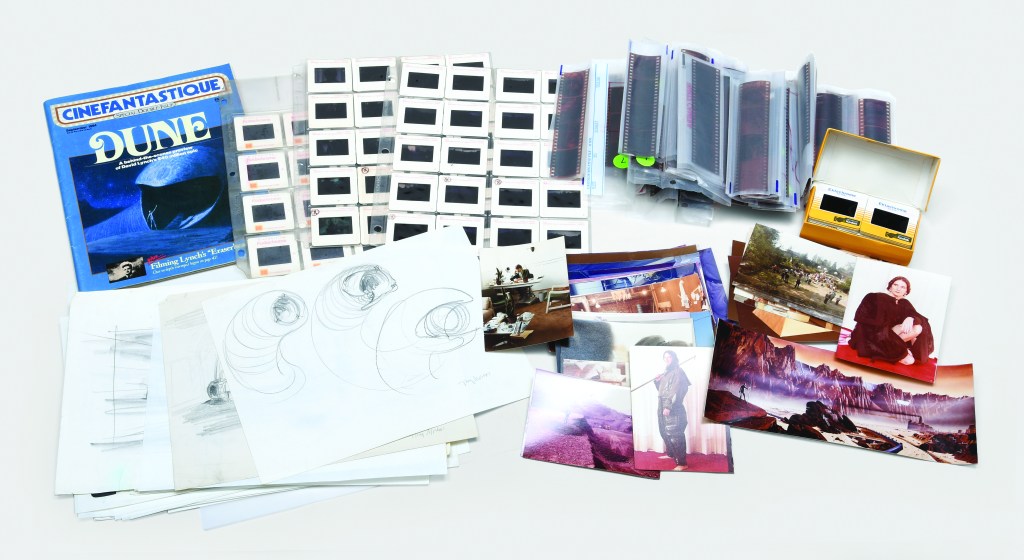
More than a year after the passing of visionary director David Lynch, his surreal back catalogue of work continues to intrigue the public. Giving fans an unprecedented look into his creative world, Peter Harrington Rare Books has unveiled an archive of behind-the-scenes production materials from Lynch’s 1984 adaptation of Dune.
Serious collectors will have to dig deep into their wallets for this one. Priced at just over $37,000, the extensive collection offers a profound visual record of a film. The archive serves as the centerpiece of Peter Harrington’s new catalogue, Quo Vadis? Visions of the Future, with select highlights currently on display at the gallery’s New York and London locations, and the full collection available for purchase online.
The archive originates from the personal collection of production illustrator Ron Miller. Following the massive success of The Elephant Man, executive producer Dino de Laurentiis hired David Lynch to tackle Herbert’s “unfilmable” book.
To fully appreciate what Lynch was up against, you have to look back to the mid-1970s when filmmaker Alejandro Jodorowsky spent years attempting to mount his own adaptation of Frank Herbert’s masterpiece.
Jodorowsky’s Dune is widely considered the greatest movie never made. It was set to be a 14-hour psychedelic space opera starring Salvador Dalí, Mick Jagger, and Orson Welles, with a soundtrack by Pink Floyd and art design by H.R. Giger and Moebius. The project spectacularly collapsed under the weight of its own ambition, but its massive pre-production book of concept art became Hollywood legend.
Miller was brought on to help realize Lynch’s surreal vision when the production team consisted of barely half a dozen people. Producer Raffaella de Laurentiis (Dino’s daughter) personally recruited Miller after spotting his Arrakis-like illustrations of Mars in the 1981 book The Grand Tour. Miller’s decorated career also includes work for NASA, the Smithsonian, National Geographic, and the 1990 sci-fi film Total Recall.
The collection provides a detailed look at the complex, physical world-building required to bring the film to life. Among the assets are eight preliminary artwork leaves by Academy Award-winning production designer Tony Masters (seven of which are signed), alongside extensive designs by Miller. In addition to conceptual sketches, the archive features original photographs, slides, and negatives primarily captured on location at Estudios Churubusco in Mexico City.
Highlights of the photographic material include a cheerful group shot captioned “First Day of Filming” and a rare, candid snap of Lynch looking intensely focused at his desk. The collection also features images of costume designs by Bob Ringwood and 3D models of Guild Navigators and spaceships crafted by Judith Miller.
The offering follows the massive momentum of June 2025, when David Lynch’s personal estate went under the hammer. That historic auction, hosted by Julien’s Auctions, whipped cinephiles into a bidding frenzy. Featuring nearly 450 items of the auteur’s personal effects and film memorabilia, the live event ultimately raked in a staggering $4.25 million.
When David Lynch’s Dune hit theaters in December 1984, critics didn’t just pan it; they practically exorcised it. The movie emerged as a notorious box office bomb, grossing a mere $30.9 million against a budget pushing past $40 million. Heavily compromised by studio executives who seemingly wanted a traditional space opera rather than Lynch’s trademark surrealism.
Yet, time heals all box office wounds. Decades later, the film has achieved legendary status as a brilliant, uncompromisingly weird cult classic.
The timing of the sale couldn’t be better. Director Denis Villeneuve recently managed to break the “unfilmable” curse of the novel, turning Dune (2021) and Dune: Part Two (2024) into multi-Oscar-winning blockbusters. With Villeneuve’s highly anticipated trilogy closer, Dune: Part Three, locked in for a December 2026 release, this archive provides a fascinating look at the very first cinematic blueprint of Arrakis back when the spice flowed entirely via practical effects and pure imagination.
Scroll down to view the items.