
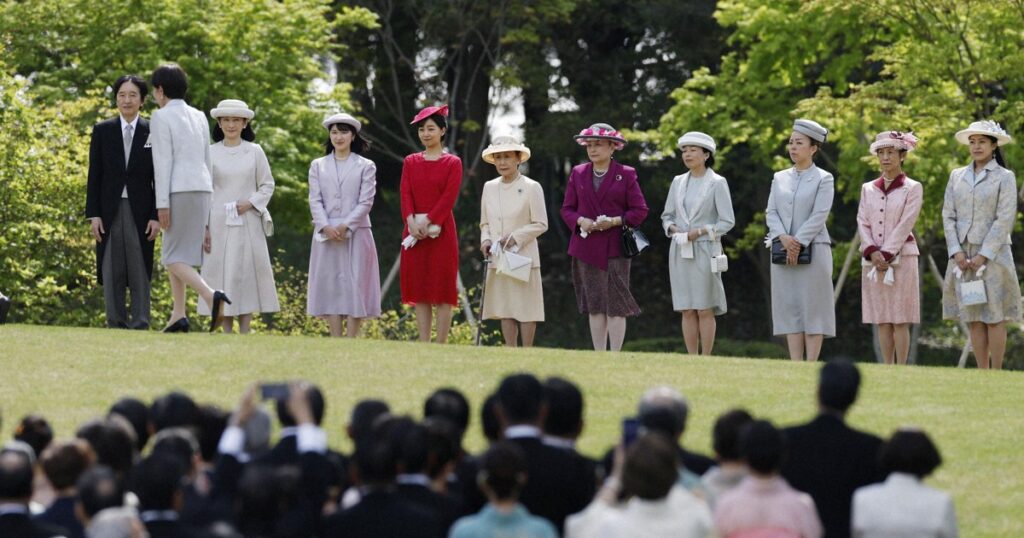
This file photo taken on April 17, 2026, shows Crown Prince Fumihito, Crown Princess Kiko and other members of the imperial family, as well as Japanese Prime Minister Sanae Takaichi (2nd from left), at the spring garden party in Tokyo. (Kyodo)
TOKYO (Kyodo) — Officials and staff who work in support of Japan’s imperial family are facing unprecedented uncertainty as to how their duties in the royal system will be affected by the country’s legal change aimed at making the world’s oldest hereditary monarchy sustainable.
The move has also split public opinion and prompted many to express concern about entering uncharted territory. Both Imperial Household Agency officials and ordinary Japanese, however, welcome aspects of the revised Imperial House Law, such as allowing men from former imperial branch families to be adopted and letting princesses retain their royal status after marriage to commoners.
The first major revision of the 1947 law is intended to reverse the decline in the number of imperial family members, now at 16, which is one of the top priorities for Japan’s conservative Prime Minister Sanae Takaichi.
But critics regard the change as part of a broader push by conservatives to maintain the male-only imperial succession, a priority out of touch with public sentiment as polls suggest many Japanese want to see a woman like Princess Aiko, the only daughter of Emperor Naruhito, ascend the throne in the future.
“It’s significant in that there is now a path toward securing a stable number of imperial members,” an official of the Imperial Household Agency said.
“The decision has been made. If there comes a day when we see an adopted person join the imperial family, we’d have no choice but to support them so they steadily carry out their official duties and earn the affection of the people,” the official added.
Under the revised law enacted by parliament on Friday, males aged 15 and older from 11 former imperial branch families that gave up their royal status in 1947 may be adopted into the imperial family.
A man from one such lineage, Asahiro Kuni, the 81-year-old third son of the Kuninomiya branch, expressed skepticism. “I wonder if anyone would actually step forward to be adopted. It doesn’t seem very realistic,” he told Kyodo News.
Another official from the agency voiced concern about continuity. “Whether adoptees will understand the nature of the symbolic imperial system and be able to properly carry on the wishes is my worry,” the official said, referring to recent emperors.
The emperor is defined as the “symbol” of the state under the Japanese Constitution. Emperor Naruhito and Empress Masako, a former diplomat who joined the imperial family, and their daughter Princess Aiko occasionally visit various places, including disaster-hit areas in Japan and foreign countries.
Despite the legal change, Princess Aiko is not eligible to succeed Emperor Naruhito because she is a woman. But if she marries someone outside the family, she will be able to choose whether or not to retain her royal status.
Agency staffers say the decision would be a tough one for princesses. There are currently five unmarried female members of the imperial family who could face that question, including Princess Aiko and Princess Kako, a daughter of Crown Prince Fumihito.
“Given the current state of the Imperial Household and public expectations, it will be quite difficult for them to leave. This has become a rather harsh choice,” said a senior agency official.
Since the spouses and children in such marriages will remain commoners under the new policy, an aide to one female imperial family member said it could be “strange having different statuses within the same family.”
“I sense the government intends to rule out female emperors or emperors from the matrilineal line,” the aide added.
Meanwhile, the public appears split, with some expressing support and others casting doubt on the amended law and the government measures.
“It depends on how those adopted would behave. If they can stand by the people just as the emperor does, I don’t think there will be any problem,” said Shinichi Kokubun, 76.
He met the emperor, the empress and Princess Aiko in April when they visited Futaba, Fukushima Prefecture, hit by the massive 2011 earthquake and tsunami that caused meltdowns at the Fukushima Daiichi nuclear power station.
Young people around the same age as Princess Aiko took issue with the way the major overhaul was carried out.
In Hiroshima, Miyu Nakao, 22, pointed out strong support for a female emperor in opinion polls. “The government has made a decision on the imperial system all by itself,” she said, criticizing leaders for leaving the public out of the debate.
“Not many people around me, including myself, are familiar with what the Imperial House Law is,” said a 20-year-old male college student in Osaka.
“I don’t think that there have been sufficient discussions or public outreach” from the government, he said.