
In a controversial Friday news dump, the Television Academy announced it was pulling five categories (limited/movie supporting actress, limited/movie supporting actor, limited/movie directing, limited/movie writing, and variety series writing) from the Primetime Emmys and moving them to the Creative Arts Emmys. Blowback was immediate, with the guilds slamming the shift.
The TV Academy claimed it is “committed to delivering a fresh new take on the Emmys broadcast, with a focus on entertainment,” but SAG-AFTRA, DGA, and WGA pushed back. “The decision to eliminate these categories from the prime-time broadcast devalues the contributions of the talented people the Academy is meant to honor,” the guilds declared in a joint statement provided to Gold Derby.
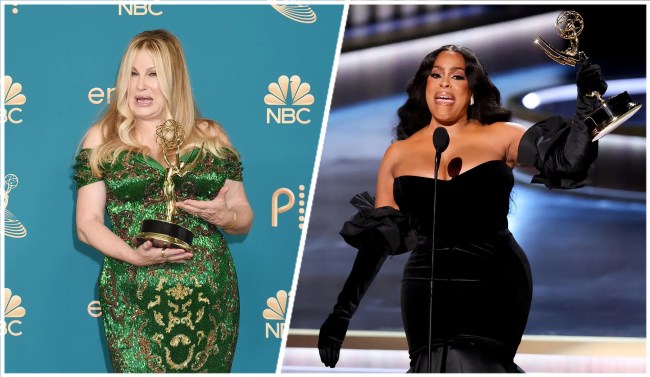
Putting the news into context, if the TV Academy had its way and these two supporting acting categories had never been a part of the Primetime Emmys broadcast, we would have missed out on countless memorable speeches and historic moments, including Jennifer Coolidge and Niecy Nash. Yes, a highly edited version of the Creative Arts typically airs a week later, but to much less fanfare.
Below, we take a stroll down memory lane to help illustrate why the limited/movie supporting Emmy races belong in primetime.
Owen Cooper for Adolescence (2025)
Last year, viewers witnessed history as 15-year-old Owen Cooper became the youngest male actor ever to win an Emmy. His character of Jamie Miller, a teenager accused of murdering a classmate, was talked about all over the world as Adolescence became one of Netflix’s most successful original series of all time. When the theater applause finally died down, Cooper announced, “Honestly, when I started these drama classes a couple years back, I didn’t expect to be even in the United States, never mind here. If you listen and you focus and you step out of your comfort zone, you can achieve anything in your life.”
Lamorne Morris for Fargo (2024)
FX’s Fargo finally won its first acting Emmy for Season 5, in the form of Lamorne Morris as Deputy Whitley “Witt” Farr. The shocked actor spent his brief time on the stage thanking God and his mother, and proving he knows “where babies come from.” He then made his fellow nominee Robert Downey Jr. fist-bump proudly when he confessed: “I’ve got a poster of you in my house — please sign it.” Something tells us Downey would have never set foot inside the Creative Arts ceremony, so this is a moment that wouldn’t exist if not for the Primetime Emmys.
Niecy Nash for Monster (2023)
For her compassionate role as Glenda Cleveland on Monster: The Jeffrey Dahmer Story, Niecy Nash was finally declared a “winner, baby!” During her passionate speech, the actress rattled off her list of thank-yous including God, showrunner Ryan Murphy, and leading actor Evan Peters. But then she did something truly original by thanking herself. “I want to thank me, for believing in me, and doing what they said I could not do,” Nash declared. “And I want to say to myself in front of all you beautiful people, ‘Go on girl with your bad self. You did that!'” She ended her speech by recognizing “Black and Brown women who have gone unheard yet over-policed. … As an artist, my job is to speak truth to power, and baby, I’m gonna do it till the day I die.”
Jennifer Coolidge for The White Lotus (2022)
Jennifer Coolidge earned the best raves of her career for playing Tanya McQuoid on Mike White’s The White Lotus, and won a pair of Emmys: Best Limited/Movie Supporting Actress in 2022 and Best Drama Supporting Actress in 2023. The TV Academy’s new ruling would have shunted her iconic first speech off to the Creative Arts, where virtually nobody would have seen it. “I took a lavender bath tonight right before the show, and it made me swell up inside my dress,” Coolidge acknowledged after reaching the microphone. When the music tried to play her off, she interjected, “Hold on, this is a once-in-a-lifetime thing — and I’m full!” She then shimmied her body along with the music, and the rest is history.
Laura Dern for Big Little Lies (2017)
Laura Dern dedicated her Emmy win for playing Renata Klein to all of the “fierce women” she co-starred with on Big Little Lies, explaining, “I’ve been acting since I was 11 years old, and I think I worked with maybe 12 women, so I just want to thank the Television Academy for honoring our show.” To date, it’s the legendary actress’ sole Emmy win from nine nominations. She also took home a Best Supporting Actress Oscar for Marriage Story (2019).
Sterling K. Brown for The People v. O.J. Simpson (2016)
Before Paradise and This Is Us, Sterling K. Brown was a self-described “journeyman actor” who put food on the table by working job to job. But then, thanks to playing real-life prosecutor Christopher Darden in The People v. O.J. Simpson, he finally became a household name. SKB won his first Emmy Award in 2016 and said to voters, “A lot of you may not have known who I was, but you checked the box anyway — and that makes me very, very happy.” As for Ryan Murphy and the producers who took a chance on him, a tearful Brown stated, “Thank you for giving a brother a chance.” It was a homerun of a speech that no doubt helped him prevail again the following year in Best Drama Actor for This Is Us.
Regina King for American Crime (2015)
This was Regina King’s first of two consecutive Emmy Awards for American Crime, neither of which would have been seen by the public at large if the supporting categories were relegated to the Creative Arts. She later won a pair of lead Emmys for Seven Seconds (2018) and Watchmen (2020), and a supporting Oscar for If Beale Street Could Talk (2018). During her first trip to the podium for playing Aliyah Shadeed, a visibly nervous King joked that she wished she had “one of those papers that all of the comedy people had, [but she] was not expecting this.”
Jessica Lange for American Horror Story: Murder House (2012)
Before American Horror Story, Emmy voters were terrified of the horror genre. However, thanks in part to the casting of Jessica Lange, a two-time Oscar winner for Tootsie (1982) and Blue Sky (1994), they were finally able to look past all the jump-scares and gore and honor a worthy performance, regardless of genre. Lange’s role as Constance Langdon, a sassy, chain-smoking neighbor, is one that’s still talked about today. During her speech, she thanked Ryan Murphy and the writers for creating a character especially for her, based on her own personal “strengths” and what she “loves to play.” She won two years later in the lead category for American Horror Story: Coven.