
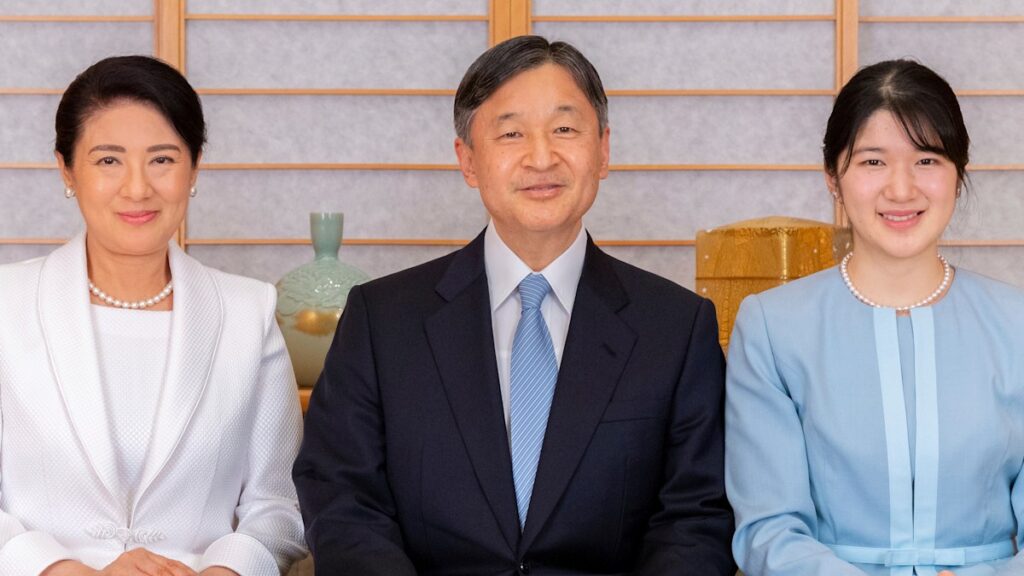
She’s the only child of the emperor but unable to ascend the throne, despite recent changes to imperial succession rules forced by an unprecedented crisis facing Japan’s royal family.
Princess Aiko, who is 24, could save the world’s oldest hereditary monarchy from extinction. However, only males are allowed to become emperor under the current laws governing the Imperial House, known as the Chrysanthemum Throne.
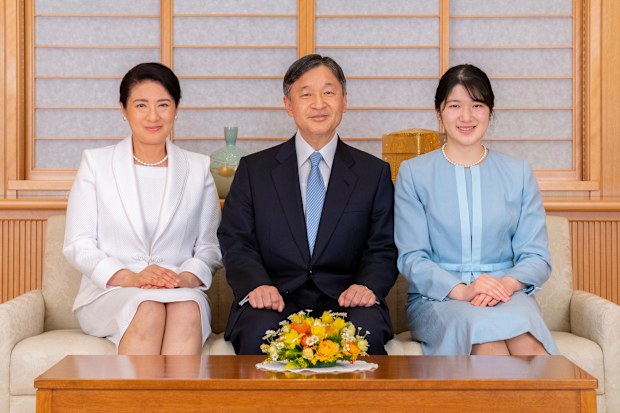
Japan’s Emperor Naruhito and his wife Empress Masako with their daughter Princess Aiko, pictured in 2021. The princess, who is the emperor’s only child, is not eligible to ascend the throne. AP
There have been recent moves to change this, though.
On Friday, Japan’s parliament approved a bill to relax imperial succession rules, making key changes in two areas.
The first will allow the imperial family to adopt distant male relatives over the age of 15 − former members whose ancestors were stripped of their princely titles after Japan’s defeat in the Second World War.
These male descendants will be allowed to rejoin the imperial family and any males they later produce, theoretically, could become emperor.
There are just four of the 11 former imperial families who have suitable male descendants: the Kayas, the Kunis, the Higashikunis and the Takedas. Within those families, there are 12 unmarried males.
But it’s unclear whether any of them would want to return to the imperial family having lived for decades as civilians, or commoners.
The second change, which was part of the bill, will allow female members of the imperial family − the princesses − to keep their royal status if they marry a commoner.
Under the current rules, princesses have to give up their imperial status if they marry civilians, as Princess Mako did in 2021.
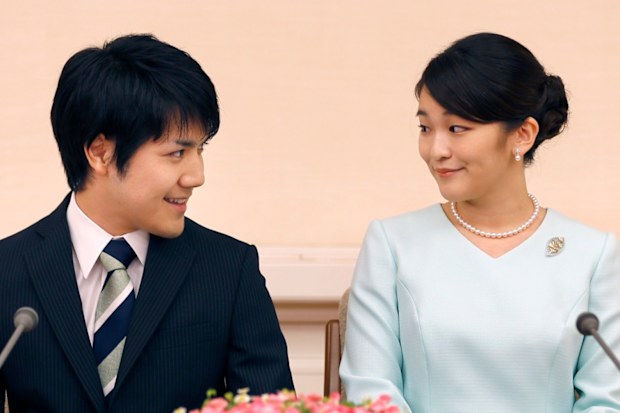
Princess Mako gave up her status in Japan’s Imperial Family to marry commoner Kei Komuro in 2021. They now live in the US with their young child. AP
Mako, who is the niece of Emperor Naruhito and daughter of Crown Prince Fumihito and Crown Princess Kiko, made headlines around the world when she left her family to marry her college boyfriend Kei Komuro.
The former princess declined the traditional payment offered to royal females upon their departure from the imperial family and moved to the US soon after her marriage. She and her husband now have a young child.
Because the proposed changes to the Imperial House Law are not retroactive, Mako will not get back her princess title or royal status.
The bill is the biggest overhaul to Japan’s imperial system since 1949.
The changes are being made to save the imperial family from extinction as Japanese law says only a male child descended from a male emperor can ascend the throne.
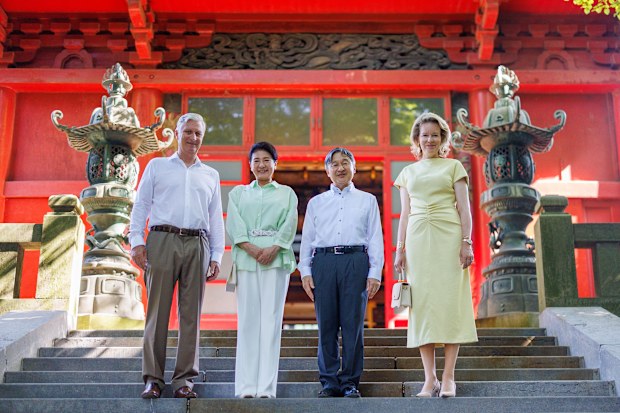
Japan’s Emperor Naruhito and Empress Masako made a state visit to Belgium in June, joining with King Philippe and Queen Mathilde for a number of engagements. Olivier Matthys, Pool Photo via AP
There are also a lack of working royals available to carry out official duties.
Japan’s current ruler is Emperor Naruhito, 66, whose only child is Princess Aiko.
First in line to the throne is Crown Prince Fumihito, 60, the emperor’s younger brother. His son, Prince Hisahito, 19, is second in line.
Third in line for the throne, and the last eligible candidate for the top job, is the emperor’s 90-year-old uncle, Prince Hitachi.
If Prince Hisahito does not have a male child, the line of succession will end − unless there are amendments to the law.
The bill will now move through the final legal procedures before the changes take effect.
However, there is another way to safeguard the future of Japan’s monarchy, which has only recently opened itself up to the modern world.
In April 2024, the Imperial Household Agency − a government body in charge of the family’s affairs − launched an Instagram account to give the public a better understanding of the royal family’s official duties.
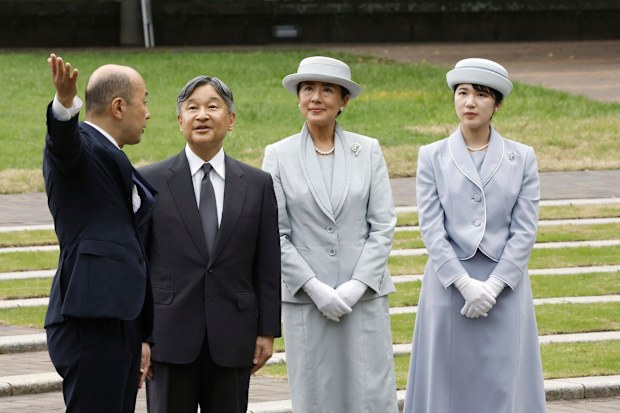
Emperor Naruhito and Empress Masako, and their daughter Princess Aiko, are among the small number of Imperial House members who perform official duties. Changes to the law could see a boost to the number of working royals. Kyodo News via AP, File
The imperial family’s social media debut came 15 years after Britain’s royal family joined social media, in 2009, and years after other royal families launched onto the platform such as Denmark, Sweden, Spain and Norway.
An opinion poll in June, by newspaper Mainichi Shimbun, found that 70 per cent of the public do support the idea of Japan having a female emperor, with Aiko the ideal candidate for such a position.
A separate poll, by Kyodo News, found that 83 per cent of respondents were in favour of allowing a woman to ascend to the throne.
The emperor’s only child is hugely popular in Japan but there remains opposition to her succeeding the throne after her father.
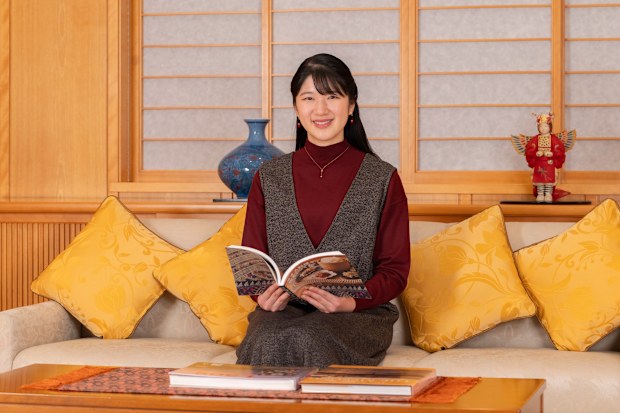
There is widespread support for Japan to have a female emperor and Emperor Naruhito’s only child, Princess Aiko, is the frontrunner. But there are others who oppose a female in the top job. Imperial Household Agency of Japan via AP
Japan’s first female prime minister Sanae Takaichi is one of the opponents, along with other conservative leaders, who claim that imperial descent can be through the male line only.
However, throughout its long history Japan’s imperial house has had eight female sovereigns before changes to female succession came into force under the Meiji-era Imperial House Law in 1889.
And the constitution does not stipulate the emperor must be male. Instead, succession is governed under Imperial House Law, meaning parliament has the power to change the rules.