
The Gist
After Princess Diana died tragically in a Paris car crash on August 31, 1997, Queen Elizabeth faced ample criticism for not returning to London from Balmoral, where she was with Diana’s sons Prince William, 15, and Prince Harry, 12.
In this instance, the queen put being a grandmother ahead of being a monarch—a touching pivot from her steadfast commitment to duty.
The monarch was left “hurt and angered” by the public’s criticism of her decisions in the days following Diana’s death, according to royal biographer Gyles Brandreth.
During the intensely fraught days after Princess Diana’s shocking death following a Paris car crash on August 31, 1997, the public plunged into mourning. Queen Elizabeth was at Balmoral—the royal family’s beloved Scottish retreat—along with, among others, her eldest son Prince Charles and her grandsons Prince William and Prince Harry, who had just lost their mother so tragically.
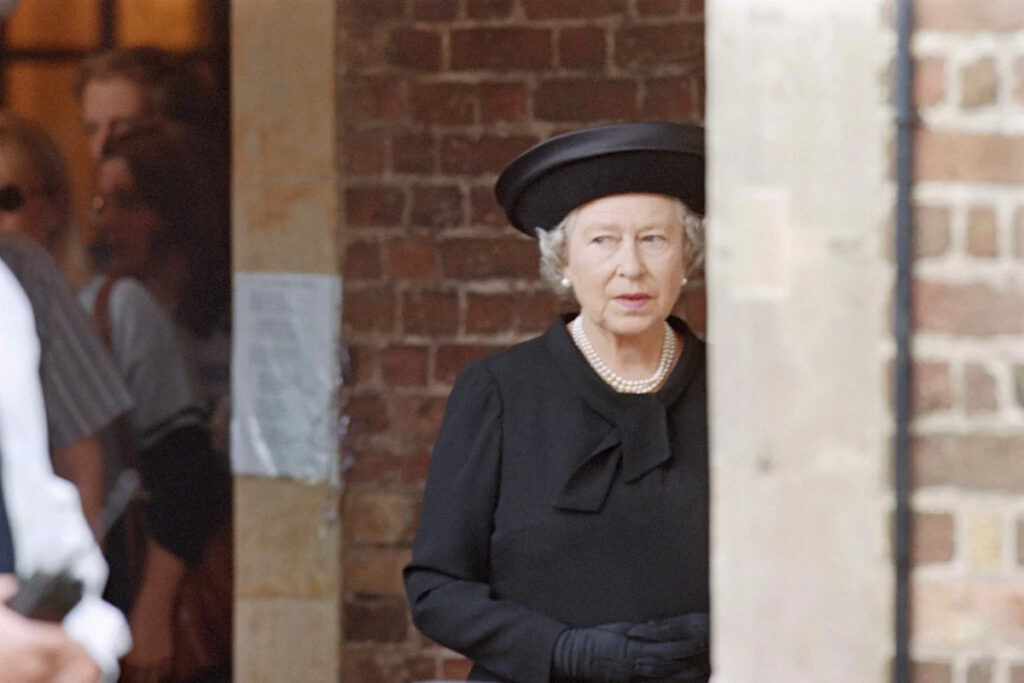
The queen was known to put duty above all else throughout her historic 70-year reign—but this time, she became a grandmother first. Instead of returning to London, the monarch stayed at Balmoral with her grandsons, which led to ample criticism from both the public and the media. The outcry is depicted in fictionalized portrayals like 2006’s The Queen and Netflix’s series The Crown.

Princess Diana in Washington, D.C. just two months before her death.
Credit: Getty
In addition to her delay in returning to Buckingham Palace—ultimately staying in Scotland with William and Harry for five days—she also refused to fly the Royal Standard at half-mast over the palace. Protocol dictated that the flag only flew when the queen was present, and, as she wasn’t there, it didn’t fly. Beyond that, protocol dictated that the Royal Standard “is never flown at half-mast,” according to Marie Claire.
According to royal biographer Gyles Brandreth, the monarch was “hurt and angered” by the public’s criticism of her decisions in the immediate aftermath of Diana’s death. In his book Elizabeth: An Intimate Portrait, Brandreth—a longtime friend of the royal family—said that the queen “was not often given to anger,” but was in this instance.
“She felt it showed a lack of understanding of history and tradition,” he wrote.
As he put it, “The flagpole at Buckingham Palace was bare because flags are only flown over a royal residence when the sovereign is in residence.” Queen Elizabeth “could see no reason to break with precedent”—but the public pressure altered her plans.

Prince Philip and Queen Elizabeth viewing floral tributes for Princess Diana at Kensington Palace.
Credit: Getty
“After several days, against her better judgment, she was persuaded to change her mind and allow a compromise: The Union flag—not the Royal Standard—was flown at half-mast over Buckingham Palace,” Brandreth wrote. This ultimately started a new trend—now, the Union Jack flies above Buckingham Palace whenever the monarch isn’t in residence, an interesting protocol change that came from the most unpredictable of weeks in British royal family history.
This wasn’t the only protocol break that happened regarding Diana’s death. It has long been understood that the queen bows to no one—others do the bowing to her. But, in a show of respect for the people’s princess, Queen Elizabeth deliberately and meaningfully bowed her head as Diana’s casket rode by on the day of her September 6, 1997 funeral.
The day before, on September 5, the queen made a televised speech to the nation, addressing the mourning happening around the U.K. and globally. Speaking from the Chinese Dining Room at Buckingham Palace, the queen addressed the “overwhelming expression of sadness at Diana’s death,” adding, “We have all been trying in our different ways to cope.”
“It is not easy to express a sense of loss, since the initial shock is often succeeded by a mixture of other feelings: disbelief, incomprehension, anger—and concern for those who remain,” she added. “We have all felt those emotions in these last few days. So what I say to you know, as your queen and as a grandmother, I say from my heart.”

Queen Elizabeth viewing floral tributes at Balmoral with Prince Charles, Prince Harry, Prince William, and Prince Philip.
Credit: Getty
The moment became one of the most symbolic in her entire 70-year reign and caused public perception to switch to the positive towards the sovereign. Calling Diana “an exceptional and gifted human being,” the queen added that she “admired and respected her—for her energy and commitment to others, and especially for her devotion to her two boys.”
“This week at Balmoral, we have all been trying to help William and Harry come to terms with the devastating loss that they and the rest of us have suffered,” she continued.
Thanking those who brought an enormity of flowers, as well as sent messages and paid respects to Diana’s life, the queen also said that she believed “there are lessons to be drawn from her life and from the extraordinary and moving reaction to her death. I share in your determination to cherish her memory.” Acknowledging Diana’s “all-too-short life,” the queen called the former Princess of Wales “a remarkable person” and “someone who made many, many people happy.”
Longtime royal photographer Arthur Edwards told The Sun that he later spoke to the queen about her speech, which earned widespread praise and approval. “At the time there was questions in the papers, wasn’t it? ‘Where are the royals? Where [is] the queen? Why is the flag not at half-mast at Buckingham Palace?'”
“And she came back with the duke [Prince Philip] and I remember looking at the flowers outside the front of Buckingham Palace and there were thousands and thousands,” he added. “And then she made this amazing speech, and I remember afterwards I talked to people here and they said, ‘You know, that just stopped it all straight away.’ Everybody forgave her and, quite honestly, I didn’t think she should come back [from Balmoral].”

Queen Elizabeth and Prince Philip arriving at Buckingham Palace from Balmoral.
Credit: Getty
“She had the children—Diana’s children, William and Harry—they were mourning their mother and she was comforting them and she was helping them, and I thought she should have been there,” Edwards said. “But, of course, people were sort of screaming, saying they should be in London.”
The queen’s only daughter Princess Anne later addressed the criticism in 2017, 20 years after the accident, saying the “structure” the queen provided William and Harry in those crucial days was “exactly the right thing.”
“I don’t think either of those two could, would have been able to cope if they’d been anywhere else,” the Princess Royal said of William and Harry, who were just 15 years old and 12 years old, respectively, at the time.
In a letter written to one of her closest aides, Lady Henriette Abel Smith, in the days following Diana’s death, the queen wrote that the mood was “dreadfully sad,” adding, “William and Harry have been so brave, and I am very proud of them.”
“People expected the queen to abandon her two grandsons—whose mother had just been killed—and go to London to mourn with people who had never even met the princess,” Lady Angela Oswald said, per The Telegraph. “If you stand back and think about it, it is an extraordinarily selfish attitude.” She added, “It was such a cruel criticism, and it was unfair.”

Queen Elizabeth meeting with the public at St. James’s Palace on September 5, 1997.
Credit: Getty
Royal biographer Tina Brown said (per The Mirror), “The queen was adamant that her place was at Balmoral with her grieving grandsons. Everyone rallied around the young princes. This was the first time in a long reign that the queen was thinking about her family before her people. We should admire her for that.”
Ultimately, the queen returned to London from Balmoral a day earlier than planned, on September 4, where she viewed the massive amount of floral tributes laid outside Buckingham Palace. The next day was her televised speech, followed by the funeral on September 6—and the bow.

Queen Elizabeth just before her famous bow to Princess Diana’s coffin.
Credit: Getty

Princess Diana’s coffin on the day of her funeral, September 6, 1997.
Credit: Getty
“It was not a quick bow, nor a shallow one,” The Washington Post later reported. “The woman accustomed to being bowed by the world now lowered her head and humbly honored the princess. More than anything, it was the bow that broke the fever of anger directed at the queen and her family.”
After Queen Elizabeth’s own death on September 8, 2022, former Prime Minister Tony Blair—who was in office when Diana died—told Today of the queen and the public mood, “She sensed it, and then she responded. And when she responded—she responded perfectly.”
Read the original article on InStyle