
“Second Nature” is a documentary Drew Denny made for her younger self.
Denny, 42, lives in Los Angeles now but grew up in Texas.
At times, life “for a queer girl was actually heartbreaking,” she said.
Then as a young woman she was gifted a copy of Dr. Joan Roughgarden’s “Evolution’s Rainbow: Diversity, Gender and Sexuality in Nature and People.”
It was life-changing.
“When I read Joan’s book, for whatever reason, this is what made it click for me,” Denny said. “It was the first time I felt in my body that I belong here, too. It took that knowledge that queerness had always existed and always will and is not an aberration.”
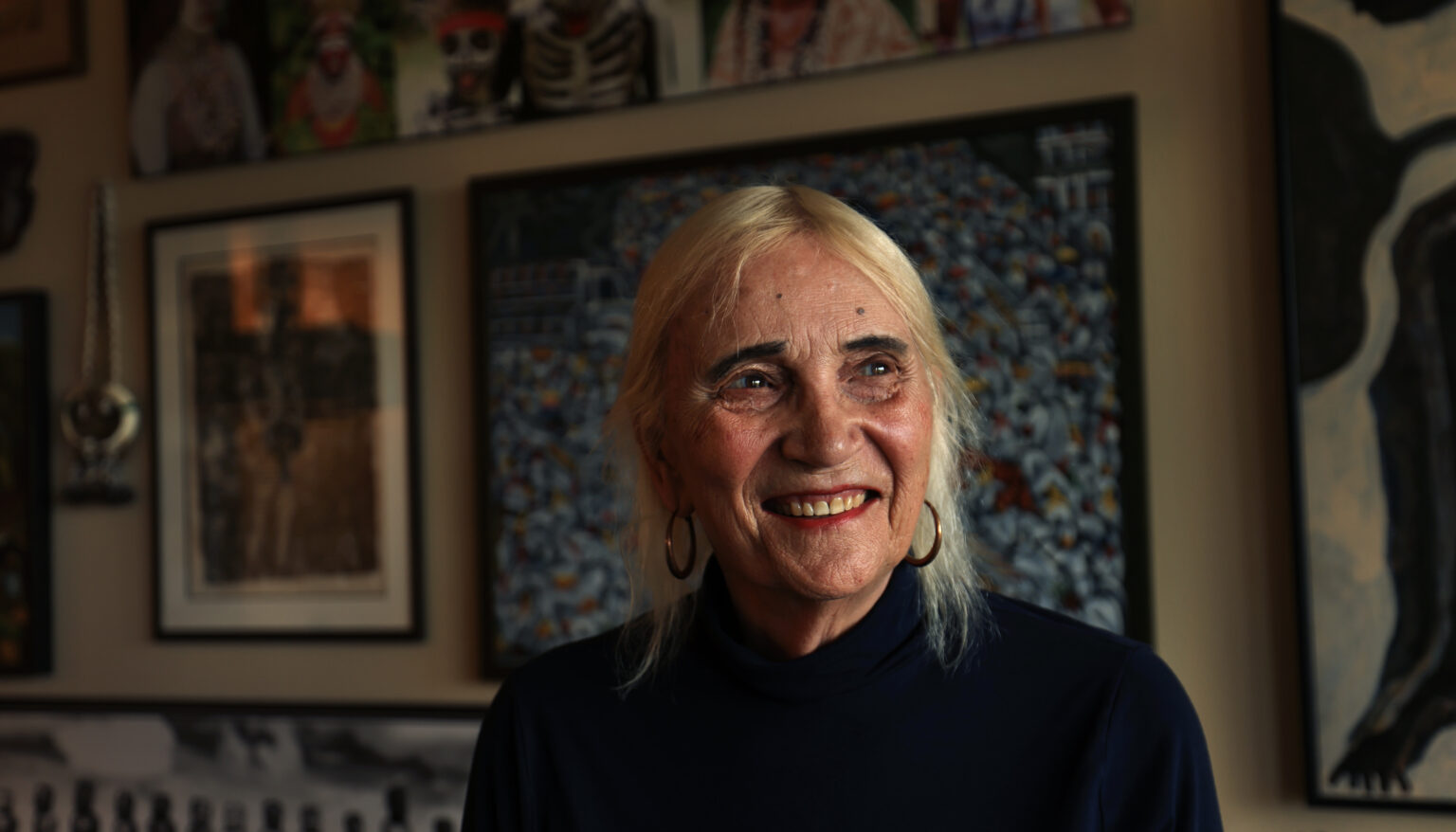
So years later, as a budding filmmaker, Denny reached out to Roughgarden, 80, with a proposal.
“She said she was a documentary filmmaker and she would like to do a documentary based on ‘Evolution’s Rainbow,’” Roughgarden said from her Santa Rosa home.
“I said, ‘Sure,’ but I confessed that she looked young, but they all look young,’” she said with a laugh. “I thought it was going to be a student project. One thing led to another, and a couple of years later a film crew rolls into town.”
Roughgarden’s work was pivotal for Denny’s personal evolution and it was crucial for her filmmaking, she said.
“She tells her story in the film and becomes the central figure who connects all the dots,” Denny said.
Eleven years in the making, Denny and that film crew have completed and released “Second Nature: Gender and Sexuality in the Animal World,” a documentary that features Roughgarden throughout and leans heavily on “Evolution’s Rainbow” and her academic works.
In still another local connection, the film is co-produced, co-written and edited by Jennifer Steinman Sternin of Santa Rosa.
The film, which features a host of celebrated scientists – biologists, anthropologists, primatologists – in addition to Roughgarden, dives into behavioral and biological diversity, including sexual conduct and characteristics, gender multiplicity, love, social hierarchies and gender presentation in a slew of animals. It also explores why and how that diversity has gone unreported or under-reported since cataloguing behaviors began.
“A lot of times sexual behaviors are recorded only when an adult male is mounting an adult female. Scientists might not code a male mounting a male as sexual so the data only represents the times a male mounts a female. That is sex and everything else is not,” Dr. Marcela Benitez says in the film. “It is called ‘greeting rituals,’ it’s called ‘domination behavior,’ it’s called ‘social bonding behaviors.’”
But not sex. So it was not recorded as such.
“I think it’s a brilliant piece of research and journalism, I guess you could say, on her part to put all of this together,” Roughgarden said.
But it was Roughgarden’s story which Denny describes as the “motor of the film.”
And by Roughgarden’s account, that story includes her first Pride March in San Francisco a quarter of a century ago.
“When I was a child, to come out as trans, it was unheard of,” she says in the film.
As a scientist, Roughgarden likes numbers. But hearing that 5% of the population is gay didn’t ring true in her world.
“I didn’t believe the numbers because 5% of the people I knew weren’t gay,” she said. “It was the first Pride Parade that I ever marched in … for the first time I saw so many people who were gay and that made the numbers plausible.”
And her life’s work as a scientist played a role in the evolution of her thinking. She describes understanding “gayness” as an adaptive, natural, positive trait across the natural world.
“If it were maladaptive, it would have been brought down to a lower factor,” she said. “You know that there is some type of adaptivity involved.”
So Roughgarden began to inquire and investigate. She thought she’d write what she described as a “pamphlet” about her findings. But the evidence, the examples of gender fluidity, arrays of sexual conduct and behaviors in the natural world were overwhelming, she said.
Clown fish can change from male to female. The bluehead wrasse can change from female to male. Male seahorses give birth.
“It was a lot of information that wasn’t being summarized anywhere and wasn’t being presented,” she said. “There is a panoply of diversity of genders and sexuality that weren’t making it into the curriculum, and this changed our concept of what is going on out there and what is natural.”
So she wrote a book, and a young woman in Texas finally felt seen. And in reading, Denny said she was able to intellectually and emotionally counter “all the things you are told, that you don’t belong on planet Earth.”
“There is nothing inferior about being female or being queer,” Denny said.
It was for her younger self and all of those who were told they were unnatural or didn’t belong that Denny decided to use Roughgarden’s studies and her story as the foundation for her documentary.
Denny, sometimes with Roughgarden in tow, traveled the globe to see scientists at work and to see the natural world in all of its diverse glory. The film takes viewers to to Hawaii, Costa Rica and the Netherlands among other locales, to speak with scientists and to see them at work.
And the final product? It’s getting the same kind of response that Denny said she felt when she read Roughgarden’s book.
Lifesaving.
“There is a serious mission behind it,” she said last month in an interview with Democracy Now’s Amy Goodman. “I know what it’s like to be told that here is something wrong with you and you don’t belong on planet Earth and that you might have to look for a way out.”
“We want this to be a suicide prevention resource,” she said.
Agreed, said River Suh, who teaches science at Abraham Lincoln High School in San Francisco and is featured in the documentary.
“We are teaching more accurate information and we are saving kids lives,” they said in the film.
In the film, a well-worn, dog-eared copy of Roughgarden’s “Evolution’s Rainbow” sits on Suh’s desk.
Roughgarden, a professor emerita of biology at Stanford University, has published nine books and published more than 190 papers, but it was “Evolution’s Rainbow” that spoke to Denny.
Nearly a quarter-century since her book was published, Roughgarden said the need is still there to show and tell people about the variety within natural existence. And that need is even more acute in a political climate in which President Donald Trump signed an executive order on his first day in office declaring the federal government would recognize just two biologically distinct sexes.
“Obviously the queer community is under siege right now,” Roughgarden said. “Once you dehumanize people … they automatically don’t have rights because they aren’t human.”
“It’s the people who need validation, to know that there is a place for them in this world, that is the audience that I know Drew Denny had in mind,” Roughgarden said. “For people who are indifferent or who have no empathy for the people who are currently being persecuted, the movie is irrelevant.”
But for those seeking proof that they belong and they are natural, the film might be life-affirming or even life-saving.
“The need that people have, especially if they are gay or lesbian or trans or anything like this, the need to feel that you are a part of nature, that you aren’t a weird mutant or freak or something – the need is so strong,” she said.
“Second Nature” is being self-distributed by Denny and her team. It was premiered in New York City three weeks ago. Roughgarden walked the red carpet along with one of the film’s executive directors and its narrator, Academy Award-nominee Elliot Page.
“I got to meet a real-life movie star,” Roughgarden said. “He’s a very impressive guy and really out there. I was very proud of him.”
The film is scheduled to be screened as part of Critter Fest presented by the San Francisco IndieFest from Sept. 17 to 20.
For Denny, the film is as much a love letter to her younger self and those like her as it is an homage to Roughgarden, both as a scientist and a woman.
“She is just such a force of nature,” Denny said. “I’m just glad we finished in those 11 years because I have to do Joan justice. She deserves it.”
How to watch the film
“Second Nature” is scheduled to be screened at CritterFest in San Francisco in September. For more information, go to: https://sfcritterfest.eventive.org
You can reach Staff Columnist Kerry Benefield at 707-526-8671 or kerry.benefield@pressdemocrat.com. On Instagram @kerry.benefield.