
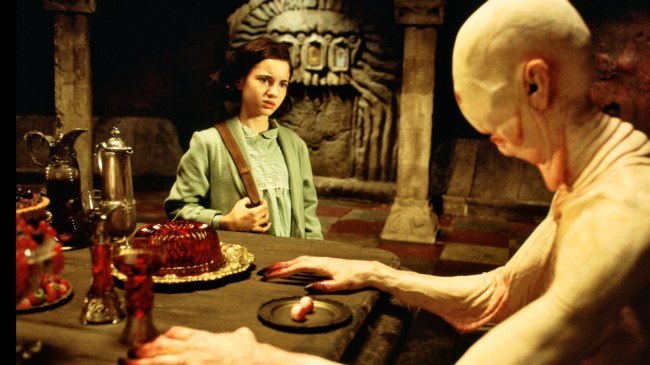
While some audiences may have a hard time viewing Pan’s Labyrinth because of the film’s terrifying Pale Man or the wanton fascist violence, Guillermo del Toro has as different reason for struggling to rewatch his classic fantasy about a girl’s struggles in Franco’s Spain. “We had a lot of adversity on this movie,” he proclaimed during the film’s 20th anniversary panel at Comic-Con. “It’s the second-most difficult shoot I’ve ever gone through.”
Del Toro was joined in the session by Ivana Baquero, who played the young Ofelia; Doug Jones, who embodied the dual roles of the Pale Man and the Faun; and the film’s Oscar-winning cinematographer, Guillermo Navarro. In a wide-ranging discussion, the collaborators discussed the challenges of making Pan’s Labyrinth, their most memorable scenes, the film’s legacy, and the upcoming 3D re-release of the film, which was nominated for a half-dozen Academy Awards and took home three. Here are the highlights.
The pain of Pan’s
From fights with the crew to logistics issues, del Toro struggled to get Pan’s Labyrinth over the finish line.
Guillermo del Toro: The entirety of this movie was sacrifice. Everything. Forty, 50, 60 times, the thing to do was not to make the movie, and to give up on things. It was the first time in my life where I said, “I don’t care. I’m going to do it exactly as I need it, exactly as I want it. It’s not about making friends — it’s about making a goddamn movie.”
We had a lot of adversity on this movie — it’s the second-most difficult shoot I’ve ever gone through. A lot of the crew was very skeptical. They would see a faun come in in the middle of a Civil War movie, and they’d say, “This guy is crazy.” But I remember the first time I knew: we were shooting the Pale Man, and the whole crew went, “Ah!” It changed then.
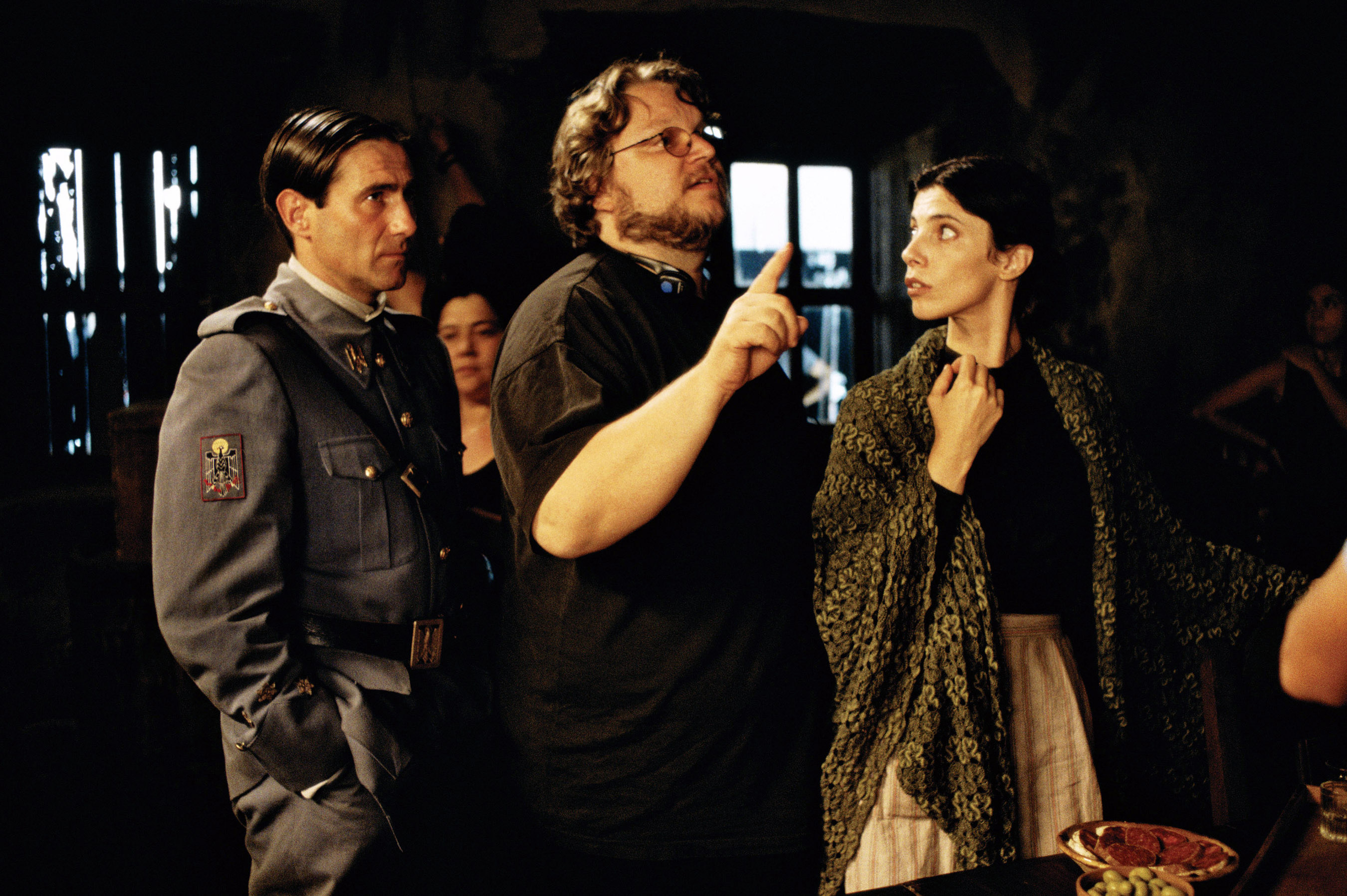 Sergi Lopez, Guillermo del Toro, and Maribel Verdu on set, 2006, © Picturehouse/Courtesy Everett Collection
I went against people I had collaborated with in the past. I said, “Look, you’re going to hate me now, but you’ll thank me later, because we’ll have a better movie.” And disobedience meant everything. On this movie, we were not allowed to fire blanks. We were not allowed to have a fire in the forest. This is a war movie, and we had to find ways to do that with different instruments. [Navarro] can talk about it, but on the last day, the fire department was not around, and I blew up a truck. Because I’m Mexican.
‘More Bowie, more Jagger’
Jones and Baquero explained what it was like working with del Toro and the process of creating their cinematic alter egos.
Doug Jones: First of all, Guillermo said, “Study the hindquarters of barn animals.” How petty is that? Look at the back of a cow or a goat — see how their hooves meet the ground, and how they shake off flies. So if you see the Faun moving in the movie, that’s because of that note. He was a trickster, the Faun, and the ambiguity of him was discussed. Is he good? Is he evil? Don’t let that answer out just yet — until the very end of the movie, when you finally see that I was on the good side all along.
Del Toro: What we also talked about is that the Faun ages backwards.
Jones: That was a great note.
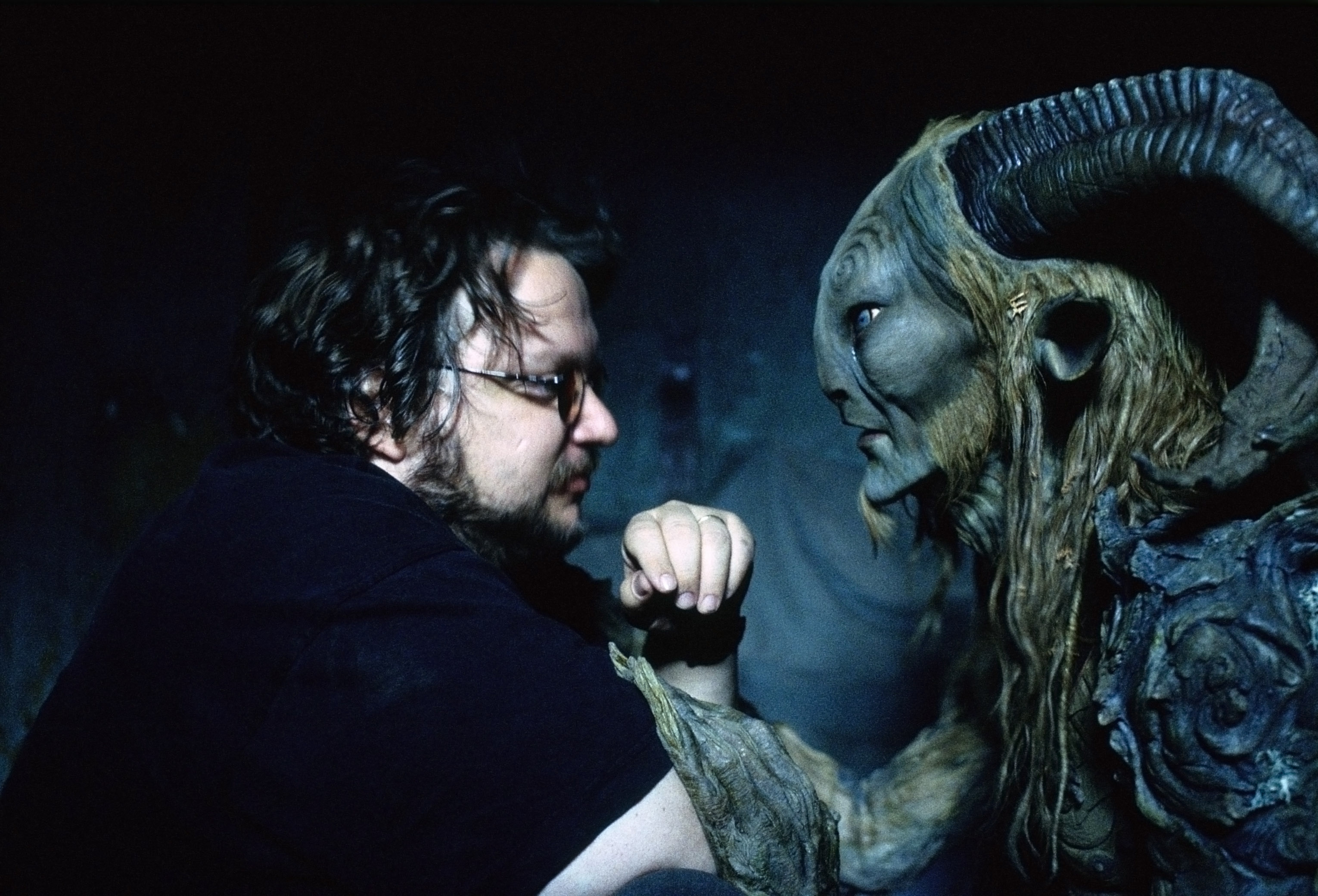 Guillermo del Toro and Doug Jones on setPicturehouse/Courtesy Everett Collection
Del Toro: Because we wanted to show him like a foolish old man in the beginning, and end up sexy and young and dangerous.
Jones: Right — because Ofelia was the key to getting the underworld back to its full life again, so the faun represented that: the more she believed, the younger and healthier I got. In my very first scene, I was more arthritic and older-looking, and the makeup changed incrementally throughout the movie until, at the very end, I started off grayish and ended up auburn and moving more fluidly.
Del Toro: At the end, when he’s bringing the greatest proposal — we talked about rock stars. I said, “More Bowie, more Jagger.”
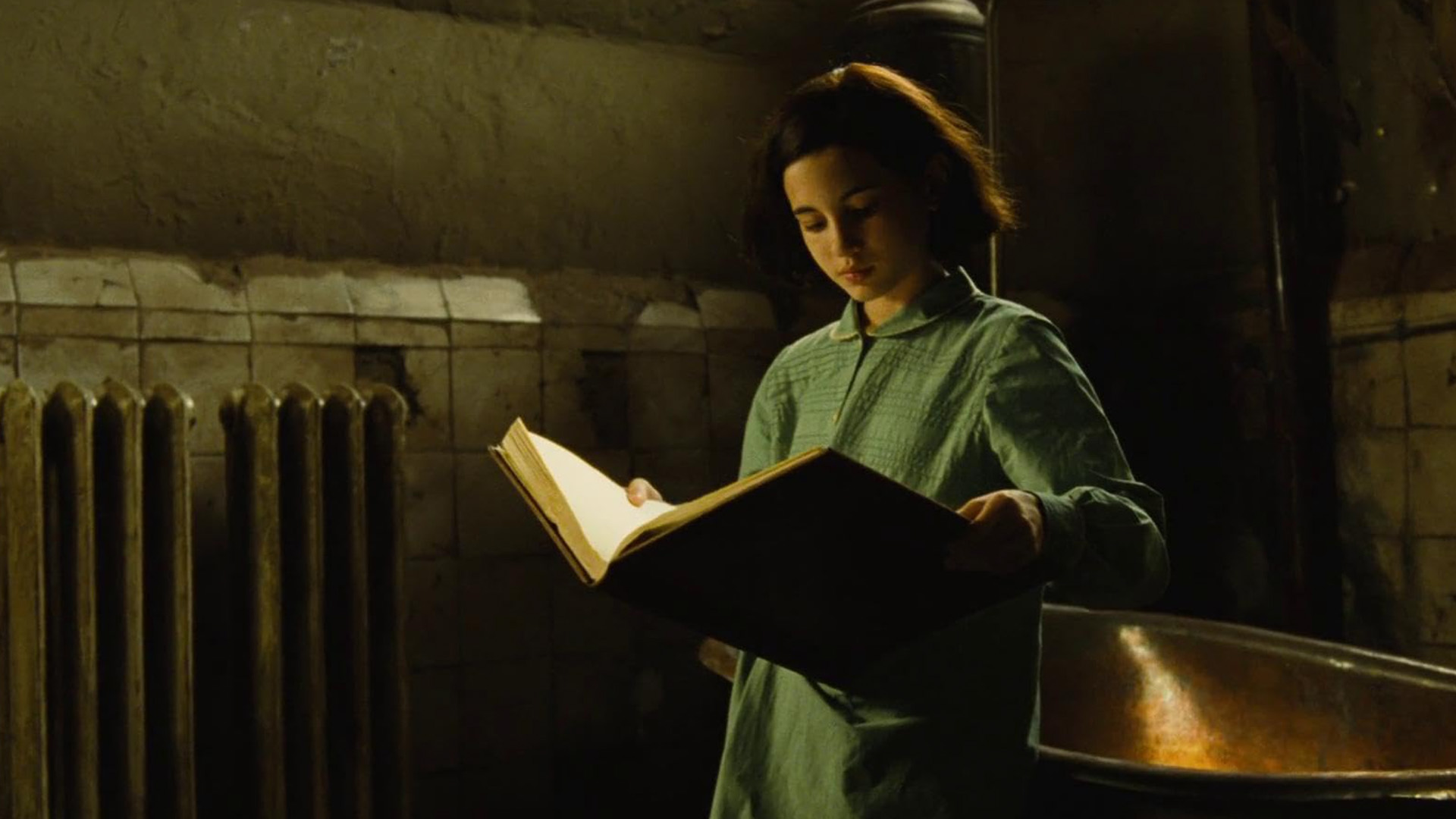 Ofelia and her enchanted bookNew Line Cinema
Ivana Baquero: Guillermo gave me so much trust. Mind you, Guillermo knows exactly what he wants, always — remember, he walked around with his notebook, and you’d never fail because he always had your back and always executed his vision. But he also gave me and the cast so much trust, and he treated me as an adult, so I felt the freedom to really contribute to the project in my own way. That was really interesting for me as an actor.
Del Toro: And we wrote her biography together.
Baquero: We did. We did so much prep. The thing is, on set it was crunch time, and there were so many difficulties, so many challenges. Doug was wearing all his prosthetics and the costume, and there was a lack of time sometimes, so we needed to make sure that when I was on set, I could execute — and I knew exactly what the vision was and what I was expected to do. We worked on the biography. You gave me a lot of material, too — comic books. I remember Nausicaä of the Valley of the Wind and Grave of the Fireflies. It was a lot for me to study, and to really understand that level of depth that was required for Ofelia, because I was a child. I didn’t know that amount of sorrow, and somehow I was able to connect to it via all the prep we did.
Navarro: This was a little girl, and you’d tell her, “Now the fairies are around you, and now this insect just landed, and now this,” and she had to interact with all of it while the camera was moving on top of it. So it was remarkable that she allowed us — not even knowing it — to keep going on that very complicated path.
Del Toro: [to Baquero] You were the most serious actor in the bunch. … I cast eyes. When I saw the eyes of Ivana, I said, “Those are the eyes of Ofelia.” Ivana had the capacity to react to everything. She was always an adult — always the most intelligent, cerebral, precise actor I’ve ever worked with. You treat actors with the love and respect their magic deserves, and you guide them. But guiding is not dictating.
AKA The Pale Man
Each panelist was asked to pick their favorite scene from the film. Del Toro chose the nightmare-fuel sequence that introduced the Pale Man.
Del Toro: We knew from the beginning that when you make a movie, you can’t shoot everything the same way. Some scenes you have to shoot fast; some you have to give the time. When we talked about this scene, we always knew we’d have to give it many days — it was always the centerpiece of the film.
I knew this scene came in the middle of the movie, and you had to understand that her tests required her to be very brave. This was the setting that was going to hold the first part of the movie and give fuel to the second part.
It’s memorable to me because it’s sort of the signature of the film. This is one of the scenes where I had a huge fight — a huge fight — with the makeup effects company, because originally the Pale Man had a face, the face of an old man, and it was just that. And I said, “No, no, no — we’re going to erase the face.” They got really angry. Really angry. They said — sorry about this, kids, cover your ears — they said, “You don’t care about our job.” I said, “I don’t, actually. I care about the movie.” It got really heated. But it became the signature piece of the film. The way that character was designed was very haphazard, very beautiful, very instinctive — and it ended up being that.
Jones: And of all the characters I’ve played in my entire career, this is the one people come up to me about to this day, going, “Hi, Daddy!” [He holds up his hands in imitation of the Pale Man.]
Del Toro: And when Doug and I talked, I said, “You’re playing both characters.” And he said, “You cheap bastard.” It’s the Faun as the Pale Man, because the Faun is trying to trick Ofelia into making the wrong choice. So there was a risk there.
Jones: And he is a cheap ass.
Making the director cry
For her scene, Baquero chose the moment where Ofelia places her head against her ailing mother’s belly and addresses her unborn brother, offering to make him a prince in her fairy kingdom if he doesn’t hurt their mother when he’s born.
Baquero: I picked that clip because, for me as an actor, it was a turning point. When you’re a child, you’re encouraged, in order to perform and for them to draw emotion out of you, to use substitution — to think about all these horrible things, which is not necessarily a pleasant process. But with Guillermo, for the first time ever, I was able to connect so deeply to the story and to Ofelia that I was truly able to channel her, to be present, and to feel all those feelings she was feeling. As an adult, I now find that quite remarkable, because I hadn’t gone through that level of pain and sorrow. I think that comes as you grow up, as you become an adult and experience pain — you deepen that emotional toolkit you can then apply to your craft. But I didn’t have that back then. When it happened, and when it all clicked, I remember thinking, “Oh — this is what it’s actually about. This is addictive. This is what it feels like. This is the point of what we do, of performing.” So from then on, that’s when I fell in love with acting, and when I decided that’s what I wanted to do — because I wanted to chase that feeling.
Del Toro: And that was your audition scene. … All the actresses coming in for Ofelia read that scene, and I remember you read it, and all of us were crying.
Finding the Faun
Jones’ pick was the scene where the Faun introduces himself to Ofelia.
Jones: First of all, when Guillermo offered me this role and I heard it was going to be in Spanish, I freaked out and said, “You’ve got the wrong guy!” And he said, “Dougie, you can count to 10, for all I care.” But I couldn’t get away with just counting to 10 — if I went, “one, two, three, four, five, six, seven, eight, nine, 10,” that would be a lip-sync issue. So I thought I’d better buckle down and learn the language of the film. What you heard was a voiceover — it was a Spanish actor who could hear the nuances I couldn’t hear — but I got to set the tone and the pace of his dialogue. I was terrified, so nervous. I was sure I was going to ruin this beautiful film for him. So on that first scene, I got very little direction from Guillermo as we were filming. About a week into filming, after this scene was done, he approached me on set one day between shot setups and said, “Dougie, I know you have not heard much from me, my friend, as a director. It’s because you’re getting it right.”
Del Toro: He sounded like an American tourist ordering beer.
Toad in the hole
Navarro, meanwhile, selected the scene where Ofelia must confront the giant toad that dwells in the roots of the tree and trick it into eating special stones to break its spell.
Navarro: The original set for that scene was going to be bigger — a giant chamber. But when we started playing with the toad model, when they were demonstrating it to us, it was very heavy and limited. So we did the opposite thing: we put him — put us — in a tight environment, where he couldn’t really move, because now he’s contained by this set, sort of a tunnel, with mud, and where the camera had to fly to things. It was actually a pretty complicated set that we could cut in half, to be able to shoot the parallel shots you just saw. So it was that kind of thing where we said, “OK, we don’t have the solution we wanted, so we’ll turn it around.” Let’s do the opposite — let’s bring it to something tight, where there’s no room.
Del Toro: But the movie dictates itself, if you learn to talk to the movie. You think, “Oh, they planned it like that.” No — it happened like that.
Baquero: And he won the Oscar.
Del Toro: First Mexican cinematographer in the history of the Academy! You have to understand this: wherever you come from, whatever you’re told is against you, you can power through. When Guillermo and I came to the United States early in the ’90s, Guillermo went to a talent agency for cinematographers, and they said to him, “Why would we hire a Mexican? We already have a gardener.” So what do you say to that? I won’t say it, because audiences under 18 are present.
The ambiguity of the ending
There’s been much debate about whether Ofelia’s fantasy world was real or imagined and whether she really entered upon her physical death in the end. While del Toro has maintained that the fantasy is real and there are clues sprinkled throughout to indicate as much, the argument is far from settled.
Del Toro: I think it’s a movie about the clash of two wills — the will of a girl who has no power in the real world, and the will of a fascist who has all the power in the real world but nothing inside. And I still think the girl wins. Because the moment you sing while they’re boiling you alive, you won. The moment you have your last two seconds of life to say, “Thank you” or “No thank you” to the choices of life — I think you win. They tell us what they think we are, but we know what we are, and that’s a power evil doesn’t have. When they tell you, “Oh, this is inevitable,” we say, “We’ll see about that.”
If you need a thing to make art, then you’re not an artist, I’m sorry. Art comes from experience, from pain. The sacredness of imagery, the sacredness of stories — they want to take it away because it makes us more vulnerable, more divided, and more stupid, and they want us that way. So art, and beauty, and the human spirit are resistance.
Baquero: When I was first watching it while promoting it, at 11 years old, I didn’t want to believe that her inner world was real. There was a part of me that thought, well, maybe she was evading reality. But as I’ve grown older, as opposed to being jaded, I want to believe more and more that that was, in fact, the real world — that was her reality, and she was not hiding away from the world, but fighting for the world. So I’ve become more and more of a believer.
That’s one of the reasons I’m so excited for people to rediscover the movie and hopefully discover new things in it, because it’s got so many layers. That’s one of the beauties of it.
Set souvenirs
Del Toro’s home in Los Angeles houses a museum’s worth of memorabilia spanning both the history of filmmaking as well as his own career. So what did he keep from Pan’s Labyrinth?
Del Toro: That’s a very good question. I actually kept the original book, the one with the drawings, that Ofelia has. And I kept the monolith with the eye in it. The experience was — I mean, you must understand, I didn’t know. I say this with certain movies: “This is my last movie, because I’m going to put everything into it.” The first one that was “the last one” was Cronos. Then came this one. Then came The Shape of Water. Each time I said, “That’s it, I’m retiring after this.” I’m not a good “wife,” and I didn’t keep many things — but I kept those two things, and I will never, ever in my life part ways with them.
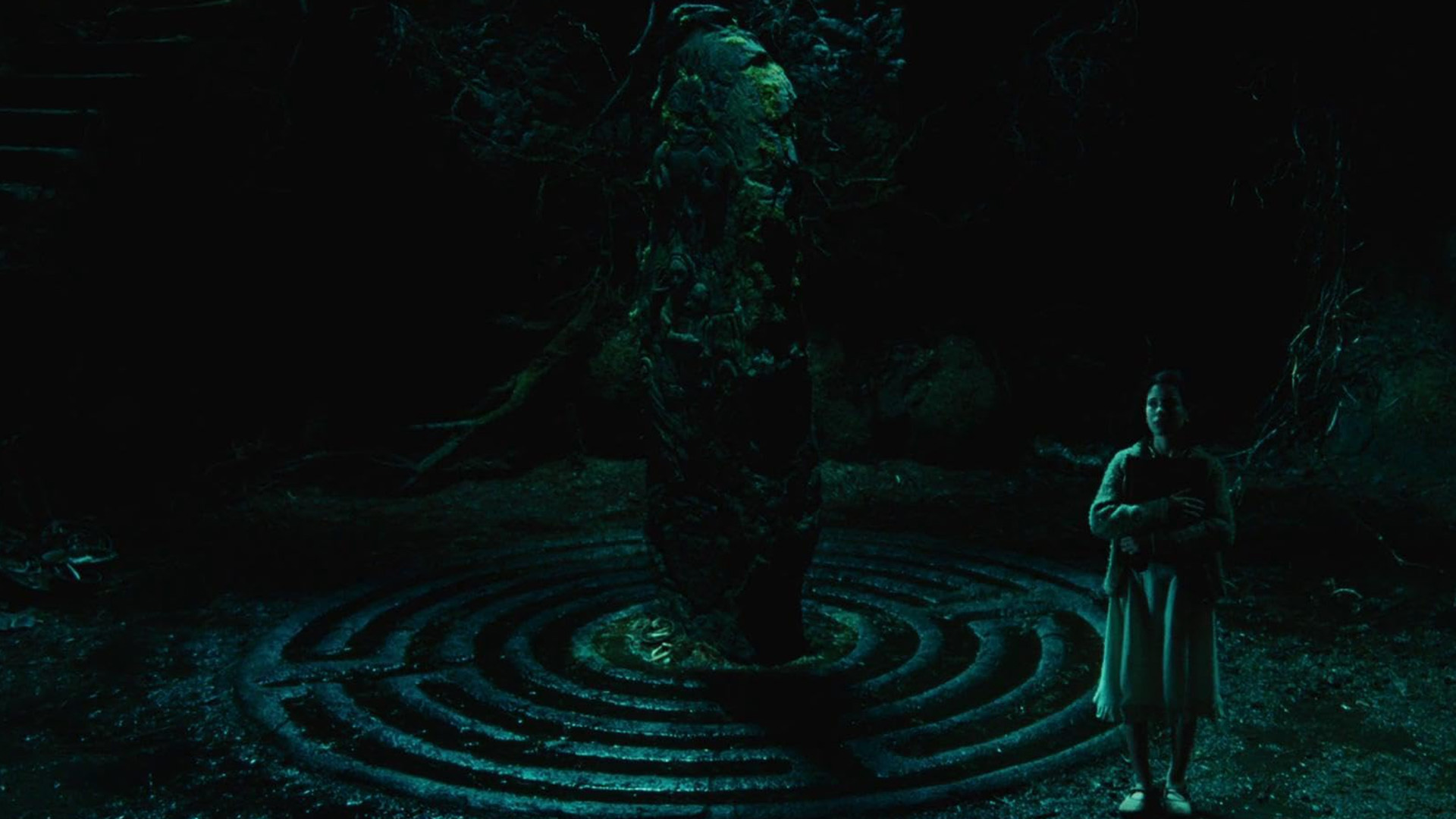 Del Toro kept the monolith and book props New Line Cinema
The film’s legacy
Del Toro is bankrolling a full restoration of the film, which includes creating a 3D version, as well as a premium HDR format—without the use of AI. It will be released on his birthday, Oct. 9. He and his team are excited to have a new generation discover the film.
Del Toro: When you convert to 3D, there are two ways: quick, or good. I chose good. Specifically, when I talked to Jim Cameron about conversion, he said, “If you take less than 300 days, I’ll kill you.” Because you have to put in the time — you go to every element by hand. A human-made a decision. We’re redoing some sound elements, remixing it in Atmos, and doing a new color pass. I’ll tell you one thing: you haven’t seen it. Seeing it in 3D is extraordinary.
We’re ready for it to have a second life, because it’s relevant today. If you can renew it visually and in audio, you can attract people who saw it as kids and who might be parents now. You have an intergenerational possibility to re-experience the movie for a new audience. The other day, I saw 70 minutes of the movie — we’re still away from finishing — and it was the first time it’s been very hard for me to watch this movie, because I remember everything that was going wrong. It’s the first time I’ve gone, “I want to see more.”
Jones: I meet a lot of young people who watched the movie as teenagers, and it helped them find their voice and fight the evils of the world — and if you feel like the underdog, maybe you have a chance to be the one on top at some point. I love seeing that evolution.
Navarro: Now, 20 years after, it proves to be still very relevant. We’re still fighting dictatorships, we still have things to believe in, and we have to carry on. So Pan’s Labyrinth is very alive.