
 Roy Rochlin/Getty Images
Moneywise and Yahoo Finance LLC may earn commission or revenue through links in the content below.
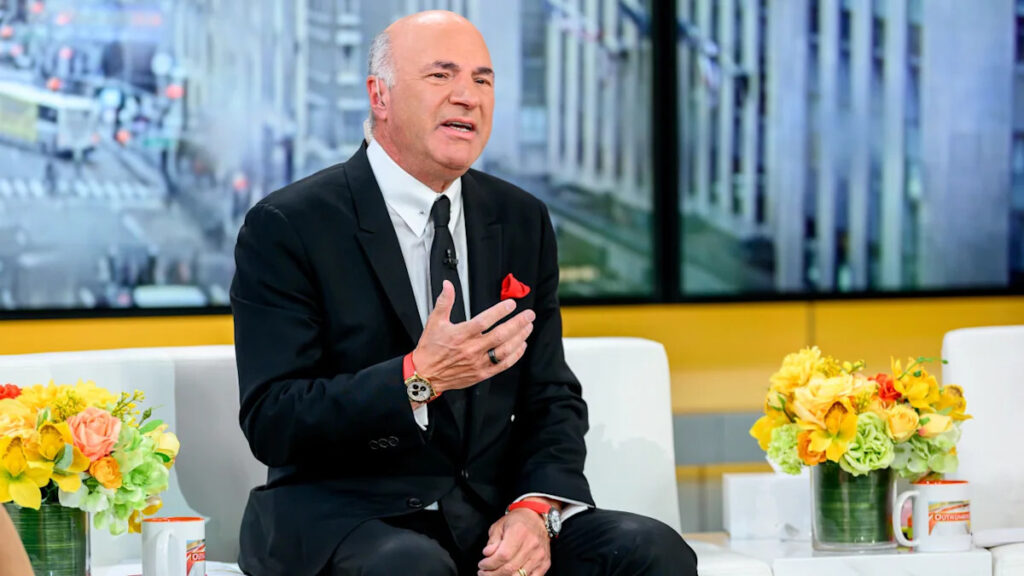
Kevin O’Leary has a dollar figure for you, and it comes with a deadline.
“By the time you hit 33 years old, you should have $100,000 saved somewhere,” the Shark Tank investor and personal finance commentator said in a recent video shared on X. “Make that your goal (1).”
Must Read
JPMorgan still sees gold hitting $5,000/oz by Q4 — and savvy investors are protecting their wealth with a tax-advantaged Gold IRA. Learn more with a free guide from Priority Gold
He even built in some wiggle room, noting 35-years-old is okay too.
Hitting that mark sets up for $500,000 before retirement
O’Leary frames this age as a financial inflection point — the moment when time and compounding interest either start working for you or begin to slip away. His logic extends to a larger goal: accumulating $500,000 before retirement.
“Your goal should be to try and amass at least $500,000,” he said. “So you start to chop up the decades you’re gonna work. By 33, you better have 100K if you’re gonna get the other 400K by the time you’re 60 (1).”
His prescription for getting there? Save 20% of your paycheck and then let market growth do the work.
How most Americans are actually doing
Most people are nowhere near O’Leary’s target. (2)According to Vanguard’s How America Saves 2026 report, the median 401(k) balance across all savers at year-end 2025 was $44,115 (3).
That figure skews upward because it includes older, higher-balance savers. For workers in their late 20s and early 30s specifically, balances are considerably lower: the Vanguard data confirms the median for workers under 25 is just $2,234, and $18,732 for those aged 25–34, making O’Leary’s $100,000 target all but insurmountable.
That gap is partly structural. SmartAsset notes median earnings for Americans aged 20–24 are just $41,392 annually, before rising to $59,800 for those aged 25–34 — meaning early-career workers are simultaneously building income while managing competing financial pressures (4).
And CNBC’s analysis of Federal Student Aid data shows almost 43 million Americans have about $1.83 trillion in student loans — a burden that weighs heaviest in the early career years when O’Leary’s 20% savings rate would be hardest to achieve (5).
Still, it’s worth noting that the most significant jumps in retirement savings occur between your 40s and 50s — when incomes are higher, debt loads have often eased and compounding has had more time to work, according to Empower’s data. That makes the early accumulation O’Leary prescribes by 33 all the more critical as the foundation for what comes later (6).
Read More: Millionaires under 43 hold only 25% of their wealth in stocks. Here’s where their money is actually going
The math behind the 20% rule
O’Leary’s method is achievable but demanding. It assumes consistent contributions and long enough time in the market to let compound interest work its magic. A Kiplinger savings analysis illustrates the underlying principle directly: $10,000 invested at age 30 at 7% annual returns grows to roughly $106,000 by age 65. Wait until 45, and the same investment yields only about $38,000 (7). Those last couple of decades are essential.
For someone earning near the U.S. median — which the Bureau of Labor Statistics reports for full-time workers as $1,233 per week, or roughly $64,000 annually — saving 20% means setting aside approximately $12,800 annually, or about $1,070 per month (8).
Accounting for employer 401(k) matching, which Vanguard found averages 4.7% of salary, reduces the required personal contribution, but the target still demands consistent prioritization over discretionary spending (9).
Make saving a habit
O’Leary’s specific figure is less important than the habit it represents. As the SEC notes, “The earlier you start investing, the more powerful the impact of compounding becomes (10).”
“If you haven’t saved anything by the time you’re 33, you’re way behind the 8-ball,” O’Leary said (1).
Every year you postpone investing means you lose another year of compounding, forcing you to contribute more later just to catch up. Building wealth is often less about finding the perfect investment and more about simply staying invested for the long haul.
History backs that up. The S&P 500 has generated average annual returns of roughly 10% since 1957 (11). At that rate, investing just $20 a week for 30 years could grow into more than $179,000 (12).
For many people, the hardest part is staying consistent. That’s where automated investing tools like Acorns come in.
Acorns allows users to invest spare change from everyday purchases automatically — helping them steadily build wealth without having to think about every market move.
All you have to do is link your cards, and Acorns will round up each purchase to the nearest dollar, investing the difference — your spare change — into a diversified portfolio of ETFs managed by experts at leading investment firms like Vanguard and BlackRock. Over a lifetime, a little bit of consistency can go a long way.
With Acorns, you can invest in an S&P 500 ETF built and managed by experts with as little as $5 — and, if you sign up today and set up a recurring investment, Acorns will add a $20 bonus to help you begin your investment journey.
Diversify beyond stocks
Once you’ve built the habit of investing consistently, the next step is making sure your portfolio isn’t overly dependent on a single asset class. While stocks have historically delivered strong long-term returns, concentrating all your investments in the stock market can leave you exposed in the event of a sharp market correction.
That’s why many financial professionals recommend broad diversification across different asset classes. When one asset struggles, another may hold its value or even appreciate, helping cushion overall returns.
Gold has traditionally played that role during periods of uncertainty. Investors often turn to it during periods of market stress, geopolitical uncertainty, or persistent inflation. Gold prices have more than doubled over the past five years, hitting multiple record highs along the way and outpacing the S&P 500 over the same period.
A gold IRA from Goldco lets you hold physical gold and other metals while still getting the tax advantages of an IRA.
They also offer a guaranteed buyback program, meaning they’ll repurchase your metals at the highest price according to market value if you ever decide to sell.
If you’re curious whether this is the right investment to diversify your portfolio, you can download your free gold and silver information guide today. You can also get up to 10% in free gold or silver on qualifying purchases. Just remember, gold is usually best used as one part of a portfolio.
Create a source of passive income
One of the most effective ways to accelerate wealth building is by investing in assets that generate ongoing cash flow. This way, you can have additional money to reinvest, strengthen your financial flexibility and help offset the rising cost of living over time.
Real estate has historically checked many of those boxes. Rental properties can generate recurring income, and rents have historically tended to rise alongside inflation. Even better, property values don’t always move in lockstep with the stock market, making them a useful diversification tool.
Still, direct property ownership isn’t for everyone. Managing tenants, maintenance, insurance and unexpected repairs can quickly turn passive income into a full-time job.
But with platforms like Arrived, you can invest in real estate without the burden of mortgages or tenant management. And you can get started with as little as $100.
Backed by world-class investors like Jeff Bezos, Arrived lets you purchase shares of vacation and rental properties across the country. Arrived distributes any rental income generated by properties to investors monthly, allowing you to potentially set up a passive income stream without the extra work that comes with being a landlord of your own rental property.
The best part? For a limited time, when you open an account and add $1,000 or more, Arrived will credit your account with a 1% match.
Put your emergency savings to work
Saving your first $100,000 is rarely a straight line. Along the way, unexpected expenses — whether it’s a car repair, medical bill or sudden job loss — are almost guaranteed to pop up. That’s why financial experts consistently recommend building an emergency fund before focusing exclusively on growing your investment portfolio.
Having three to six months’ worth of living expenses in reserve creates a financial buffer that can keep temporary setbacks from becoming long-term problems. Instead of reaching for a credit card or pausing your investment contributions, you can lean on your emergency savings to cover any unforeseen costs while keeping your long-term savings plan intact.
That doesn’t mean your emergency fund should sit idle. As inflation continues to chip away at purchasing power, leaving thousands of dollars in a traditional checking or low-interest savings account could mean your money loses value over time.
A high-yield account like a Wealthfront Cash Account can be a great place to grow your uninvested cash, offering both competitive interest rates and easy access to your money when you need it.
A Wealthfront Cash Account currently offers a base APY of 3.30% through program banks, and new clients can get an extra 0.75% boost during their first three months on up to $150,000 for a total variable APY of 4.05%.
That’s 10 times the national deposit savings rate, according to the FDIC’s June report.
Additionally, Wealthfront is offering new clients who enable direct deposit ($1,000/mo minimum) to their Cash Account and open and fund a new investment account an additional 0.25% APY increase with no expiration date or balance limit, meaning your APY could be as high as 4.30%.
With no minimum balances or account fees, as well as 24/7 withdrawals and free domestic wire transfers, your funds remain accessible at all times. Plus, you get access to up to $8M FDIC Insurance eligibility through program banks.
Run the numbers by an expert
The sheer size of a six-figure savings goal can feel intimidating, especially if you’re just beginning your financial journey. But with the right investment strategy, can make it feel far more achievable.
That’s where professional guidance can make a difference. A financial advisor can help identify gaps in your plan, recommend adjustments based on your goals and risk tolerance, and periodically rebalance your portfolio as markets change. Having a clear roadmap can also make it easier to stay disciplined during periods of market volatility instead of making emotional decisions.
You can connect with a vetted FINRA/SEC-registered advisor near you for free through Advisor.com.
The platform does the heavy lifting for you, vetting advisors based on track record, client ratios and regulatory background. Plus, their network comprises fiduciaries, who are legally required to act in your best interests.
Here’s how it works: Simply enter a few details about your finances and goals, and Advisor.com will comb through its roster and connect you with a qualified expert best-suited for your needs based on your unique financial goals and preferences.
Even better, Advisor.com lets you set up a free initial consultation with no obligation to hire to see if your match is the right fit for you before making a decision.
— With files from Emma Caplan-Fisher
You May Also Like
Join 250,000+ readers and get Moneywise’s best stories and exclusive interviews first — clear insights curated and delivered weekly. Subscribe now.
Article Sources
We rely only on vetted sources and credible third-party reporting. For details, see our ethics and guidelines.
@cptdankkk/ X (1); Guardian Life Insurance Company of America (2); Vanguard (3); SmartAsset (4); CNBC (5); Empower (6); Kiplinger (7); Bureau of Labor Statistics (8); Vanguard (9); Investor.gov (10); Investopedia (11); Acorns (12)
This article provides information only and should not be construed as advice. It is provided without warranty of any kind.