
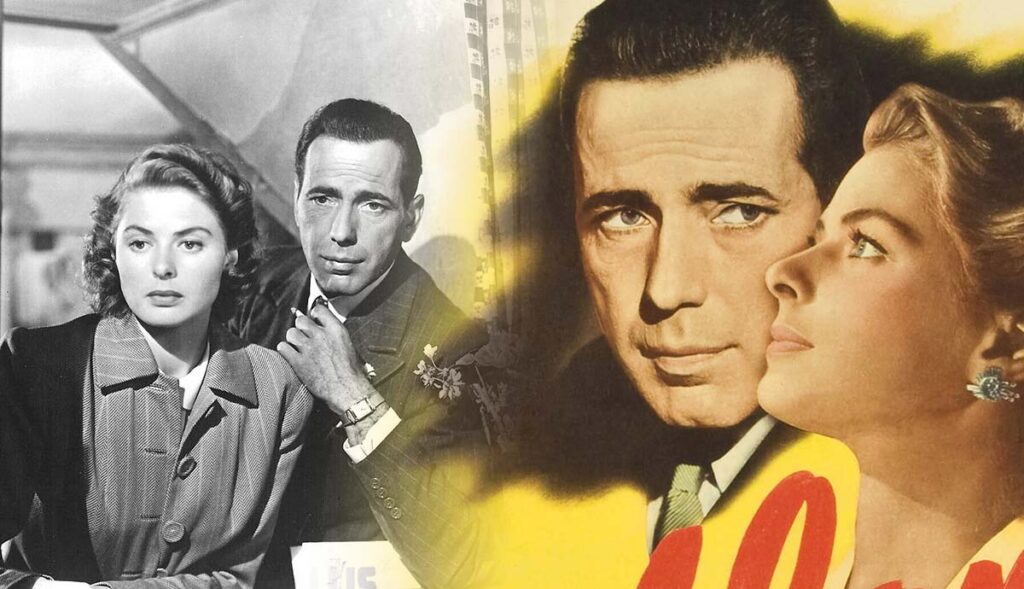
Published: Sep 9, 2026written by Thom Delapa, MA Cinema Studies, MA Social Sciences, BA Liberal Arts


Even filmgoers who have never seen the 1942 Humphrey Bogart/Ingrid Bergman Oscar winner have heard its famous lines quoted in countless spoofs, memes, and homages, both on and off the screen. So the next time you hear “Round up the usual suspects,” or “Of all the gin joints in all the towns in all the world, she walks into mine,” or the infinite variations on “I’m shocked, shocked, to find out that [fill in the blank] is going on here!” you must remember this: They all came from Casablanca.
Casablanca: The Road to Morocco
 Original Warner Bros. poster for Casablanca.
When it came to production and release timing, Warner Bros. struck gold—and not just Oscar’s gold enamel. Co-written by Murray Burnett and Joan Alison, their 1940 play (Everybody Comes to Rick’s) was snapped up by the studio immediately after the December 7, 1941 Japanese attack on Pearl Harbor. The next day, President Franklin D. Roosevelt asked for—and was granted—a declaration of war against Japan and, within days, its European “Axis” allies Germany and Italy.
Before Pearl Harbor, the U.S. was ostensibly neutral regarding the war already raging in Europe. But with America’s decisive entrance into both the European and Pacific fronts, Warner Bros. launched into action, armed with a 43-year-old supporting actor who had made his name playing heavies in the studio’s bread-and-butter 1930s gangster films. Humphrey Bogart would not only star in Casablanca, but his command performance would win him a first-class new contract, making him Hollywood’s highest-paid actor.
 U.S. military map of Casablanca, French Morocco, in 1942. Source: Wikimedia Commons
Warners not only played the conquering hero at the 1942-43 Academy Awards (three Oscars including Best Picture), it went home a winner at the box-office, too. In production during the summer of 1942, the film’s late November New York City premiere astoundingly landed almost exactly when U.S. forces (under Gen. George S. Patton) marched into Casablanca following a cease-fire agreed to by the outmanned French “Vichy” army. With Germany’s blitzkrieg defeat of France in 1940, Paris and half the country fell under direct Nazi control, while French officials willing to collaborate with the Nazi occupation ruled the other half. The latter included France’s colonies in North Africa, including Morocco. Several hundred Vichy officials were executed as traitors following the war.
“The Same Old Story, a Fight for Love and Glory”
 1947 Dutch cinema lobby display for Casablanca. Source: Wikimedia Commons
Of course, while the film contains realistic “big picture” elements reflecting the glum wartime context, it is nevertheless popular entertainment, however compelling it was for 1943 audiences, as well as modern ones. A platoon of screenwriters adapted and honed the play, chief among them the Epstein brothers, Julius and Philip, as well as the more politically minded Howard Koch. This type of “assembly line” scripting (with multiple writers working on different drafts in succession) was standard for classic Hollywood and especially in this case since the writers were reworking the script nearly every day of the production. It is a lesser-known trivia fact that the constant re-writes were such that co-star Ingrid Bergman was never sure which man she would romantically end up with until the finale was actually shot.
 Bogart in Casablanca. Source: BAMF Style
Against the war’s backdrop, Casablanca’s plot pitches a three-sided romantic battlefield. In one corner is Bogart’s Rick Blaine, a disillusioned American ex-pat who’s fled to the port city to open a swanky bar and night club. In the first years of Hollywood stardom after leaving her native Sweden, Bergman plays Ilsa, Rick’s old flame who arrives in Casablanca with her husband Victor (Paul Henreid), a dedicated Resistance leader on the run from the Nazis. Now cue Rick’s world-weary complaint about how, “of all the gin joints in the world,” one night Ilsa elegantly strolls into his. On the outside wryly looking in is Captain Renault (Claude Rains), the lecherous, easily corrupted Vichy prefect with an eye for young ladies in need. As for the Nazi villain of the piece, Conrad Veidt’s Major Strasser flies in to serve with meritorious menacing distinction.
Under the glossy black-and-white front of romance and intrigue, from almost the first shot the writers and director Michael Curtiz front-load the story with ammunition to keep audiences at attention. The action starts when a smuggler comes into Rick’s Café bearing two stolen “letters of transit” that will allow their owners safe passage out of Casablanca, on to Lisbon, and then hopefully to freedom in the United States or England. Ever the cool, chess-playing man’s man, Rick stashes the letters in the barroom’s upright piano. Now “captive” audience members have at least two key questions to keep them guessing: Who will eventually obtain these precious exit visas and fly from Casablanca? Will it be Victor and Ilsa, Rick and Ilsa, or some other lucky couple?
Vive la France
 Casablanca’s French newspaper announcing a cease-fire between Vichy forces and Allied troops, 1942. Source: Bibliothèque Nationale de France
Except for the celebrated final departure scene (shot at Los Angeles’ Van Nuys Airport), the entire production took place on soundstages at the sprawling Warner Bros. lot in nearby Burbank. But for its legion of world-wide fans, Casablanca’s most memorable moment comes with the singing of the French “La Marseillaise” one evening at Rick’s. The stage is set once a group of German officers boisterously break into “Die Wacht am Rhein” (“Watch on the Rhine”), a patriotic, anti-French drinking song.
In unarmed yet vocal resistance, one by one the European émigrés and exiles respond by standing to sing the French national anthem, quickly drowning out the outnumbered, humbled Germans. It’s a beautiful, transcendent screen epiphany, one of Hollywood’s greatest, and a testament to the power of cinema to move and inspire with rich communal sentiment. Careful observers will also note that this resounding Francophile retort is silently sanctioned by Rick, who strikes up the band to play along with a subtle nod.
The scene is pivotal on several beats, most especially in how it sets off a diametrical shift in Rick’s own allegiances vis-à-vis the war. The film’s topical brilliance resides in how Rick is, in fact, an allegorical stand-in for America itself on the eve of World War II. Many times he asserts his “neutrality” and cynical and selfish sense of survival. “I stick my neck out for nobody” and “I’m the only cause I’m interested in,” he declares. As for his nationality, he sardonically says he is a “drunkard.”
 Dooley Wilson. Source: IMDb
Underneath his stoic isolation and indifference lies, alas, a broken heart, torn asunder by Ilsa when they had been lovers in Paris the year before. Thus, a revealing flashback fades in while Rick drinks himself into a stupor and his right-hand and piano man Sam (Dooley Wilson) plays the indelible theme song “As Times Goes By” (with its ever-quoted lyric “You must remember this”). Songs are of utmost importance in the drama, sparking personal memories (good and bad) as well as nationalist nostalgia and longing. As a side note, while some modern audiences may belittle the secondary role of Sam as a Black American “sidekick,” his close, unguarded friendship with Rick is historically unusual and progressive.
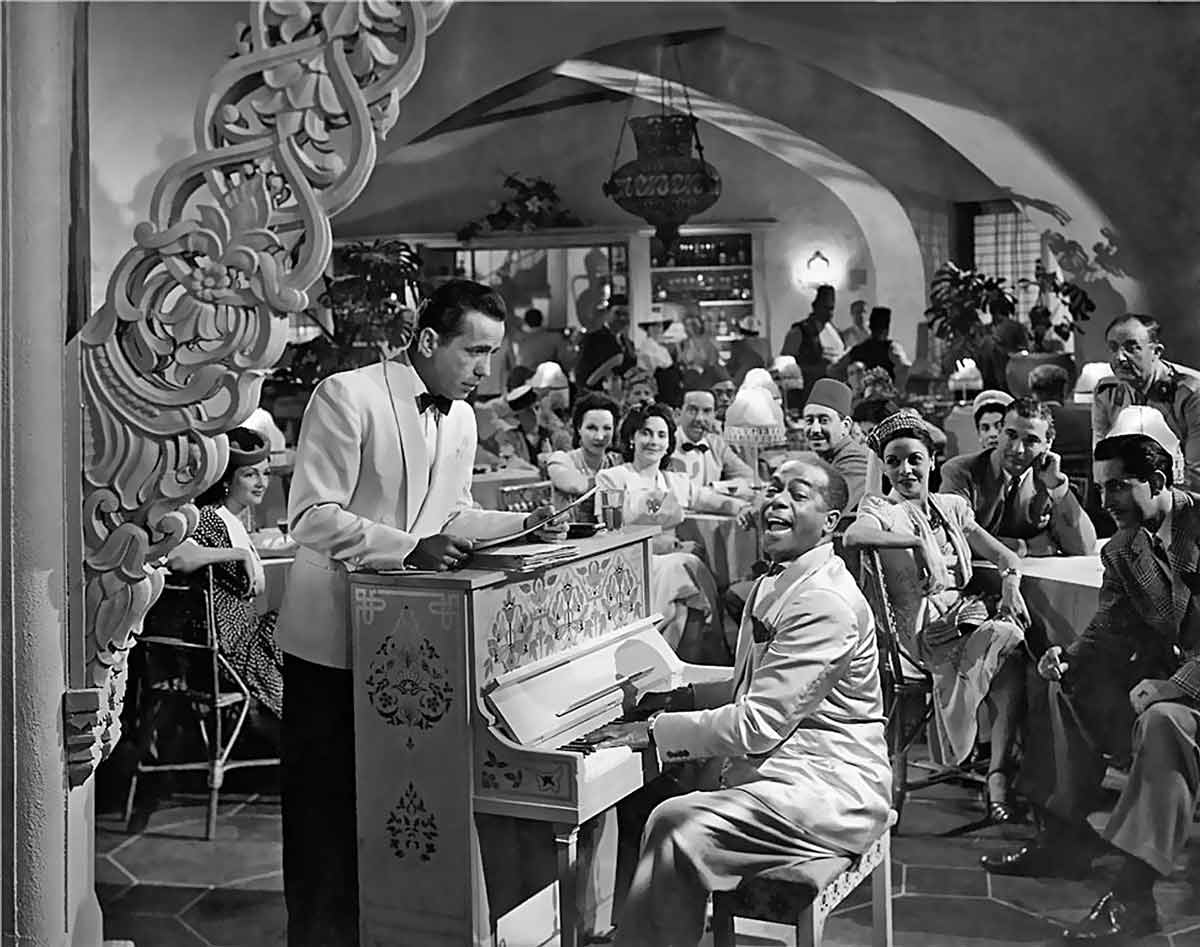 Rick listens as Sam plays it in Casablanca.
Digging deeper, it is also fascinating to consider the symbolic complexities echoing through Rick’s Café Americain itself. It is hardly just a “gin joint” where its ragtag ethnic émigrés find refuge; it is a microcosm that, in concentric circles, can be seen as the Warner Bros. studio, Hollywood itself, and finally the United States in toto. By the mid-1930s, scores of European artistic talents (especially Jewish ones) had fled their native countries with the spread of Nazism and relocated to the States. Naturally, many of those in the cinema gathered in the Los Angeles area for a chance to work in Hollywood.
Marquee directors such as Germany’s Fritz Lang and Billy Wilder were part of that wave, along with the iconoclastic Marxist playwright Bertolt Brecht. You will find other émigré names among the stranded denizens at Rick’s, including Peter Lorre, the star of Lang’s great 1931 crime thriller M. In 1942-43, during Casablanca’s theatrical run, America’s global image as a beacon of freedom, equality, and hope for the world was likely never brighter, most especially for would-be immigrants. Like Rick, many social observers today can only look back to that time with an aching hangover of nostalgia.
“Here’s Looking at You, Kid”
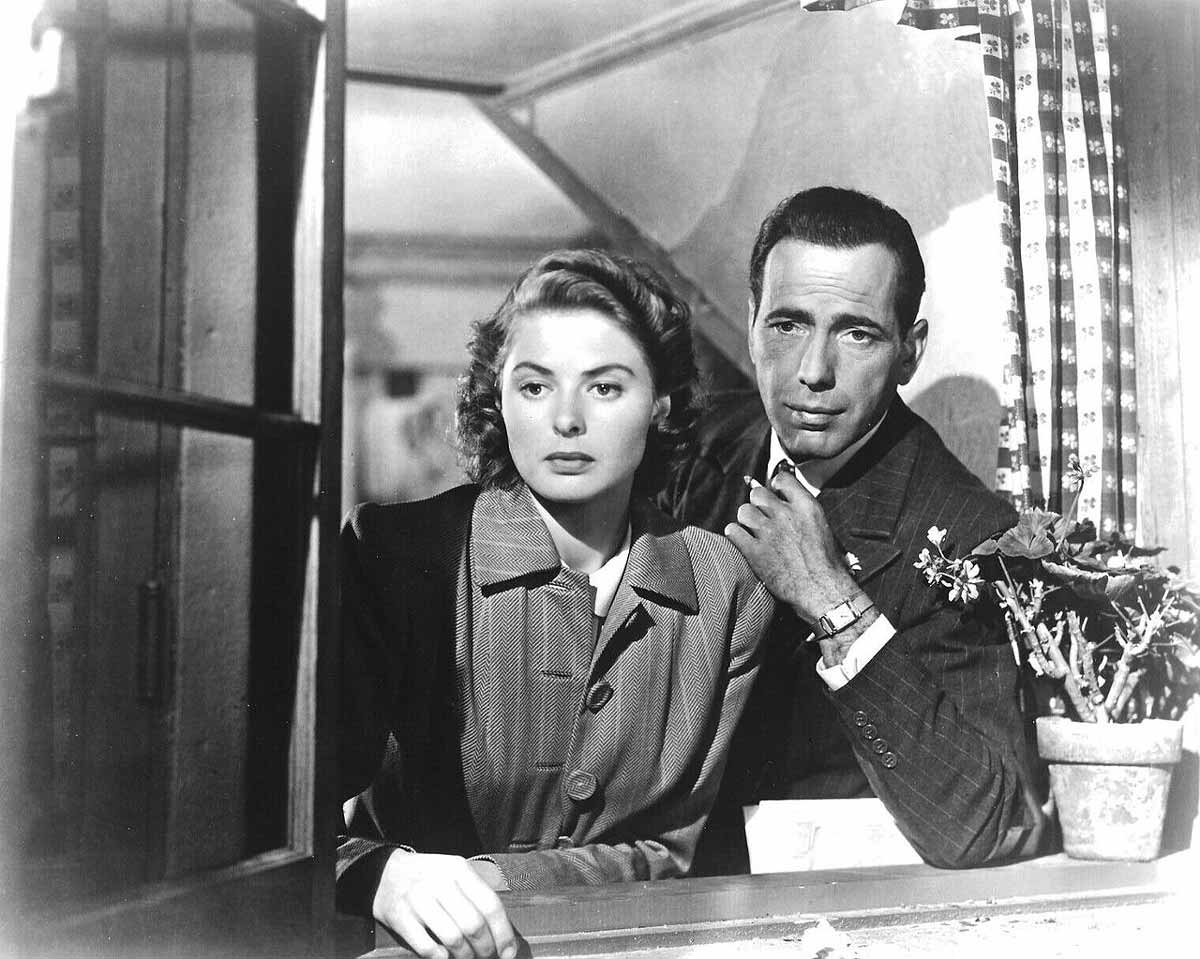 Ilsa and Rick in love.
Since Rick is the clear protagonist, how and why does he migrate from cynical, on-the-fence loner to partisan joiner and combatant, ala the U.S. in World War II? The key is locked in that Paris flashback, together with a “sequel” of sorts that unfolds in Rick’s apartment above the bar. In Paris, Ilsa had suddenly deserted Rick just as the German troops were marching in, leaving only an enigmatic farewell note behind. After her arrival in Casablanca, provoking Rick’s anger and resentment, she shows up unannounced one night to demand that he hand over the letters of transit so that she and Victor can escape. His leadership fighting the Nazis must continue, she tells Rick, and he must get to Lisbon before he is arrested.
Yet as the night wears into the wee hours and she breaks down, it dawns (almost literally) on Rick why she left him. With that he not only understands her reasoning, but also that her shocking “Dear John” letter didn’t mean she didn’t love him. Far from it. From there, 1943 adult audiences might suspect what happens next, even if it is unsaid and censoriously left in the dark. Once their heart-to-heart talk is over and they embrace, there is a passage of time suggested by a “dissolve” (one shot superimposed into the next). In the next shot, a relaxed Ilsa appears on Rick’s couch while he smokes a cigarette, old Hollywood’s wispy, time-honored signal of post-smoldering passion.
Building to that iconic last scene at the airport, Rick bluffs and puffs as long as possible before he lays all his cards on the table, holding both Strasser and Renault at bay until his final declaration of where he stands. But will it be a declaration of love or a declaration of war? Or will he hold his fire? You must remember this: The famous last words of Casablanca are, after all, “This could be the beginning of a beautiful friendship.”