


Credit: Far Out / Angel
Sat 12 September 2026 14:30, UK
The odd-couple action comedy is a tale as old as time in cinematic terms, but that’s kind of the point of Scott Waugh’s Runner, which was made as a throwback to the genre’s ‘Golden Age’.
While cinemas remain awash in punchy thrillers that pair two disparate personalities up with each other under extreme circumstances to achieve a common goal, Waugh’s latest is much more indebted to the Tony Scotts and Lethal Weapons of the world than the CGI overload that’s gradually taken over.
Like every movie of its ilk, Runner has the requisite high concept, which in this case finds Alan Ritchson’s courier, Hank Malone, tasked with delivering a new liver to a young girl in dire need of a transplant, with Owen Wilson’s Ben Bishop, who holds a similar job in the medical profession, making it his mission to ensure that he stays with the replacement organ along every step of the way.
Naturally, there are issues to overcome, which include, but aren’t limited to, a vengeful cartel that wants the liver for themselves, a talking bird, the obligatory tragic backstory for Ritchson’s protagonist, and enough shootouts, fistfights, car chases, and explosions to satiate the audience who grew up on these kinds of flicks.
Waugh, whose previous credits include the militarised actioner Act of Valor, Aaron Paul’s video game adaptation Need for Speed, John Cena and Jackie Chan’s Hidden Strike, and the fourth instalment in the Expendables franchise, knows a thing or two about crafting a set piece, which he knew long before he stepped behind the camera as a vastly experienced stunt performer.
 Credit: Far Out / Angel
Having been officially announced as Runner‘s megaphone-wielder in October 2024, by which point Ritchson was already on board to star and produce, the filmmaker admitted that the lengthy process of making any movie is more than worth it when people finally get to see it for themselves, which for his newest picture will be September 11th, 2026, in cinemas.
“Most movies, especially for me, are usually a two-year haul from start to release, and as it gets closer to release, it does get a little bit more exciting for me,” Waugh told Far Out. “Personally, I make my films for the audience, so I get really excited when they finally get a chance to experience it in the theatre, so I’m very eager to finally put it out there.”
Miles Hubley and Tommy White’s script made it onto the 2023 edition of the Black List, so there was already some buzz surrounding it, and that was one of the reasons why the director didn’t feel the need to make too many changes or alterations.
One of the biggest was relocating the action from Los Angeles to Brisbane and the Gold Coast in Queensland, Australia, but beyond that, little was changed about Runner, story-wise. Still, Waugh wanted to keep a surprise or two up his sleeve, and he wasn’t willing to divulge before the movie hits cinemas.
After praising the “fantastic” screenplay, which is what got him “super excited” about the project in the first place, he teased that “one of the things that I wanted to shift with the film, and I really can’t give you the exact specifics because it gives away the plot, but I just really wanted the ending of the film to land in a different way than expected.”
This writer has seen the movie and knows exactly what he’s talking about, and it’s not a spoiler to call it a bookend of sorts. In addition, that talking bird we mentioned earlier wasn’t originally quite as prominent a fixture on the script, but when the director wants to increase the screentime for an unwitting avian accomplice, who’s going to tell them no?
“A couple of other devices in the film were positioned to disappear in the first act,” he offered. “And I’m like, ‘They’re such great devices’. Like the bird. I’m like, ‘I think we should carry that through the movie’. It used to come and go until page ten, and I’m like, ‘I think that’s a fun, clever plot point to kind of weave throughout more of the screenplay’, so the writers were very grateful in trying to incorporate my new ideas.”
 Credit: Angel
Since Ritchson was attached before Waugh, it wasn’t a sure thing that he’d get the job. All it took was one meeting for the pair to realise that they wouldn’t need to work very hard to see eye-to-eye, though, with the latter revealing that from their initial discussion, they were pretty much on an identical page.
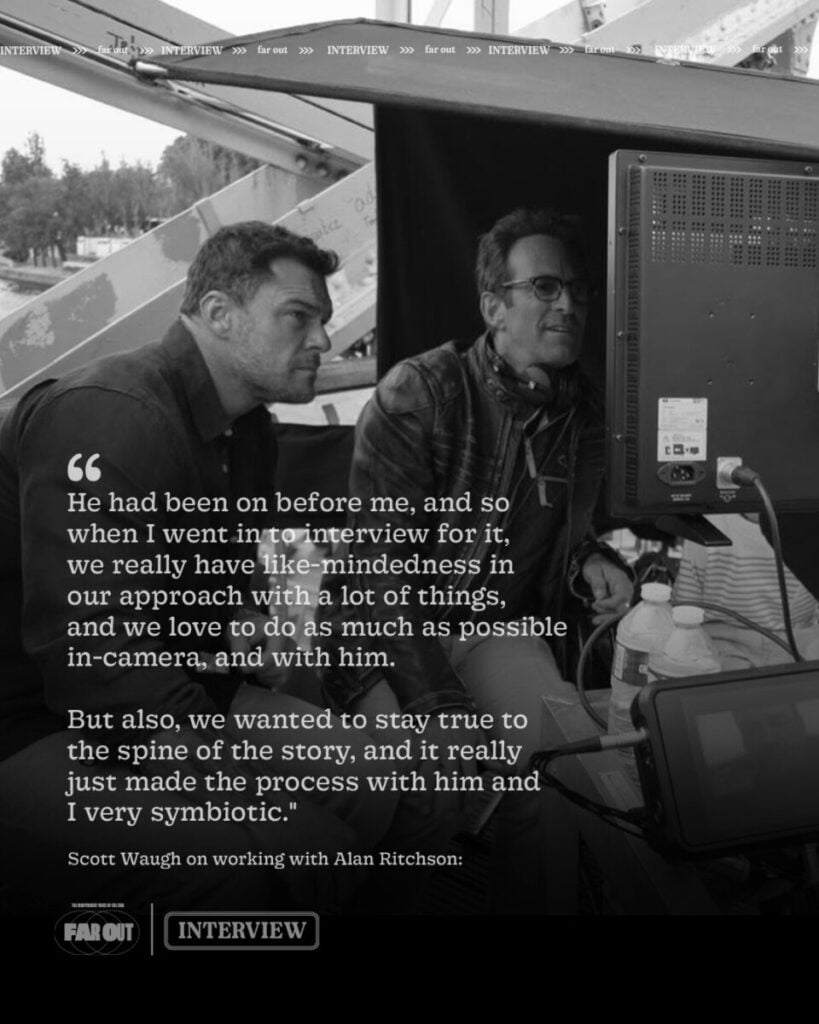
“He had been on before me, and so when I went in to interview for it, we really have a like-mindedness in our approach with a lot of things, and we love to do as much as possible in-camera, and with him,” the filmmaker went on. “But also, we wanted to stay true to the spine of the story, and it really just made the the process with him and I very symbiotic.”
Once that trust had been established, Waugh started bouncing ideas off his leading man, or as he put it, “collective minds like that can really take the ball further down the field.” Presumably, bouncing things off Ritchson isn’t too difficult, seeing as the Reacher star is built like an absolute brick shithouse.
It goes without saying that he’s a big fella, and he also happens to be a committed one. That made things a lot easier for Waugh, because having the actor be so willing to do as many of his own stunts as possible largely negated the tricky task of either shooting around him or finding a beefy enough stand-in.
“That’s true!” Waugh agreed. “Luckily, he’s a super-gifted actor in terms of his range and emotion, but what makes it fun for me as an action filmmaker is that he absolutely is one of those actors who is completely capable of doing all of his own stunts, and loves it, and wants to go and do it over and over, too, until he gets it right.”
As a result, “It’s pretty fun because we never have to hide a stunt double with him,” which was a blessing in more ways than one. “And, yes,” the helmer accurately pointed out. “Finding a stunt double for his size is pretty difficult!” Ritchson is a bit of a throwback in that regard, and having worked with some heavyweight action heroes himself, it’s worth asking how he stacks up.
After all, Waugh has made films with Sylvester Stallone, Jackie Chan, John Cena, Jason Statham, Dolph Lundgren, Tony Jaa, and Iko Uwais, among others. Despite that, bullets, brawn, and biceps were never at the forefront of his mind when he was making Runner, and he was aiming for more of a feeling.
 Credit: Far Out / Angel
“I grew up on Tony Scott movies, and I just absolutely loved his style of filmmaking and loved the commercial spectacle,” he proffered. “But what I really enjoyed about his movies, like Man on Fire and even Top Gun, the characters were really grounded, and I think that’s something that Alan and I both really strive for.”
As a former stunt performer himself, Waugh knows better than most that “it’s not the spectacle of the stunt; it’s more of the emotion behind all of it, and that’s what the driver is for the entire movie.” More than that, he said it “lends me back to ’80s and ’90s films, where ordinary men were doing extraordinary things, whereas nowadays, we’ve got extraordinary men, like superheroes, trying to be ordinary.”
That flavour has been getting more pronounced in recent years, whether or not it has anything to do with audiences becoming increasingly fatigued by the effects-heavy and identikit blockbusters that swamp the marketplace every year, but you can’t make a buddy action flick without having two people front and centre.
In Runner‘s case, the other side of the coin is occupied by Wilson, who doesn’t make an awful lot of movies like this one. It’s his first appearance in an action-oriented feature since No Escape, where he gloriously tosses a child from the roof of a building, released over a decade ago, and it was an opportunity that Waugh was keen to make the most of.
“Alan and Owen together; I just had the vision,” the director smiled. “I just felt like their chemistry was going to be magical. It was definitely going to be that Mel Gibson/Danny Glover combo. They’re just so kinetic and fun together. And yes, it seemed to be a rare gem to get Owen to do this type of movie because he usually doesn’t do that.”
As an Academy Award-nominated screenwriter himself, it’s no surprise that Wilson “brought so many interesting dynamics to the film that weren’t there in the original screenplay.” Whenever Waugh had a suggestion for something they could “sharpen with dialogue,” he was on hand to come up with a line on the spot, which he calls “the true treat of working with somebody like Owen.”
Even though the script didn’t need much in the way of refinement, if you’ve cast two big personalities in a picture like Runner, then it would be foolish not to capitalise on whatever natural chemistry they generate. Sure enough, as Ritchson and Wilson grew into their roles, they also grew more comfortable with adding their own flourishes.
“As they got comfortable with each other, and it happened really quickly, all of a sudden, you could see that actual energy and their charisma together blossom, and it got so magical,” Waugh marvelled, and from his recollections, by the time they reached the end of the shoot, “Their chemistry had glued so well.”
“I was like, ‘God, I wish we could keep on shooting’, because they had really hit a stride where freedom to improvise was there, and they knew what each other was going to do, and so they go back and forth even better in such a genuine way.”
Scott Waugh
While these kinds of movies always live and die by the chemistry of their leads, the classic odd-couple setup is one that viewers have seen countless times before. That made Waugh keen to approach something that’s so familiar on paper and try to make it feel fresh in execution, with his inspiration coming from a name he’d already dropped.
“From my standpoint, and again, I really reiterate that from a Tony Scott standpoint, really is; you gotta have the emotional driver of the movie,” he declared. “You can’t have just a stunt spectacle.” To achieve that, the focus fell on Ritchson’s Hank and the tragic backstory we alluded to earlier.
According to Waugh, having “an ordinary man who has a redemptive story to save a seven-year-old girl that he doesn’t even know” provides the emotional driver, but Runner would still fall apart if it weren’t for the other moving cogs, like Ritchson’s performance, his dynamic with Wilson, or making sure that the action beats exist for a reason other than the obligation of the genre.
Hanks is grieving from the death of his own young daughter, which saw him spiral into alcoholism and separate from his wife, before he finds himself in a race against time to guarantee a child’s liver transplant. That’s pretty heavy stuff, especially in what’s ostensibly a gun-toting, tyre-screeching, and knuckle-pounding actioner, which required a tonal balance that the director was always cognisant of.
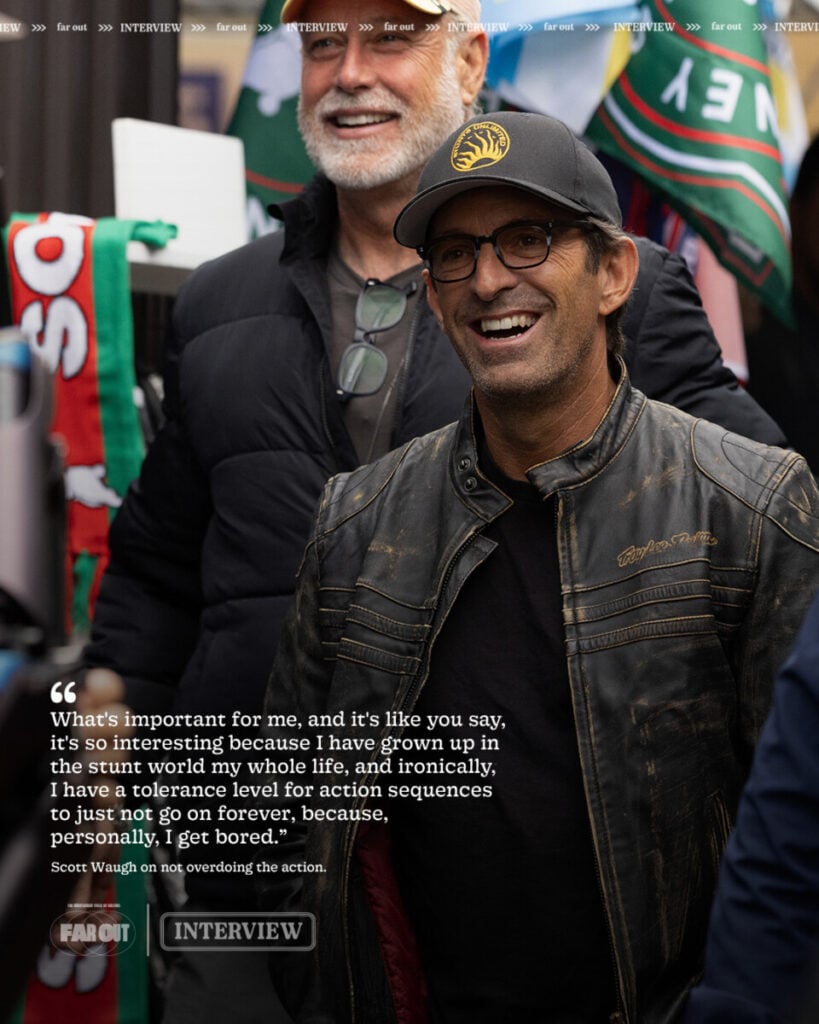
“What’s important for me, and it’s like you say, it’s so interesting because I have grown up in the stunt world my whole life, and ironically, I have a tolerance level for action sequences to just not go on forever, because, personally, I get bored,” came the revelation from a stuntman-turned-action director.
 Credit: Far Out / Angel
To avoid what he calls “action fatigue,” Waugh paid as much attention to the so-called “quieter” sections of the movie, so that “there’s still the tension underneath, because you have the big ticking clock, but it’s not the noise of a big action sequence.” In another surprising development, given his past and present, he even has a habit of making sure his movies don’t fall into action overload.
“I always tell my producers and actors, ‘Hey, we need to smell the coffee’, right?” he continued. “We need to take a moment, slow down, recalibrate, get the audience to sit back and get the exposition we need, and sometimes some levity that we need, before we jump back in and really put them back on the edge of their seat.” Still, it’s an action flick, and action flicks need action.
It shouldn’t be to anyone’s surprise that Waugh favours practicality, and having seen both sides of the coin, he has a process for designing, executing, and capturing those set pieces. Thanks to a combination of personal experience on one side of the camera and the industry know-how acquired from his career on the other, he’s earned the right to say he probably knows what he’s doing.
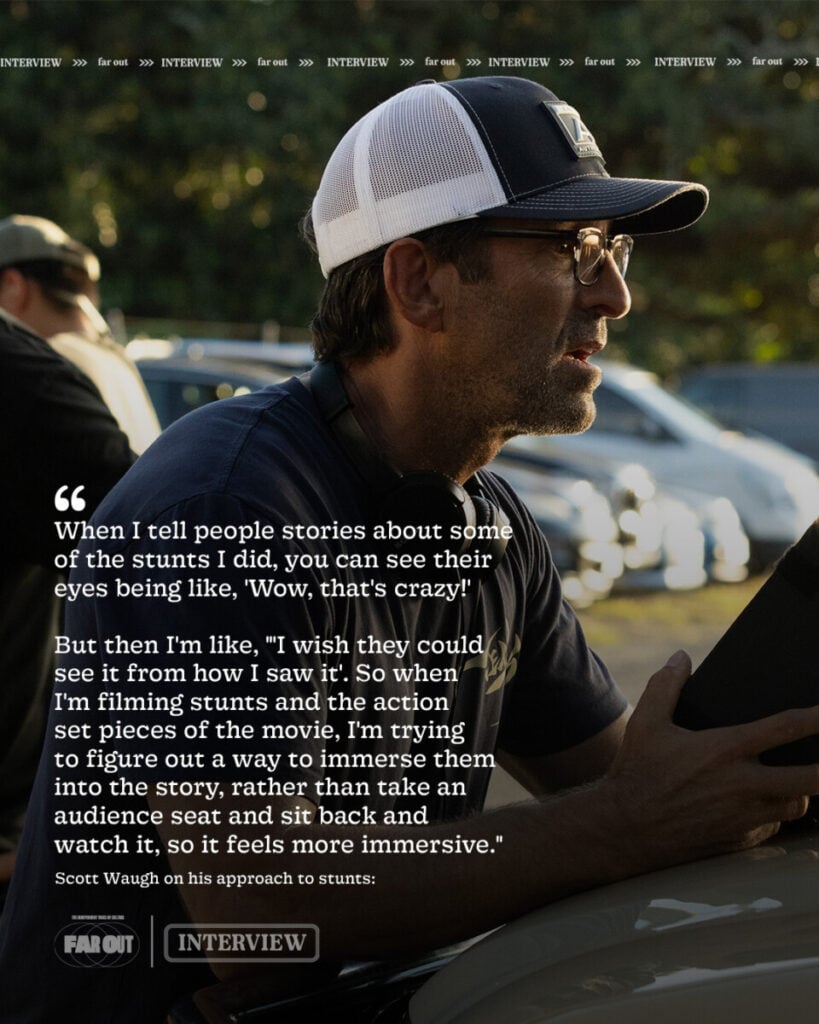
“When I tell people stories about some of the stunts I did, you can see their eyes being like, ‘Wow, that’s crazy!’” he reminisced. “But then I’m like, ‘I wish they could see it from how I saw it’. So when I’m filming stunts and the action set pieces of the movie, I’m trying to figure out a way to immerse them into the story, rather than take an audience seat and sit back and watch it, so it feels more immersive.”
“I got to set that kind of style of my filmmaking on Act of Valor, where I really took the audience along the ride of the Navy SEALs, and this movie really let me get back to that type of filmmaking.”
Scott Waugh
Along those lines, the filmmaker’s last two efforts, Hidden Strike and Expendables, were broader, more expansive, and fairly effects-heavy. While there is some CGI in Runner, it’s not as pronounced, the action beats are more contained and harder-hitting, and taking that step back to return to his roots was a deliberate move on Waugh’s part.
“One of the biggest things after those big movies, I was really excited to just get back to a more grounded, ’90s-style action film,” Waugh concurred. “When I read the screenplay, I was so excited that I could get back to what I feel is my strength and my roots, and really have that Tony Scott-style film, and that’s what really gravitated me towards the script.”
As you might have noticed, stunt performers becoming directors has become an increasingly common practice in Hollywood. There’s John Wick‘s Chad Stahelski, The Fall Guy‘s David Leitch, Extraction‘s Sam Hargrave, and Day Shift‘s JJ Perry, to name a few.
Having made his feature-length debut in 2012, and with his older brother, Ric Roman Waugh, having made his in 2001 before becoming a frequent Gerard Butler collaborator on titles like Angel Has Fallen, Greenland, and Kandahar, as well as Jason Statham’s Mutiny and Dwayne Johnson’s Snitch, you could say the siblings were a little bit ahead of the curve in that regard.
It’s literally in his blood, with Waugh’s father, Fred Waugh, having worked on everything from John Wayne’s Circus World and Gene Hackman’s Night Moves to Tim Burton’s Beetlejuice, Joel Schumacher’s Batman & Robin, and Steven Spielberg’s Minority Report in a decades-long career, but the Runner director wouldn’t call himself a trailblazer, because someone got there long before he did.
“There’s a true pioneer, who was one of my idols when I was growing up as a stunt man; his name’s Hal Needham. He’s truly the pioneer of that transition,” he shared. “He was best friends with my father and was the one to make the transition as a director with Smokey and the Bandit and Hooper, which were great, great movies of the time, and they still hold up all day.”
Waugh didn’t just idolise the frequent Burt Reynolds collaborator, but as a friend of the family, he was “able to grow up around him and see him,” and he “always aspired to one day get there the way Hal did.” He’s lived his dream, but with action being his bread and butter, maybe it’s time for a change of pace.
 Credit: Far Out / Angel
Funnily enough, that’s about to happen, even if he remains sworn to secrecy. “I actually am involved in casting my first sci-fi thriller,” the filmmaker hinted. “Of course, it’s action-based, right? That’s my skill set, but this will be my first foray into the sci-fi realm.” That’s all he can say about that, but Far Out still had the time for some hypothetical spit-balling.
In an ideal world, Waugh has one movie that he’d love to make and one that he’s always dreamed of making. Much to his dismay, the former sounds much more likely to happen than the latter, but there’s no point in making a living in Hollywood if you aren’t going to aim as high as possible.
“The one that I’ve always wanted to follow up, and I haven’t because I have not found the right story yet, is Act of Valor,” the director outlined. “I really want to do another military movie in its purest sense, the way Act of Valor was, but hopefully, one day I will find that story and be able to get back into that sandbox, which will be incredible.”
As for the second? It’s another one close to his heart, albeit for different reasons: “The other one that I have toyed with, and it’s a lot of rights issues, and I actually did meet with Hal Needham on it, was to do a reimagining of Smokey and the Bandit, and he was super excited about it. I pitched him the idea, and he goes, ‘Scotty, that sounds great, and I would love it for you to do it’. And I’m like, ‘Hal, I don’t think I can get it away from Universal’. So, yeah, those are the two movies that I hope to one day make.”
“I want to do it for Hal, because I know it,” Waugh concluded. “He was really proud of that movie, and I just felt like it was a part of my era because it’s a ’70s movie. My kids, they actually watch it all the time with me, and they love it, so it would be really amazing if I could bring that to life.”
From where he’s sitting, his version of Smokey and the Bandit is “something that will hopefully happen someday,” and in a world where too many remakes exist for the most cynical, commercial reasons, maybe we’re overdue for one that’s made for nothing other than a personal attachment and emotional connection.
ADD AS A PREFERRED SOURCE ON GOOGLE 